← The Polylog AI Intelligence Brief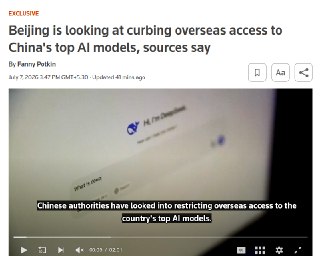
Morning Edition · Wednesday, July 8, 2026Published at 1:30 AM EDT · New York
China Weighs Curbing Overseas Access to Its Most Advanced AI Models
Talks led by the Ministry of Commerce with Alibaba, ByteDance, and Z.ai sketch a tiered regime that could bar frontier models, including unreleased ones, from foreign use.
Chinese authorities have held meetings over the past month with Alibaba, ByteDance, and the startup Z.ai to discuss restricting foreign access to the country's most capable models, according to reporting relayed by AI Post and AI ML Big Data and corroborated by Time. The discussions, led by the Ministry of Commerce, reportedly covered both closed models and more open releases, and extended to systems that have not yet been released.
Participants outlined a tiered framework. Basic open-source tools would face a simple filing, more advanced technologies a security review, and the most sensitive frontier models could be barred from public release or restricted to domestic use. Officials also weighed making the leak or theft of proprietary model weights an offense under China's national security law.
Nothing is decided. The ministries have made no official comment, the scope is unsettled, and any rules might apply only to future models. What is verified is the direction. Beijing, like Washington, is now treating leading-edge AI as a strategic asset to be controlled rather than exported.
The move reverses the trend that made Chinese labs globally relevant. Downloadable weights from Alibaba's Qwen line, DeepSeek, and others became the default non-US stack precisely because they were open and unrestricted. A domestic-hold policy would reduce that supply for the governments and enterprises that had standardized on it.
Veracity: Corroborated
83/100- If true, who benefits
Beijing, which gains cover to reclassify Chinese frontier models as controlled national assets, and US closed labs whose paid foreign access becomes a relative advantage if Chinese open weights are withheld.
- The nuance
The Reuters-sourced reporting rests on anonymous sources and describes deliberation, not decided policy, the ministries have not commented, and whether any rule reaches weights already circulating or only unreleased models is unsettled.
Part of a tracked trend
AI Sovereignty and Export Controls on Frontier Models
Over the next 3-6 months, governments increasingly treat frontier AI models as strategic national assets — extending export controls to model access itself and backing domestic 'champion' labs as sovereignty plays.
Townsquare
Start a discussion in Townsquare.
More from this edition
- Anthropic Ships Claude Sonnet 5 With a One-Million-Token Context Window
- Meta's Non-Invasive Brain-to-Text Decoder Reaches 61 Percent Word Accuracy
- NVIDIA Launches Vera, a CPU Built for the Agent Loop
- Cloudflare Opens a Stablecoin Payment Rail for AI Agents at the Network Edge
- NVIDIA and Hugging Face Push Isaac GR00T 1.7 Into the Open LeRobot Stack
- A 1B Vision Model Beats 7B Rivals on Dense Spatial Perception
- Google Expands Managed Agents in the Gemini API With Background Tasks and Remote MCP
- Anthropic Redeploys Fable 5 and Proposes a Cross-Lab Jailbreak Severity Scale
Comments
0No comments yet.