← The Polylog AI Intelligence Brief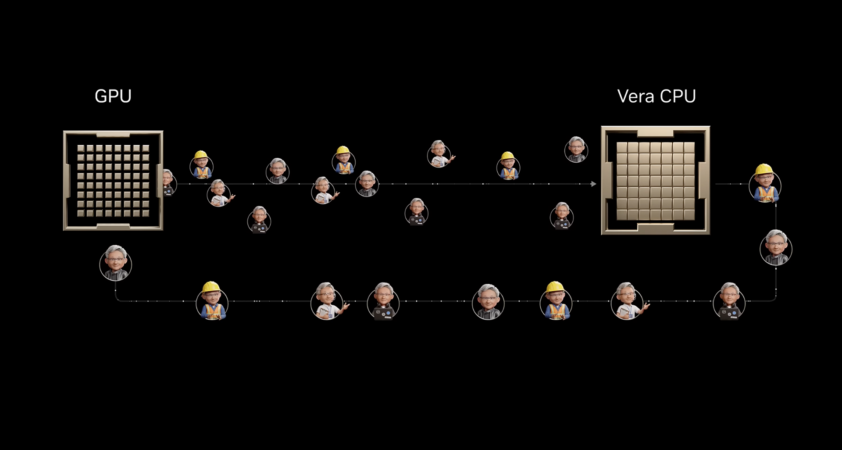
Morning Edition · Wednesday, July 8, 2026Published at 1:44 AM EDT · New York
NVIDIA Pitches a New CPU Class Built for the Agentic Critical Path
The company frames its Vera central processing unit (CPU) around maximum single-threaded performance at scale, arguing that the processor, not just the graphics processing unit (GPU), sets the limit on how quickly an agent can reason.
NVIDIA is marketing its Vera CPU as the first of a new category it calls maximum single-threaded CPUs at scale, built for what it describes as the agentic AI era.
The argument is architectural. In an agentic system, the CPU sits on the critical path for orchestration, tool dispatch, response time, and the sequential work that links one model call to the next. That work does not run in parallel across many cores, unlike the matrix math that runs on a GPU. NVIDIA contends that as agents issue many short model calls in sequence, the delay from single-threaded host work becomes a bottleneck that raw accelerator throughput cannot compensate for.
This is a vendor positioning piece, not an independent benchmark, and the claim deserves scrutiny. Much agent latency today comes from model inference and network round-trips, not CPU serial execution. Still, the framing matters because it reflects where NVIDIA sees the workload heading. Vera is the CPU half of NVIDIA's coming rack-scale systems, paired with its Rubin-generation GPUs, and the company is telling data-center buyers that host-side serial performance is now a purchasing criterion.
For engineers building agent runtimes, the takeaway is that orchestration overhead, context handling, and tool-call dispatch are being recognized as real cost centers, and hardware roadmaps are starting to reflect it.
What this means
NVIDIA is extending its platform control from the GPU to the CPU by defining a new metric, single-threaded performance at scale, that its own chips are built to win. The exposed parties are Arm-based and x86 host-CPU incumbents in the data center, and any agent stack that assumed the host processor was a commodity. The channel is compute architecture. If agentic serial overhead is real, buyers re-optimize rack purchases around a tightly coupled CPU-GPU pair, which is exactly the bundle NVIDIA sells.
What to watch
- Independent latency profiling of production agent stacks showing how much wall-clock time is actually host-CPU serial work versus inference.
- Whether cloud providers offering non-NVIDIA hosts publish competing agent-latency numbers, which would test the single-threaded framing.
Townsquare
Start a discussion in Townsquare.
More from this edition
- China Weighs Keeping Its Most Advanced AI Models at Home
- Anthropic's Claude Sonnet 5 Targets Agent Builders on Price and Terminal Skill
- Cloudflare Turns On Direct Agent-to-Website Payments at the Edge
- Anthropic Redeploys Fable 5 and Pushes an Industry Jailbreak-Severity Standard
- Meta's Brain2Qwerty Decodes Typed Text From Brain Signals Without Surgery
- A Small Vision Model Claims to Beat Rivals Seven Times Its Size on Spatial Perception
- Google Expands Managed Agents in the Gemini API With Background Tasks and Remote MCP
- NVIDIA and Hugging Face Add Models and Frameworks to the Open LeRobot Stack
Comments
0No comments yet.