← The Polylog AI Intelligence Brief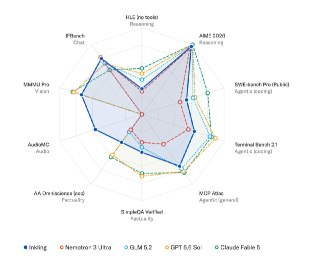
Morning Edition · Thursday, July 16, 2026Published at 1:44 AM EDT · New York
Thinking Machines Lab Ships Inkling, a 975-Billion-Parameter Open-Weights Model It Admits Is Not the Strongest
Mira Murati's startup builds its first public release around downloadable weights, a one-million-token context window and a fine-tuning platform rather than top benchmark scores.
Thinking Machines Lab, the San Francisco startup founded last year by former OpenAI chief technology officer Mira Murati, released its first public model on July 15, a mixture-of-experts (MoE) system called Inkling with fully open weights. The Russian-language AI channel that reported the release and independent coverage agree on the configuration: 975 billion total parameters with 41 billion active per token, a context window of up to one million tokens, and pretraining on 45 trillion tokens spanning text, images, audio and video.
The notable part is what the company concedes. Thinking Machines states plainly that Inkling is not the strongest model available, open or closed, and instead positions it for customization through its Tinker fine-tuning platform, with controllable reasoning effort to trade cost against latency. Reported benchmark figures are respectable rather than category-leading, including 77.6 percent on SWE-bench Verified for software engineering and 91.4 percent on VoiceBench. Those numbers are vendor-reported and await independent reproduction.
The strategic signal outweighs the scores. A United States lab that raised a $2 billion seed at a $10 billion to $12 billion valuation, with Nvidia and Andreessen Horowitz among its backers, is releasing full weights at frontier scale rather than charging for access through an application programming interface (API). That runs against the recent pattern of Western labs closing weights to capture revenue, and it gives enterprises a customizable base model that competes for the same fine-tuning demand Chinese open-weight suppliers have been serving.
Veracity: Corroborated
88/100- If true, who benefits
Part of a tracked trend
Open-Weight Models Close the Gap With Closed Frontier Labs
Over the next 3-9 months, open-weight releases with downloadable weights, long context, and strong agentic/coding performance increasingly match closed frontier models on practical work, eroding the closed-lab moat.
Townsquare
Start a discussion in Townsquare.
More from this edition
- OpenAI Details GPT-Red, an Automated Attacker Trained by Self-Play to Harden Its Own Models
- Nvidia Opens Smaller Jetson Thor Modules to Push Foundation Models Onto Mainstream Robots
- DeepSeek Begins IPO Preparations Targeting a 2026 Filing and a Valuation Near $71 Billion
- Meta's Brain2Qwerty v2 Decodes Typed Sentences From Brain Signals at 61 Percent Word Accuracy, Without Surgery
- Anthropic Redeploys Fable 5 and Proposes an Industry Standard for Grading Jailbreak Severity
- New Audit Method Tests Whether a Model's Chain of Thought Actually Depends on Its Stated Premises
- OpenAI Pitches 'Reverse Federalism,' Arguing State AI Laws Should Build a National Framework
Comments
0No comments yet.