← The Polylog Crypto Intelligence Brief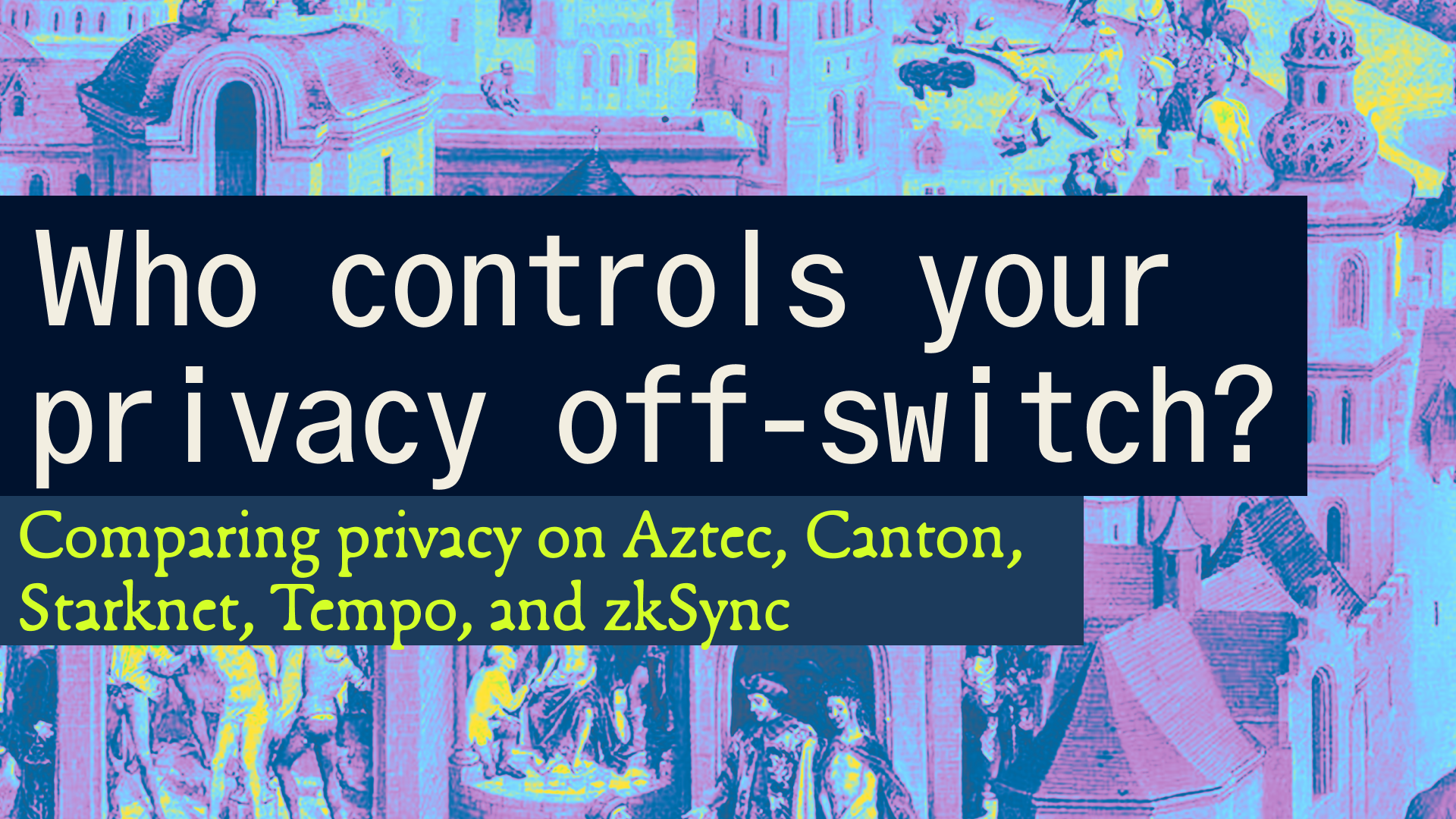
Morning Edition · Wednesday, June 17, 2026Published at 6:30 AM EDT · New York
Privacy Chains Reframe Confidential Execution as a Requirement for Serious On-Chain Use
Aztec, Miden, and Ethereum researchers are converging on the same argument: institutions will not transact on fully transparent ledgers, and the contest is over who controls the off-switch.
The privacy-focused projects in the Ethereum ecosystem are making a unified argument this week. Confidential execution is a prerequisite for institutional on-chain activity, not an optional feature for dissidents. Aztec, whose Alpha Network went live on Ethereum mainnet in March as the first layer-2 with fully private smart contracts, argues in a new post that the real design question is who controls the privacy "off-switch", meaning who can compel disclosure and under what rules.
Miden frames the same point in practical terms, arguing that practical privacy is the precondition for blockchain's next era of real-world adoption rather than a niche concern. Both projects rely on zero-knowledge proofs, in which a user proves a statement is true without revealing the underlying data, and both pair confidentiality with selective disclosure so that compliance checks remain possible.
On the research side, a contributor published GhostShard, a proposal to use ownership fragmentation as a privacy primitive for the post-Pectra Ethereum Virtual Machine. The approach splits control of assets to break the association between an address and a single owner while preserving selective disclosure.
The question here is whether these systems are genuinely decentralized. Privacy that an operator can revoke at will is effectively custody by that operator. Aztec's own launch disclosure, that the experimental software was released with known serious vulnerabilities still under audit, is a reminder that confidential systems carry their own counterparty and code risk. The contest these teams are naming, over who controls confidentiality, is the right one.
What this means
Privacy is shifting from a fringe value to a stated institutional requirement, which matters because transparent ledgers expose trading strategy, payroll, and counterparties. The unresolved design question is whether confidentiality is controlled by the user, by the protocol, or by a regulator-facing operator, and that choice determines whether these chains are genuinely private or merely permissioned.
What to watch
Townsquare
Start a discussion in Townsquare.
More from this edition
- Binance Faces European Exit as Greece Moves to Reject Its License Before MiCA Deadline
- Coinbase Pushes Tokenized Stocks, Options and an AI Advisor in Bid to Become an "Everything Exchange"
- Attacker Drains Deprecated Thetanuts Vault for $2.1 Million as June DeFi Losses Mount
- Standard Chartered's $100 Uniswap Call Tests Whether Tokenized Assets Reach Open DeFi
- Ethereum Researchers Debate Encrypted Mempools as a Defense Against Front-Running
- XRP Ledger Ships 3.2.0 Software Upgrade as Schwartz Moves His Hub
- Bitcoin's Iran-Driven Rally Enters a 60-Day Test as Attention Shifts to the Fed
Comments
0No comments yet.