← The Polylog Crypto Intelligence Brief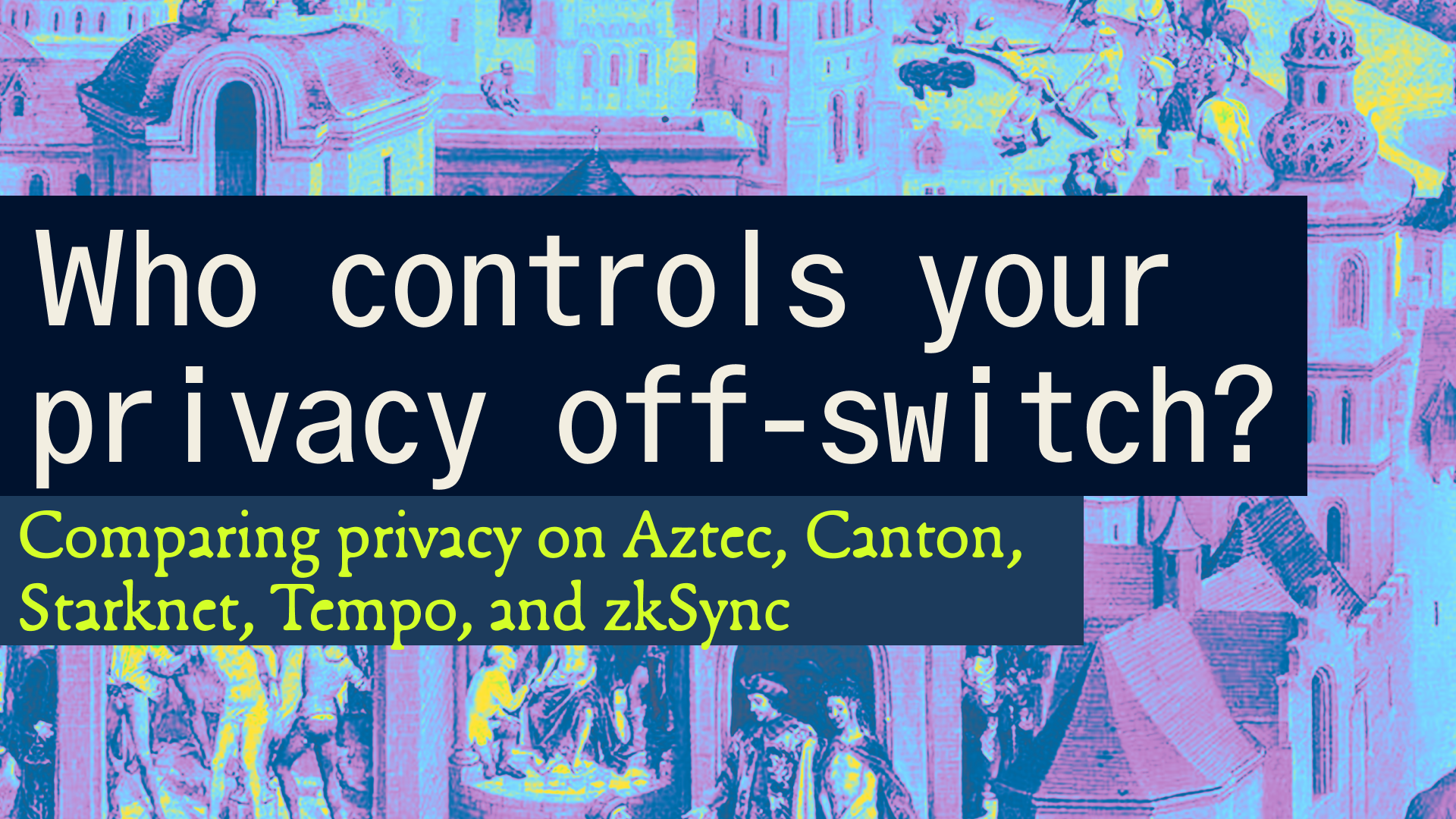
Morning Edition · Sunday, June 21, 2026Published at 6:31 AM EDT · New York
Aztec Pushes Programmable Privacy as a Prerequisite, Not a Feature
With its alpha network live, Aztec argues that the central question for confidential blockchains is who controls the ability to turn privacy off.
Aztec, a privacy-focused layer-2 network built on Ethereum, is reframing the privacy debate around control. In a post titled "Who controls your privacy off-switch?", the team argues that confidentiality is only meaningful if the user, rather than an operator or a regulator, decides when to disclose. The distinction matters because many "private" systems retain a master key or an administrative path that can reveal balances and history.
The argument comes with working software. Aztec has announced its alpha network, moving its zero-knowledge design from research into a live, permissionless system where transactions are validated by cryptographic proofs rather than by trusted intermediaries. Zero-knowledge proofs let one party prove a statement is true without revealing the underlying data.
Aztec also lists a set of privacy capabilities it says Ethereum developers have wanted for years, including private state, confidential function calls and selective disclosure. The approach is aimed less at retail anonymity and more at institutions that cannot expose counterparties, positions or payroll on a public ledger.
A sound-money perspective applies in two ways here. Confidential execution is closer to the privacy of physical cash than a fully transparent blockchain is. The open question is whether a decentralized set of provers and sequencers actually emerges, or whether early privacy networks concentrate control in a small group that becomes the very mechanism for turning privacy off that they warn about.
What this means
Privacy is moving from an ideological position to a product requirement for serious on-chain use, and the contest is shifting to governance. The key questions are who can compel disclosure and who holds the keys. A network that provides confidential execution but keeps an operator override is materially different from one that does not, and that difference will increasingly determine which blockchains institutions can use legally and competitively.
What to watch
- Whether Aztec's alpha network decentralizes its sequencer and prover set on a public timeline. That is the test of whether its claim of having no off-switch holds up in real operations.
Part of a tracked trend
Privacy Chains Pivot From Niche to Institutional Pitch
Over 3-6 months, confidential execution reframes as a prerequisite for serious/institutional on-chain use, with privacy L2s shipping live networks and contesting who controls confidentiality.
Townsquare
Start a discussion in Townsquare.
More from this edition
- Ethereum's Largest Sandwich Bot Is Drained of About $7.5 Million by Its Own Logic
- Strategy's Preferred Stock Slips Below Par, and Its Founder Calls a Bitcoin Sale a Feature
- 'Crypto Mom' Hester Peirce to Leave the SEC With Key Rules Unfinished
- An Ethereum Proposal Tries to Fix Who Pays for Shared Upgrades
- Miden Makes the Case for 'Practical Privacy' as Blockchain's Next Phase
- Bitcoin Holds Near $64,000 as Iran Again Orders the Strait of Hormuz Closed
- Morgan Stanley Files the Cheapest Ethereum and Solana ETFs Yet, at 0.14%
- AI Is Lowering the Cost of Crypto Security, and Raising the Baseline
Comments
0No comments yet.