← The Polylog Crypto Intelligence Brief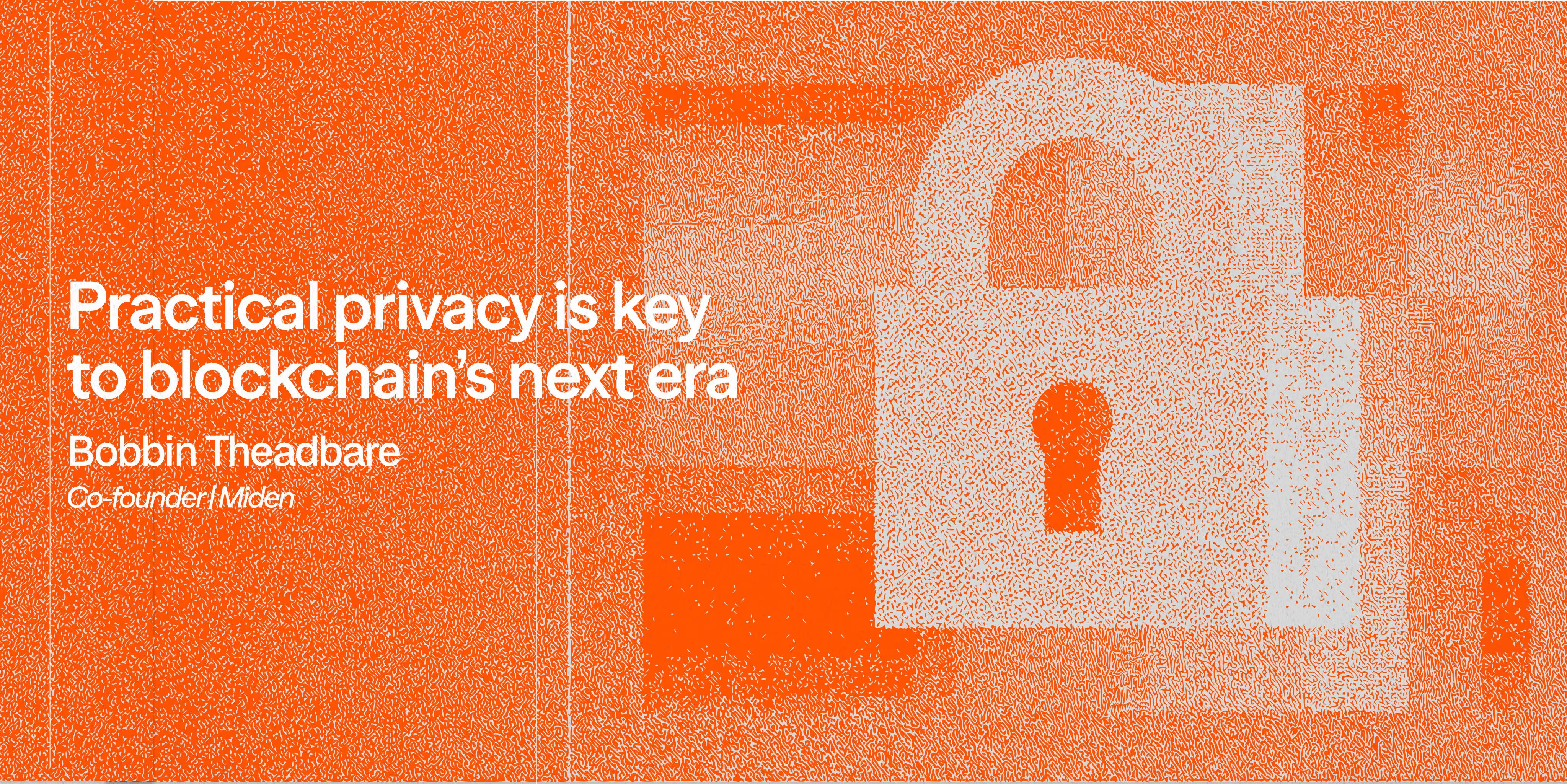
Morning Edition · Friday, June 26, 2026Published at 6:31 AM EDT · New York
Privacy Chains Sharpen Their Pitch: Confidentiality as a Prerequisite, Not a Feature
Aztec and Miden are launching live networks and arguing publicly over who should have the power to disable on-chain privacy.
The teams building privacy-preserving blockchains are reframing their work, moving from a niche appeal toward the claim that confidential execution is a baseline requirement for serious on-chain activity. Aztec, an Ethereum-based network using zero-knowledge proofs, published an argument it titles "The Devil's Bargain," contending that privacy without credible neutrality is not a durable property, because any system that lets someone switch privacy off recreates the surveillance it claims to escape.
Miden, a separate zero-knowledge network, makes a parallel case that practical privacy is the condition for blockchain's next phase and has described a tool it calls Guardian for managing confidential state. The shared thesis is that institutions and ordinary users alike will not put meaningful balances or business logic on a fully public ledger, where competitors and counterparties can read every position in real time.
The first-principles question these projects raise is governance, not cryptography. The mathematics of zero-knowledge proofs is mature enough to hide transaction details while still proving them valid. The unresolved issue is control: who, if anyone, can compel disclosure, and whether a network can offer confidentiality to users without also handing full control to an operator or a state. Aztec's framing is that a discretionary power to disable privacy is itself the flaw.
This is the contest that will define the category. Privacy chains are pivoting from a tool associated mainly with evasion toward a pitch aimed at regulated institutions, and the design dispute over who can compel disclosure will determine whether confidential execution becomes standard infrastructure or stays restricted. The same property that makes these systems attractive to serious users is the property that draws the most regulatory attention.
What this means
If confidential execution is genuinely a precondition for institutional on-chain activity, the networks that resolve the control question credibly stand to capture that demand, while those that retain a discretionary power to disable privacy may satisfy neither privacy advocates nor regulators. The debate over who can disable privacy is the real competitive contest.
What to watch
Part of a tracked trend
Privacy Chains Pivot From Niche to Institutional Pitch
Over 3-6 months, confidential execution reframes as a prerequisite for serious/institutional on-chain use, with privacy L2s shipping live networks and contesting who controls confidentiality.
Townsquare
Start a discussion in Townsquare.
More from this edition
- Base Stops for Two Hours After a Consensus Bug, Testing How Decentralized Ethereum's Largest Rollups Really Are
- Binance to Stop Serving the European Union on July 1 After Failing to Win a MiCA Licence
- CZ Floats Freezing Satoshi's Coins Against a Quantum Threat, Reopening Bitcoin's Immutability Debate
- Polymarket to Refund Users After a $2.94 Million Phishing Attack Through a Compromised Vendor
- Security Roundup: Mid-Six-Figure DeFi Drains Continue as Researchers Test AI Against On-Chain Exploits
- Stablecoins Become the Fed's Problem as Tether Briefly Outgrows Ethereum
- Real-World Assets Keep Moving On-Chain as UK Bond-Fund Records Join Ethereum and Solana
Comments
0No comments yet.