← The Global Intelligence Brief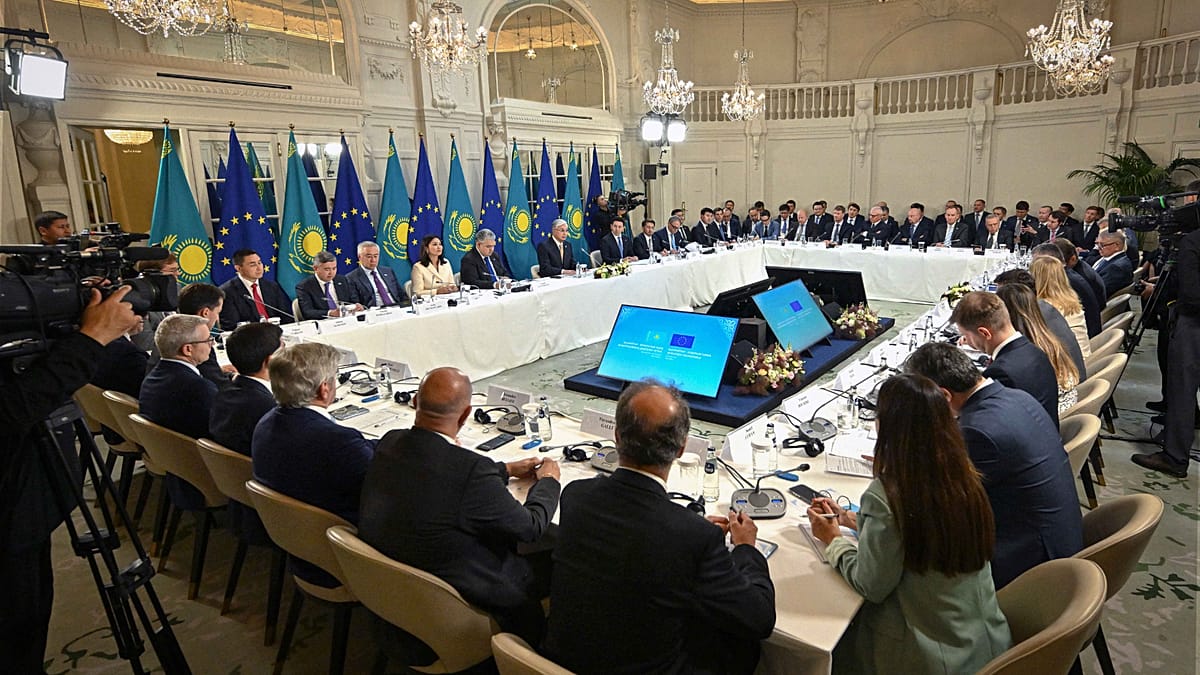


 3 sources
Morning Edition · Wednesday, June 24, 2026Published at 6:15 AM EDT · New York
Kazakhstan Signs More Than 10 Billion Euros in Deals With the EU on a Trade Route That Bypasses Russia
President Kassym-Jomart Tokayev's Brussels visit produced agreements on aircraft, critical minerals, and the Middle Corridor.
Kazakhstan and the European Union signed commercial agreements and memoranda during President Kassym-Jomart Tokayev's visit to Brussels, where the European bloc was described as the Central Asian country's largest trading and investment partner. Euronews put the total above 10 billion euros across roughly 30 deals, while Central Asian outlets reported a figure closer to 12 billion euros, including the purchase of 50 Airbus aircraft for about 7.1 billion euros.
Beyond aviation, the agreements covered critical raw materials and transport infrastructure, including financing for the Middle Corridor, a trade route that runs from Asia to Europe across the Caspian Sea and bypasses Russia. The European Investment Bank agreed to help fund road repairs along the corridor, and the two sides signed an aviation agreement opening Kazakhstan's market to European carriers.
For Brussels, the package is part of a strategy to secure access to the minerals needed for its energy transition while reducing dependence on supply routes through Russia. For Kazakhstan, long closely tied to Moscow's economy, it is a step toward a more balanced set of partners.
Veracity: Corroborated
85/100- If true, who benefits
Brussels' resource-security and route-diversification strategy, Airbus, and a Kazakhstan seeking a more balanced set of partners away from Moscow.
- The nuance
Much of the headline figure blends memoranda and intentions with one large Airbus order, and the Middle Corridor's actual volumes remain far below what a genuine Russia-bypassing route would require.
An open-source-intelligence read of how likely this story is true with its real nuance, not a judgment of any outlet. It assesses the claim, weighing independent and adversarial reporting. How we label confidence.
What this means
The deal shows how the sanctions-era reordering of trade is moving in more than one direction. Even as Russia builds sanctions-resistant blocs, its neighbors are diversifying toward the West, and Europe is funding routes and mineral supplies that avoid both Russia and China. The Middle Corridor's economics will determine whether this remains political signaling or becomes a durable trade route.
What to watch
Synthesized from: Euronews · Trend.az · Times of Central Asia
Townsquare
Start a discussion in Townsquare.
More from this edition
- Oil Falls to Multi-Month Lows as US-Iran Deal Moves Toward Implementation and Hormuz Reopens
- Venezuela Prepares to Disclose Roughly $240 Billion in Debt Before a Record Restructuring
- Rheinmetall Shares Fall More Than 15 Percent as Germany Scraps Its Largest Warship Program
- Europe's Crypto Market Faces a Reckoning as MiCA Rules Take Full Effect July 1
- Russia Extends Fuel Rationing and Freezes a Small-Business Tax Threshold as War-Economy Strains Deepen
- Gold and Silver Retreat as Markets Price In a Tighter Federal Reserve
- China Detains Two Japanese Nationals on Smuggling Charges, One Tied to Rare-Earth Exports
Comments
0No comments yet.