← The Global Intelligence Brief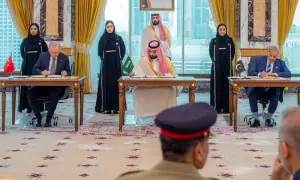


 3 sources
Morning Edition · Saturday, August 8, 2026Published at 1:21 AM EDT · New York
Saudi Arabia, Turkey and Pakistan Sign a Mutual Defense Pact in Mecca
The Makkah Joint Defence Agreement treats an armed attack on any one signatory as an attack on all three, and Recep Tayyip Erdogan said it is open to other states.
Saudi Crown Prince Mohammed bin Salman, Turkish President Recep Tayyip Erdogan and Pakistani Prime Minister Shehbaz Sharif signed a trilateral mutual defense treaty at Al-Safa Palace in Mecca on Friday. The text states that an armed attack against any one of the three "shall be regarded as an attack against them all," Dawn reported. Sharif called the accord a shield of peace, Erdogan said the alliance is open to other friendly nations, and a Saudi minister said the grouping threatens no country.
The three states bring distinct capabilities. Turkey fields the second-largest standing army in the North Atlantic Treaty Organization (NATO), Pakistan is the only Muslim-majority state with nuclear weapons, and Saudi Arabia is the largest Gulf economy and a leading oil exporter, according to reporting by The National.
Indian commentary focused on a specific question. BBC News Hindi asked whether Turkey and Saudi Arabia would in practice support Pakistan if India conducted an operation similar to Operation Sindoor, and noted that some analysts are describing the pact as a Muslim equivalent of NATO. The treaty text does not distinguish between types of attack or name any adversary, so the extent of the commitment will not be clear until a real crisis forces the three governments to interpret it.
For Riyadh, the agreement follows a period in which Gulf states have questioned the reliability of American security guarantees. For Ankara and Islamabad, it provides access to Saudi financing and strategic depth. None of the three has said the pact replaces existing arrangements with Washington.
Part of a tracked trend
Middle Powers Build Security Blocs Outside Washington
States that once relied on American guarantees keep forming their own mutual defense arrangements, redirecting arms procurement away from Western suppliers and creating overlapping commitments that make regional crises harder to contain.
Veracity: Corroborated
93/100- If true, who benefits
Turkish and Pakistani defense industries gain a financed Saudi customer, Islamabad gains Gulf money and diplomatic weight against India, and Riyadh gains a hedge that raises its price in any future bargaining with Washington.
- The nuance
The signing is confirmed by Breaking Defense and Gulf outlets, but the treaty extends an existing Saudi-Pakistani mutual defense pact from September 2025 and publishes no command structure, force commitment or trigger definition, so the comparison to NATO is commentary rather than treaty text.
An open-source-intelligence read of how likely this story is true with its real nuance, not a judgment of any outlet. It assesses the claim, weighing independent and adversarial reporting. How we label confidence.
What this means
Security guarantees affect where investors are willing to place capital, and a new mutual defense bloc that does not include the United States changes the calculation for defense procurement across the region. Turkish and Pakistani defense manufacturers gain a financed customer in Saudi Arabia, while American and European suppliers face a buyer with an alternative source. For India, the pact raises the cost of any future cross-border operation against Pakistan by introducing uncertainty about who else might respond, and that uncertainty is what tends to widen risk premiums on South Asian assets during a crisis.
Synthesized from: Dawn · BBC News Hindi · The National
Townsquare
Start a discussion in Townsquare.
More from this edition
- US Employers Cut 23,000 Jobs in July and Traders Priced Out a September Fed Rate Increase
- Trump Restarts the Removal of Fed Governor Lisa Cook, Giving Her Until August 26 to Respond
- Bitcoin Developers Warn That Selling Coins From This Weekend's Contested Fork Could Cost Holders Real Bitcoin
- US Senate Passes Russia Sanctions Bill Authorizing Tariffs of Up to 100 Percent on Buyers of Russian Oil
- Russian Strikes Hit Kyiv and Ships Near Odesa as NATO Scrambled Jets Over a Missile That Landed in Poland
- Russian Regions Report Overnight Drone Attacks From Lipetsk to the Approaches to Moscow
- Pakistan Says It Is Working to Return the United States and Iran to Talks as Riyadh Repairs Ties With Baghdad
Comments
0No comments yet.