← The Global Intelligence Brief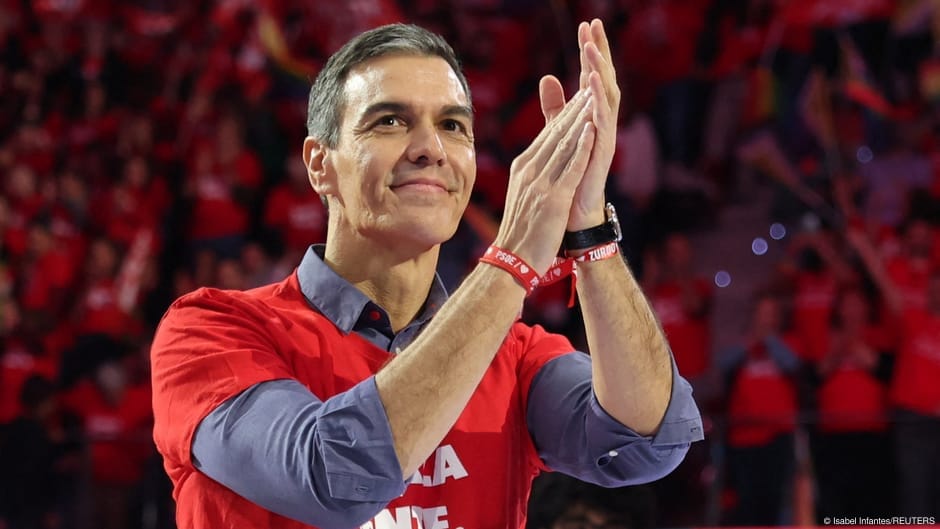
Morning Edition · Saturday, November 28, 2026Published at 12:08 AM EST · New York
Spain votes on Sunday with most private polls pointing to a conservative majority and the state pollster disagreeing
Prime Minister Pedro Sánchez urged a large turnout so the country does not go "backwards," as most surveys suggest the People's Party (PP) and Vox together could pass the 176 seats needed for a majority.
Prime Minister Pedro Sánchez made a final appeal to voters before Sunday's general election, urging a large turnout so that Spain does not go "backwards," Deutsche Welle reported. DW said the polls point to the end of his eight years leading a left-wing government.
The surveys do not agree. A poll roundup published on November 23 by The Objective put the PP, led by Alberto Núñez Feijóo, at 31.3% and 129 to 137 seats, and it found that the PP and Vox together pass the 176-seat majority in most private studies. A 40dB tracking poll put the PP 0.9 points ahead of the Socialists and gave the PP and Vox 187 seats combined, El Demócrata reported. The state-run Center for Sociological Research (CIS) is the outlier. It gives Sánchez a lead of 7.8 points over Feijóo, according to MDZ. Spanish law bans the publication of polls in the final days of a campaign, so the latest published surveys are already several days old. Polymarket runs a market on the outcome.
Each side's figures serve its campaign. The Socialists can cite the CIS to keep their voters motivated. The PP can cite private pollsters to present a change of government as already decided. Vox's seat count matters most, because most scenarios give the PP no route to a majority without it.
For investors, the question is which policies would change. Sánchez's governments imposed temporary levies on banks and energy companies, and a PP-led government relying on Vox would reopen those levies, the next budget and Madrid's positions in European Union negotiations. Coalition talks could take weeks, and Spain's recent history includes repeat elections when no bloc reached 176 seats.
Part of a tracked trend
Europe's Governing Coalitions Fragment
Fragmented parliaments across the euro area will keep producing minority or coalition governments that depend on parties outside the old center, so budgets and sector taxes are renegotiated after each vote and political risk returns to periphery bond spreads.
Townsquare
Start a discussion in Townsquare.
More from this edition
- Brazil's real gains nearly 4% after Lula names Bradesco chairman Luiz Carlos Trabuco finance minister
- US disables another ship trying to leave Iran as Brent posts its first weekly gain of November
- Gold rises about 2% to near $3,640 as Hong Kong pitches its bullion and renminbi business to European banks
- Anthropic shares jump 11% back above their IPO price as the Nasdaq leads a holiday rally
- Banned Nvidia Blackwell servers turned up in a Shanghai data center linked to Alice Huang, reports say
- India's central bank rejects most bids at a bond sale as Bank Indonesia vows to defend the rupiah
- Ukrainian drones hit the Novoshakhtinsk refinery for the second time in a week as Moscow calls its budget a financial shield
Comments
0No comments yet.