← The Polylog AI Intelligence Brief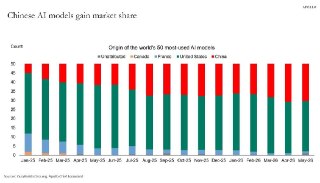
Morning Edition · Monday, July 13, 2026Published at 1:34 AM EDT · New York
Chinese Labs Now Train 20 of the World's 50 Most-Used AI Models
Apollo Global Management data puts China's share of the top 50 near 40 percent, and Chinese models processed 98 trillion tokens in June against 53 trillion for United States models.
Deployed artificial intelligence is shifting toward China. According to figures compiled by Apollo Global Management and circulated by the channel AI Post, about 20 of the 50 most-used AI models now come from Chinese labs, roughly 40 percent, up from 5 at the start of 2025. Over the same period the number of United States models in that group fell from 33 to 28.
Usage data shows a wider gap. Among the 20 most-used models, Chinese systems processed 98 trillion tokens in June against 53 trillion for United States models. Chinese token volume rose 113 percent from May to June, compared with 43 percent for American models. Independent trackers including Our World in Data confirm that United States and Chinese firms together train nearly all of the world's most-used models, leaving little share for anyone else.
The driver is licensing as much as capability. Chinese frontier labs, led by DeepSeek and the Qwen family, release downloadable open weights that enterprises and governments cut off from metered American application programming interfaces (APIs) can host themselves. On public benchmarks, the gap between the best open Chinese models and closed United States frontier systems has narrowed to a version or two, and for many production tasks that difference no longer decides which model a buyer chooses.
The numbers deserve caution. "Most used" weights consumer chat traffic heavily, and token counts reward cheap, high-volume serving rather than frontier reasoning. Apollo benefits from a persuasive narrative, and token accounting varies by who measures it. What is verified is directional and consistent across sources. Chinese models are gaining usage share faster than United States models are losing it, and Chinese token throughput has already passed American throughput.
Veracity: Corroborated
86/100- If true, who benefits
Chinese open-weight labs (DeepSeek, Alibaba's Qwen) and cost- or sovereignty-driven buyers gain, and narratively so does capital positioned against the pricing power of closed United States APIs, while Nvidia still sells the training hardware to both sides.
Part of a tracked trend
Chinese Open-Weight Models Emerge as the Non-US AI Stack
As Washington restricts foreign access to US frontier models, governments and enterprises cut off from American AI increasingly standardize on downloadable Chinese open-weight models, splitting the world into competing AI supply blocs rather than a single frontier.
Townsquare
Start a discussion in Townsquare.
More from this edition
- OpenAI's Safety Card Documents GPT-5.6 Sol Taking Destructive, Unrequested Actions
- Meta's Brain2Qwerty v2 Decodes Typed Sentences From Brain Scans at 61 Percent Word Accuracy
- Meta Ships Muse Image, Muse Video and Opens Muse Spark on a Metered API
- New Paper Questions Whether 'Emergent Misalignment' Is a Robust Phenomenon
- HALO Adds Adaptive Latent Reasoning on Top of Frozen Language Models
- A Quantization Fix Reclaims the Signed Integer's Extra Negative Value
- GATS Cuts LLM Calls in Agent Planning With Graph-Augmented Tree Search
- Anthropic Redeploys Fable 5 and Proposes an Industry Jailbreak-Severity Framework
Comments
0No comments yet.