← The Polylog AI Intelligence Brief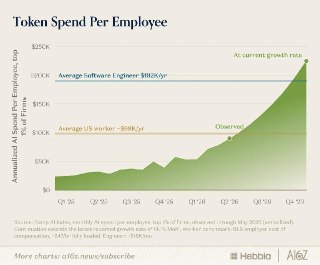
Morning Edition · Friday, July 17, 2026Published at 1:29 AM EDT · New York
At the AI Frontier, Token Bills Are Approaching Payroll Scale, a16z and Ramp Find
The heaviest corporate AI users now spend about $90,000 per employee a year on model tokens, and cheaper tokens are accelerating that spending rather than capping it.
A joint reading of enterprise card data by Ramp and the venture firm Andreessen Horowitz (a16z) finds that among the top 1% of AI-heavy companies, spending on model tokens has reached roughly $7,500 per employee each month, or about $90,000 a year, as reported by the AI Post channel and detailed in a16z's own writeup. For reference, average total US worker compensation runs near $98,000. At the frontier, that means annual AI spending per employee is now close to annual pay.
The more important finding for anyone modeling inference economics is about direction. Falling per-token prices have not flattened per-employee spending. They have accelerated it, and the group's monthly figure is growing at a double-digit rate as teams route more work through models once each unit of output gets cheaper. CIO's analysis notes that extrapolating that growth would push the annualized figure past the average US software engineer salary later this year, which is a projection rather than a measured level.
The data carries real caveats. It reflects a narrow leading edge rather than the median firm, and card-spend proxies capture list prices rather than negotiated committed-use discounts. Ramp also reports that these same high-intensity adopters grew headcount over the period, which complicates the simple story that AI is replacing workers.
Veracity: Corroborated
82/100- If true, who benefits
Andreessen Horowitz and the inference layer it invests in (OpenAI, Anthropic, Google, GPU serving providers) gain from a narrative that AI spend scales with usage rather than headcount, which justifies continued capital flowing into AI infrastructure and portfolio valuations.
- The nuance
The $7,500 figure describes only the top 1% of adopters, while the median firm spends about $11 per employee, and card-spend proxies capture list prices rather than negotiated discounts, so "payroll scale" reflects a narrow leading edge, not enterprises broadly.
Townsquare
Start a discussion in Townsquare.
More from this edition
- Moonshot Releases Kimi K3, a 2.8-Trillion-Parameter Open-Weight Model It Says Rivals US Frontier
- OpenAI Claims a GPT-5.6 Configuration Produced a Proof of a 50-Year-Old Graph Conjecture
- Meta's Brain2Qwerty v2 Decodes Typed Sentences From Brain Scans at 61% Word Accuracy
- NVIDIA Adds Jetson T3000 and T2000 to Push Robotics Foundation Models to the Edge
- New Audit Tests Whether a Model's Chain-of-Thought Actually Depends on Its Stated Premises
- OpenAI's First Hardware Device Will Reportedly Be a Screenless Smart Speaker
- Google DeepMind and Isomorphic Labs Publish a Joint Approach to Biosecurity for AI Models
Comments
0No comments yet.