← The Polylog AI Intelligence Brief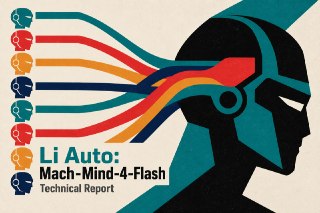
Morning Edition · Saturday, July 18, 2026Published at 1:46 AM EDT · New York
Li Auto's 35B Mixture-of-Experts Model Claims 100B-Class Performance From Post-Training Alone
Mach-Mind-4-Flash activates 3 billion parameters per token and reaches its results without scaling pretraining compute, using multi-track reinforcement learning (RL), multi-teacher distillation and a token-efficiency stage.
The AI division of Chinese electric-vehicle maker Li Auto (Lixiang) published a technical report on Mach-Mind-4-Flash, a Mixture-of-Experts (MoE) model with 35 billion total parameters and roughly 3 billion activated per token. The central claim is that through post-training optimization alone, without additional pretraining compute, the model reaches performance on par with or above 100-billion-parameter-class systems.
The method, as described in the report, is a unified RL pipeline that orchestrates multiple expert tracks, a multi-teacher distillation stage, and a dedicated token-efficiency stage, plus scalable agentic interaction environments for large-scale reinforcement learning aimed at real-world application tasks.
The framing matters as much as the numbers. An automaker's AI group, not a dedicated frontier lab, is arguing that the marginal capability now comes from post-training and environment design rather than from raw scale. That claim awaits independent reproduction on named benchmarks, and "100B-class" is not a fixed standard, depending heavily on which baseline and which tasks are chosen. What is concrete is another downloadable Chinese model built to achieve frontier-adjacent behavior with a small number of activated parameters.
Veracity: Plausible
54/100- If true, who benefits
China's open-weight ecosystem, compute-constrained governments and enterprises that want cheap-to-serve models, and Li Auto's standing as an AI developer, at the expense of compute-rich pretraining incumbents.
- The nuance
"100B-class" is not a fixed standard and rests on self-reported benchmarks, and the model is initialized from Qwen3.5-35B, so the gains are post-training on an existing base rather than a result built from scratch.
An open-source-intelligence read of how likely this story is true with its real nuance, not a judgment of any outlet. It assesses the claim, weighing independent and adversarial reporting. .
Part of a tracked trend
Frontier Model Efficiency Gains
Capability per unit of training and inference compute keeps improving, letting newer models match prior frontier performance far more cheaply and gradually loosening the link between raw scale and capability.
Townsquare
Start a discussion in Townsquare.
More from this edition
- EU Orders Google to Share Search Data With AI Rivals and Open Android Assistant Slots
- NVIDIA Reframes Vera Rubin Around Cost Per Token for the Post-Training Era
- Anthropic Redeploys Fable 5 With a Cross-Lab Jailbreak Severity Scale
- Meta's Brain2Qwerty v2 Decodes Typed Sentences From Non-Invasive Brain Signals at 61% Word Accuracy
- Hyundai Moves to Full Ownership of Boston Dynamics Days After Its Workers Struck Over Robots
- Meta Puts Muse Spark 1.1 Behind a Paid API in a Direct Bid for Coding Agents
- Anthropic Restructures Claude Code Review Into Five Effort Tiers, Topped by a Cloud Agent Fleet
Comments
0No comments yet.