← The Polylog AI Intelligence Brief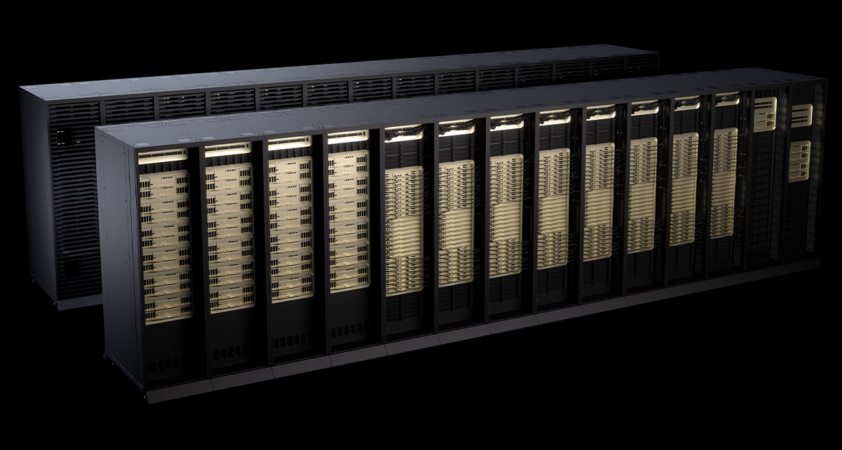
Morning Edition · Saturday, July 18, 2026Published at 1:46 AM EDT · New York
NVIDIA Reframes Vera Rubin Around Cost Per Token for the Post-Training Era
The company claims up to ten times lower cost per token than Blackwell and training of the largest models with one-quarter the GPUs, positioning inference economics as the main basis of competition.
NVIDIA published a positioning piece on July 17 arguing that the relevant metric for the agentic era is intelligence per dollar, measured as cost per token across the continuous post-training loop of reinforcement learning (RL) rollouts. The company says the Vera Rubin platform was co-designed end to end for that workload, supporting more rollouts per run and more concurrent environments, and that it can train the largest models with one-fourth the GPUs of the Blackwell generation.
The main efficiency claim, first stated at the Consumer Electronics Show (CES), is up to five times greater inference performance and ten times lower cost per token than Blackwell, with the NVL72 rack system slated for the second half of 2026.
These are vendor figures, not independent benchmarks, and the ten-times number bundles hardware, interconnect, memory and software co-design rather than isolating the chip alone. The direction is consistent with what practitioners already see, since RL post-training now consumes forward-and-backward passes at inference-like volumes, and per-token cost, not peak processing throughput (FLOPS), governs how many rollouts a lab can afford. The reframing also serves NVIDIA's interest in shifting the buying conversation from raw compute toward a metric only its full stack optimizes.
Veracity: Plausible
56/100- If true, who benefits
NVIDIA, by moving the purchasing metric to cost per token, a measure only its full rack-scale integration optimizes, and frontier labs running heavy reinforcement-learning pipelines if the gains survive production.
- The nuance
The ten-times figure is a vendor claim that bundles hardware, interconnect, memory and software co-design rather than isolating the chip, and no independent MLPerf or third-party per-token measurement yet exists.
Part of a tracked trend
The Inference-Cost Efficiency Race
Techniques that cut tokens generated and KV-cache memory per query will keep compressing the marginal cost of serving reasoning models, making inference efficiency a recurring competitive axis alongside raw capability.
Townsquare
Start a discussion in Townsquare.
More from this edition
- EU Orders Google to Share Search Data With AI Rivals and Open Android Assistant Slots
- Li Auto's 35B Mixture-of-Experts Model Claims 100B-Class Performance From Post-Training Alone
- Anthropic Redeploys Fable 5 With a Cross-Lab Jailbreak Severity Scale
- Meta's Brain2Qwerty v2 Decodes Typed Sentences From Non-Invasive Brain Signals at 61% Word Accuracy
- Hyundai Moves to Full Ownership of Boston Dynamics Days After Its Workers Struck Over Robots
- Meta Puts Muse Spark 1.1 Behind a Paid API in a Direct Bid for Coding Agents
- Anthropic Restructures Claude Code Review Into Five Effort Tiers, Topped by a Cloud Agent Fleet
Comments
0No comments yet.