← The Polylog AI Intelligence Brief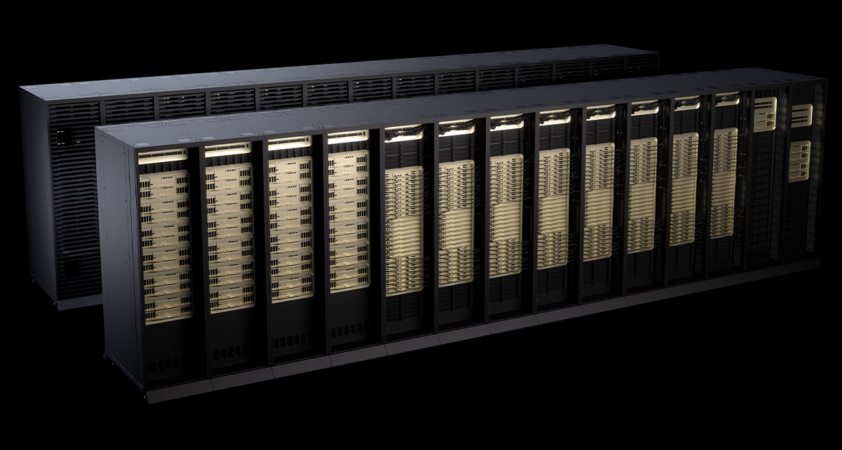
Morning Edition · Saturday, July 18, 2026Published at 2:03 AM EDT · New York
Nvidia Pitches Vera Rubin as a Post-Training Machine, Claiming Ten Times Lower Cost Per Token
The company frames its next platform around "intelligence per dollar" for reinforcement learning, but the figures are vendor benchmarks against Blackwell and the chips do not ship until late 2026.
Nvidia is repositioning its forthcoming Vera Rubin platform around post-training rather than pretraining, arguing that the reinforcement-learning (RL) stage where reasoning and agentic behavior are shaped is now the expensive part of the pipeline. In a company blog post, Nvidia says the Vera Rubin NVL72 rack maximizes what it calls intelligence per dollar by running more RL rollouts across more environments while using roughly one-fourth as many graphics processing units (GPUs) to train a given model.
The main claims, first shown at the Consumer Electronics Show (CES), are up to five times higher inference throughput and about ten times lower cost per token than Blackwell, the current generation. Nvidia's argument is that every reduction in cost per token reduces the cost of RL, because post-training now consumes tokens at inference scale rather than as a one-time cost.
Read skeptically, these are the vendor's own figures, measured against its own prior product, and the hardware is not scheduled to ship until the second half of 2026. No independent lab has reproduced them, and the comparison excludes competing accelerators from Advanced Micro Devices, Google, and Amazon. What is verified is the direction: Nvidia is explicitly optimizing its roadmap for the RL and agentic post-training workloads that labs are scaling most aggressively.
Veracity: Plausible
55/100- If true, who benefits
If the ten-times figure holds, Nvidia gains most, locking labs that serve reasoning and agentic models into its rack-scale systems and weakening the case for custom accelerators from Advanced Micro Devices, Google, and Amazon.
- The nuance
Part of a tracked trend
The Inference-Cost Efficiency Race
Techniques that cut tokens generated and KV-cache memory per query will keep compressing the marginal cost of serving reasoning models, making inference efficiency a recurring competitive axis alongside raw capability.
Townsquare
Start a discussion in Townsquare.
More from this edition
- Li Auto's 35-Billion-Parameter Model Matches 100-Billion-Class Systems Through Post-Training Alone
- Meta Reports Typing Decoded From Non-Invasive Brain Scans at 61 Percent Word Accuracy
- EU Orders Google to Share Search Data With AI Rivals Starting January 2027
- OpenAI's CFO Proposes a "Cost Per Successful Task" Scorecard for AI Spending
- Hyundai Workers Strike at Ulsan Over Plan to Deploy Boston Dynamics Humanoids
- Anthropic Restores Fable 5 and Proposes a Cross-Lab Jailbreak Severity Scale
- Meta Opens Muse Spark 1.1 to Developers via a Cheaper Model API
- Anthropic Rebuilds Claude Code Review Into Five Distinct Effort Tiers
Comments
0No comments yet.