← The Polylog AI Intelligence Brief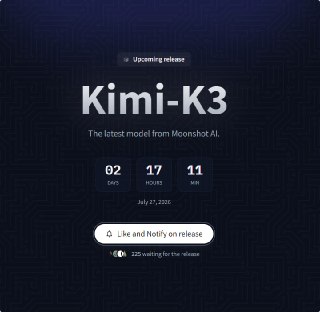
Morning Edition · Monday, July 27, 2026Published at 1:32 AM EDT · New York
Moonshot AI Releases Kimi K3 Weights, a 2.8-Trillion-Parameter Open Model
The Chinese lab is publishing downloadable weights for a mixture-of-experts model that it says outperforms proprietary US systems on several coding and agent benchmarks. The company reported those benchmark figures itself.
Moonshot AI is releasing the full weights of Kimi K3 today, following the model's announcement on July 17. The company posted a countdown on its Hugging Face account ahead of the release. The architecture is a sparse mixture-of-experts model with 2.8 trillion total parameters, 16 of 896 experts active per token, a context window of one million tokens, and native multimodal input.
On Moonshot's own charts, K3 leads every tested system on Program Bench, SWE Marathon, BrowseComp, SpreadsheetBench 2, and Automation Bench. It trails what the company labels Fable 5 and GPT-5.6 on FrontierSWE and DeepSWE. Moonshot says the model beats Claude Opus 4.8 and GPT-5.5 on most of its internal tests. These are vendor-reported figures on a mix of proprietary and public benchmarks, and independent reproduction on standardized evaluations has not yet been published.
The significance is less any single score than the pattern. As analyst Nathan Lambert described it, this is an open-weights escalation: a Chinese lab shipping frontier-scale weights that anyone can download, fine-tune, and serve, at a moment when Washington restricts foreign access to closed US models. Running a 2.8-trillion-parameter model is not cheap, but making the weights public moves control away from a company's access controls and toward whoever owns the computing hardware.
Veracity: Corroborated
83/100- If true, who benefits
Moonshot AI and China's sovereign-compute push gain a downloadable frontier substitute that undercuts US closed-lab distribution, while GPU cloud and inference providers gain serving demand and the closed labs that sell access are pressured.
- The nuance
The release, size, and open weights are independently confirmed by , but the parity claim rests on vendor runs that mix at least three agent harnesses, and independent reruns already come in lower (roughly ).
Part of a tracked trend
Chinese Open-Weight Models Emerge as the Non-US AI Stack
As Washington restricts foreign access to US frontier models, governments and enterprises cut off from American AI increasingly standardize on downloadable Chinese open-weight models, splitting the world into competing AI supply blocs rather than a single frontier.
Townsquare
Start a discussion in Townsquare.
More from this edition
- Anthropic Ships Claude Opus 5, Priced at Half Its Largest Model
- Nvidia Uses Its Own Vera CPU to Speed Up Chip Design by 1.5 Times
- OpenAI Puts ChatGPT Voice in the Desktop App to Drive Codex Agents
- SenseTime Open-Sources SenseNova-Vision, a Unified Perception Model
- Meta's Brain2Qwerty v2 Decodes Typed Sentences at 61% Word Accuracy
- FlowEvo Lets LLM Agents Co-Evolve Workflows and Reusable Skills
- CARE Proposes Pre-Execution Verification for Shell-Executing LLM Agents
- Paper Uses Reinforcement Learning to Optimize Stylistic Jailbreaks of Vision Models
Comments
0No comments yet.