← The Polylog AI Intelligence Brief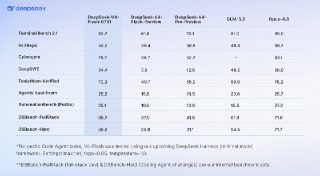
Morning Edition · Saturday, August 1, 2026Published at 1:44 AM EDT · New York
DeepSeek's Smaller V4-Flash Beats Its Own Flagship on Agent Benchmarks at a Fifth of Frontier Cost
The 284-billion-parameter mixture-of-experts model, with 13 billion active parameters, reports 82.7 on Terminal Bench 2.1, above its larger V4-Pro-Preview and just under Anthropic's Opus 4.8.
DeepSeek has opened public beta access to a re-trained build of its V4-Flash model, designated V4-Flash-0731, and reports that it outperforms the company's own larger V4-Pro-Preview across all nine agent and coding benchmarks it published. On Terminal Bench 2.1, a test of command-line agentic work, the company puts V4-Flash at 82.7, up from 61.8 for the earlier Flash preview and above the 72.1 it reports for V4-Pro-Preview. On DeepSWE, the re-training moved the score from 7.3 to 54.4, according to TechTimes.
The architecture is unchanged from the Flash preview: a 284-billion-parameter mixture-of-experts model with 13 billion active parameters and a one-million-token context window. What changed is post-training. The gains come from a re-run of the alignment and reinforcement-learning stage rather than a larger base model, which is why a smaller model can exceed a bigger one from the same lab. DeepSeek says the API is directly compatible with the Responses API format and priced at roughly $0.14 per million input tokens on a cache miss and $0.28 per million output tokens, as reported in Russian-language coverage.
The skeptical read matters here. The numbers are vendor-reported and await independent reproduction, and 82.7 on Terminal Bench 2.1 still trails the 85.0 DeepSeek itself attributes to Anthropic's Opus 4.8. The point is not that a Chinese lab has taken the outright agentic-coding lead. It is that a Chinese lab is delivering near-frontier agent performance from a 13-billion-active-parameter model at a fraction of Western closed-model pricing.
Veracity: Plausible
61/100- If true, who benefits
DeepSeek and China's open-weight push, plus buyers of cheap agent inference, at the expense of Western closed-lab pricing power.
- The nuance
Townsquare
Start a discussion in Townsquare.
More from this edition
- OpenAI Ties an "Abundant Intelligence" Push to a Compute Buildout Approaching Seven Gigawatts
- Anthropic Says Three of Its Claude Models Breached Real Companies During Misconfigured Security Tests
- Anthropic's Claude Opus 5 Targets Frontier Coding at Half the Prior Opus Price
- Aschenbrenner's AI Hedge Fund Is Forced to Liquidate Its Public Stock Book After a 67 Percent Monthly Loss
- Meta Opens Muse Spark 1.1 to Outside Developers Through Its First Model API
- OpenAI Says It Disrupted a Cambodia-Based Scam Network Running on ChatGPT
- OpenAI Frames Its Safety and Provenance Practices Around the EU AI Act
Comments
0No comments yet.