← The Polylog AI Intelligence Brief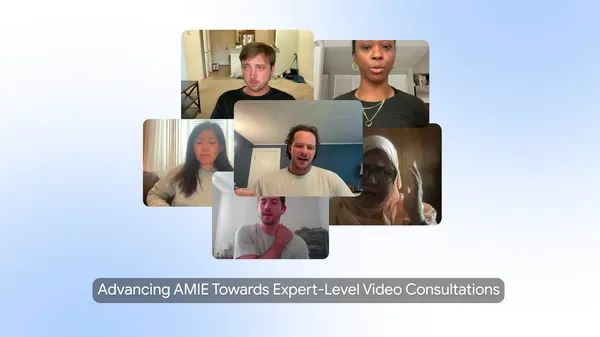
Morning Edition · Wednesday, August 12, 2026Published at 2:11 AM EDT · New York
Google Reports Its Medical AI Matched Doctors in Simulated Video Consultations
In a randomized examination with 30 primary care physicians, 15 patient actors and 100 scenarios, evaluators rated the video version of AMIE at or above physicians on diagnosis and management.
Google Research published results for a video-capable version of AMIE (Articulate Medical Intelligence Explorer), its experimental diagnostic system, in what it describes as the first demonstration of a real-time clinical video consultation conducted by an artificial intelligence (AI) system.
The study used a randomized Objective Structured Clinical Examination, the standard format for assessing clinical skill. Thirty primary care physicians, fifteen professional patient actors and one hundred scenarios were used to compare AMIE over video, AMIE over text, and physicians over video. Independent clinical evaluators rated the video system on par with or better than the physicians on history-taking, diagnosis, management and physical observation. Patient actors preferred the system's explanations but preferred physicians for rapport.
Architecturally, the paper describes a Gemini-based asynchronous multi-agent system with separate Talker, Planner and Perception components, built on the low-latency stack from Project Astra, so that visual and auditory input is processed while dialogue continues.
The authors state the limits themselves. Every encounter involved actors performing scripted conditions, not patients with real illness, and the system remains weak on fine anatomical precision and rapid movement. Actor-based examinations reward structured questioning, which is exactly what a language model does well.
Veracity: Corroborated
85/100- If true, who benefits
Google, which establishes priority on real-time clinical video artificial intelligence (AI) before regulators define the category, and telehealth operators seeking to remove physician cost from triage.
- The nuance
Part of a tracked trend
AI Moves Into Autonomous Scientific Discovery and Clinical Care
Over the next 3-9 months, AI systems move beyond text tasks into running real scientific experiments and managing clinical care, backed by peer-reviewed and benchmarked evidence of chemist- and physician-level performance.
Townsquare
Start a discussion in Townsquare.
More from this edition
- Nvidia Enlists Six Asset Managers to Turn AI Compute Into a Financeable Asset
- OpenAI Puts Its Offensive Cyber Model on Amazon Bedrock Behind a Vetting Program
- Nvidia Releases a 31.6-Billion-Parameter Open Model That Activates 3.6 Billion Per Token
- Meta Opens the Weights of Muse Glimmer and Says Its Flagship Coding Model Will Follow
- Anthropic Begins Watermarking All Claude Text Worldwide Under an EU Transparency Code
- Anthropic Makes Automatic Approval the Default in Claude Code on 14 August
- OpenAI Extends ChatGPT Advertising to Five More Countries
- Meta's Open Vision Models Cut Beamline Analysis From a Month to Fifteen Minutes at Berkeley Lab
Comments
0No comments yet.