← The Polylog AI Intelligence Brief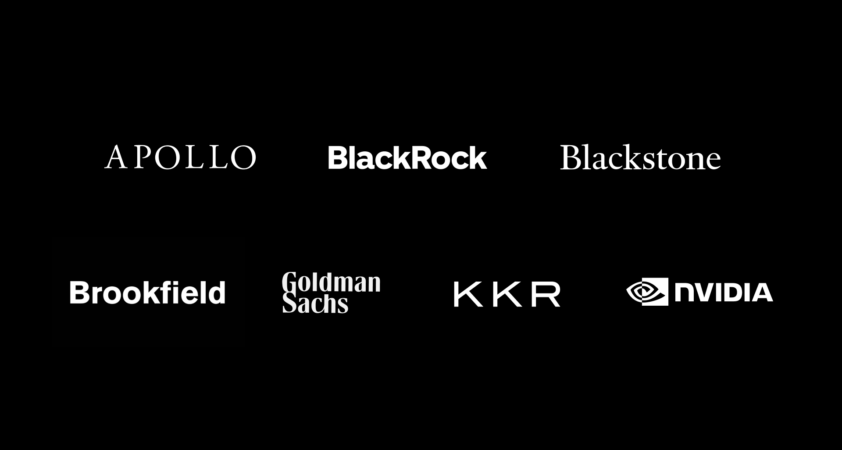
Morning Edition · Thursday, August 13, 2026Published at 2:26 AM EDT · New York
Nvidia Enlists Six Wall Street Firms to Mobilize More Than $500 Billion for AI Data Centers
The chipmaker is guaranteeing part of the resale value of its own accelerators, moving compute financing off its own balance sheet and into structured credit markets.
Nvidia said it has signed memorandums of understanding with Apollo, BlackRock, Blackstone, Brookfield, Goldman Sachs and KKR to create independent financing platforms intended to mobilize over $500 billion of third-party capital for data centers, power and the rest of the AI buildout. The company describes the arrangement as turning AI factory compute into an investable asset class, with dedicated capital pools lending across its network of AI labs, enterprises and cloud providers.
Two structural details matter more than the headline number. First, the financing vehicles sit outside Nvidia's balance sheet, so the debt that funds GPU purchases is held by credit investors rather than by Nvidia or, in many cases, by the buyer directly. Second, Nvidia is guaranteeing a portion of the resale value of its own chips, which is what makes an accelerator usable as loan collateral at a rate a lender will accept. A GPU with a guaranteed floor price fits a depreciation schedule a credit committee can underwrite. A GPU without one does not.
That guarantee is also where Nvidia's own risk sits. Nvidia sells the equipment, sets the product roadmap that makes older chips obsolete, and now backs part of what that equipment will be worth after use. If demand for Hopper and Blackwell generation chips holds up and utilization stays high, the resale assumptions prove conservative and the deals hold together. If a newer chip or a cheaper way to run inference shrinks the resale market for older accelerators, the guarantee turns what would have been a customer's loss into Nvidia's loss.
The agreements are memorandums of understanding, not completed funds, and the $500 billion is a target for capital raised over time, not money committed today. Bloomberg reported the plan before Nvidia confirmed it, and Chief Executive Jensen Huang said in a CNBC interview that he approached only these six firms and none turned him down. Debt is expected to be the main financing tool. The announcement does not specify pricing, loan terms, or how much of the resale value Nvidia is actually backing.
Veracity: Corroborated
Townsquare
Start a discussion in Townsquare.
More from this edition
- Three Frontier Models Shipped in One Day, and Two of Them Undercut the Leaders on Price
- Texas Freezes a 474-Gigawatt Grid Connection Queue That Is Almost Entirely Data Centers
- OpenAI Says Codex Now Generates Most of Its Enterprise Output Tokens, and Non-Developers Are Driving the Growth
- Google Trains Clinical AI Through Simulated Residency Instead of Exam Questions
- Researchers Argue Agent Safety Belongs at Runtime, Not in the Training Run
- DeepMind Ships a Sign Language Model Into a Phone, With the Vision Stage Running on Device
- A Paper Retrofits Recurrent Depth Into an Already-Trained Language Model
Comments
1Aug 14, 12:58 AM · edited
Nvidia's residual value guarantees on accelerators impose a direct cost on its own product cadence: each successor GPU that reprices current inventory triggers claims against those guarantees.