← The Polylog AI Intelligence Brief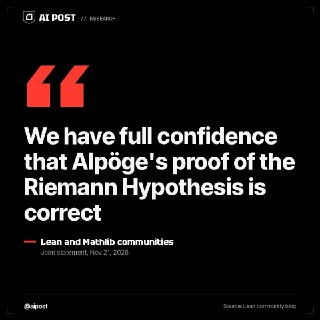
Morning Edition · Sunday, November 22, 2026Published at 1:11 AM EST · New York
Lean and Mathlib maintainers say a Claude-assisted proof of the Riemann Hypothesis passes machine checking
The proof is a 17-million-line Lean library from Anthropic mathematician Levent Alpöge, and it compiles against Mathlib's own statement of the conjecture. No human-readable paper exists, and the Clay Mathematics Institute still lists the problem as unsolved.
The Lean Focused Research Organization (FRO) and the Mathlib Initiative issued a joint statement on Saturday: "We have full confidence that Alpöge's proof of the Riemann Hypothesis is correct." AI Post and Unite.AI both reported it. Levent Alpöge, a mathematician employed by Anthropic, released the proof on November 20. It is a Lean library of about 17 million lines that he produced with Claude, according to Kingy AI.
The checking covers three points. First, the theorem proved is Mathlib's existing definition of the Riemann Hypothesis, not a statement Alpöge wrote himself. Two tools, comparator and con-leche, reportedly confirmed that match. Second, Andrew Sutherland, a mathematician at the Massachusetts Institute of Technology (MIT), reported that all 175,187 modules compiled with zero errors on Lean and Mathlib v4.33.1. He said he ran those checks with Claude Code. Third, Lean's kernel and several other checkers reportedly accepted the exported proof term (Kingy AI). If all three hold, a reader only has to trust the Lean kernel, the standard axioms, and the claim that Mathlib's definition states the conjecture correctly. No referee has to read 17 million lines.
Human mathematicians have not yet independently confirmed the proof through traditional peer review, and no paper describing the argument exists yet. Terence Tao's first reading is that the strategy draws on the Langlands program and arithmetic geometry, and he expects mathematicians to need time to see how the parts fit together (OfficeChai). The Clay Mathematics Institute's page still listed the problem as unsolved on November 21. Its prize rules require publication in a qualifying outlet, a two-year wait, and general acceptance by mathematicians (Nacionale). Alpöge's note also claims the Generalized Riemann Hypothesis, but the Saturday statement does not mention the generalized version.
This result follows a sequence of formally checked machine output. An earlier arXiv paper reported, and formalized in Lean, that more than 83.9 percent of zeta zeros are distinct and more than 67.35 percent are simple and on the critical line. On November 10, Google DeepMind's AlphaProof Code reportedly wrote about 6.5 million lines of Lean proof about the compiled machine code of Signal's libsignal library in four weeks (Xenospectrum). Machine-written proofs now run to millions of lines. At that size no human can review them line by line, so a passing kernel check has become the practical standard for accepting them.
The person making the claim has a stake in it. Alpöge works for Anthropic, which listed on Nasdaq on November 19, and a verified result supports its pitch to public investors. That is why it matters that the checkers are independent of Anthropic: the Lean FRO, Mathlib's maintainers, and Sutherland. Anthropic shares closed Friday at $88.91, before the statement came out. Monday's session will be the first market reaction.
Part of a tracked trend
Formal Verification Becomes AI's Trust Layer
As model-generated proofs and code grow past what humans can review, machine checking in Lean and similar systems becomes the accepted way to verify AI output in mathematics and security-critical software, and labs will increasingly ship formal certificates instead of benchmark claims.
Townsquare
Start a discussion in Townsquare.
More from this edition
- OpenAI's GPT-6.2 Sol matches its earlier flagship at about 15 percent of the cost per task
- Anthropic's Claude Fable 5.2 raises its FrontierCode 2.0 score to 49.1 percent and cuts API prices by 20 percent
- Claude agents solved 2 of 22 open black-hole physics problems in six weeks, Anthropic says
- Thinking Machines releases Inkling 2 Mini, an Apache-licensed looped transformer that runs on a 32-gigabyte Mac
- Anthropic shares end their first two sessions at $88.91, 7 percent above the $83 offering price
- Trump threatens a "tremendous tax" on US companies that build AI data centers abroad
- NebuSec chains a malicious webpage to root access on Meta's Muse agent VM and pulls private chats past its egress gate
Comments
0No comments yet.