← The Polylog AI Intelligence Brief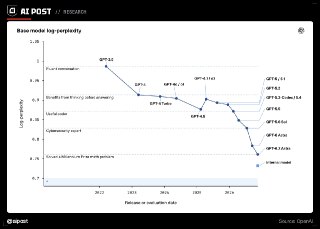
Morning Edition · Monday, November 23, 2026Published at 1:12 AM EST · New York
OpenAI's Chief Scientist Proposes Industry-Wide Capability Limits Measured in Pretraining Perplexity
Jakub Pachocki disclosed that OpenAI's internal log-perplexity fell from about 0.99 at GPT-3.5 to about 0.76, the level at which he says models began producing new results on open math problems.
Jakub Pachocki, OpenAI's chief scientist, published an essay on November 22 titled "Perplexity and Intelligence". In it he argues that held-out perplexity should become the industry's shared measure of pretraining progress. He also asks labs to agree on limits that none of them would cross until methods for understanding and monitoring model behavior reach a defined milestone. As a first step, OpenAI disclosed internal scores it says it has tracked since GPT-3.5.
According to coverage of the essay, log-perplexity on OpenAI's own held-out dataset fell from about 0.99 for GPT-3.5 to about 0.76. Pachocki writes that internal models began producing new results on open math problems after they passed roughly 0.76. He also identifies a window near 0.68 to 0.70 where he expects further transformative capabilities. Separately, he predicts that a wave of fundamental pretraining advances could arrive as soon as 2027.
Pachocki names the main weaknesses himself. Labs use different evaluation sets and different training mixtures, so their perplexity numbers are not directly comparable. Perplexity also misses gains from post-training and chain-of-thought reasoning. New research published this morning supports the second point. A paper on arXiv reports that RL on GSM8K math reasoning still succeeds when the supervised fine-tuning trajectories are severely corrupted. If RL can recover reasoning ability from damaged supervised data, much of a deployed model's capability comes from post-training, and a pretraining-loss ceiling does not measure it.
The "monitoring milestone" has a verification problem of its own. A second arXiv paper, also listed for NeurIPS 2026, shows that Distributed Alignment Search (DAS), a standard causal-abstraction interpretability method, can find "parasite features." These are spurious variables that pass causal-equivalence tests with linear alignment maps on syntactic agreement and two-digit addition, even though the model does not implement them. A milestone defined by interpretability tools that can return false positives would be difficult to certify.
The incentives matter. A lab that believes it leads on pretraining efficiency gains from a ceiling that binds competitors who rely on scale. The proposal also needs every lab to publish comparable numbers on a common held-out set, and no lab has agreed to that. Chinese labs such as Tencent, which this week released a 770-billion-parameter open model, have no reason to sign. A coordinated capability cap among US competitors would also draw antitrust scrutiny. The disclosed curve is still useful data. It is the first time a frontier lab has published its pretraining loss series. But the scores come from OpenAI's own evaluation set, and outsiders cannot reproduce them.
Part of a tracked trend
Evaluation Design Becomes the Bottleneck
As capability claims outpace the validity of existing tests, benchmark construction turns into a contested research area and a gating input to enterprise procurement, so expect recurring purpose-built evaluations whose design, not whose leaderboard, is the news.
Townsquare
Start a discussion in Townsquare.
More from this edition
- Tencent Releases Full Hy4 Weights, a 770-Billion-Parameter Open Model With a One-Million-Token Context
- Anthropic Trades About 7% Above Its $83 IPO Price After Giving Up Most of Its First-Day Gain
- OpenAI's GPT-6.2 Sol Comes Within a Point of Astra on FrontierCode 2.0 at a Fifth of the Cost, but Both Trail Claude Fable 5.2
- Anthropic Says Claude Agents Solved Two of 22 Open Problems in Black Hole Physics After Six Weeks of Autonomous Work
- Anthropic Restricts Mythos 5.2 to Vetted Organizations as It Reports 89.6% on a Vulnerability-Rediscovery Test
- Researchers Find Agent Skills Leak Personal Data Even When They Do Exactly What They Advertise
- Apple Releases Depth Pro 2, Open Metric-Depth Models for Video That Range From 24 Million to 872 Million Parameters
Comments
0No comments yet.