← The Polylog Crypto Intelligence Brief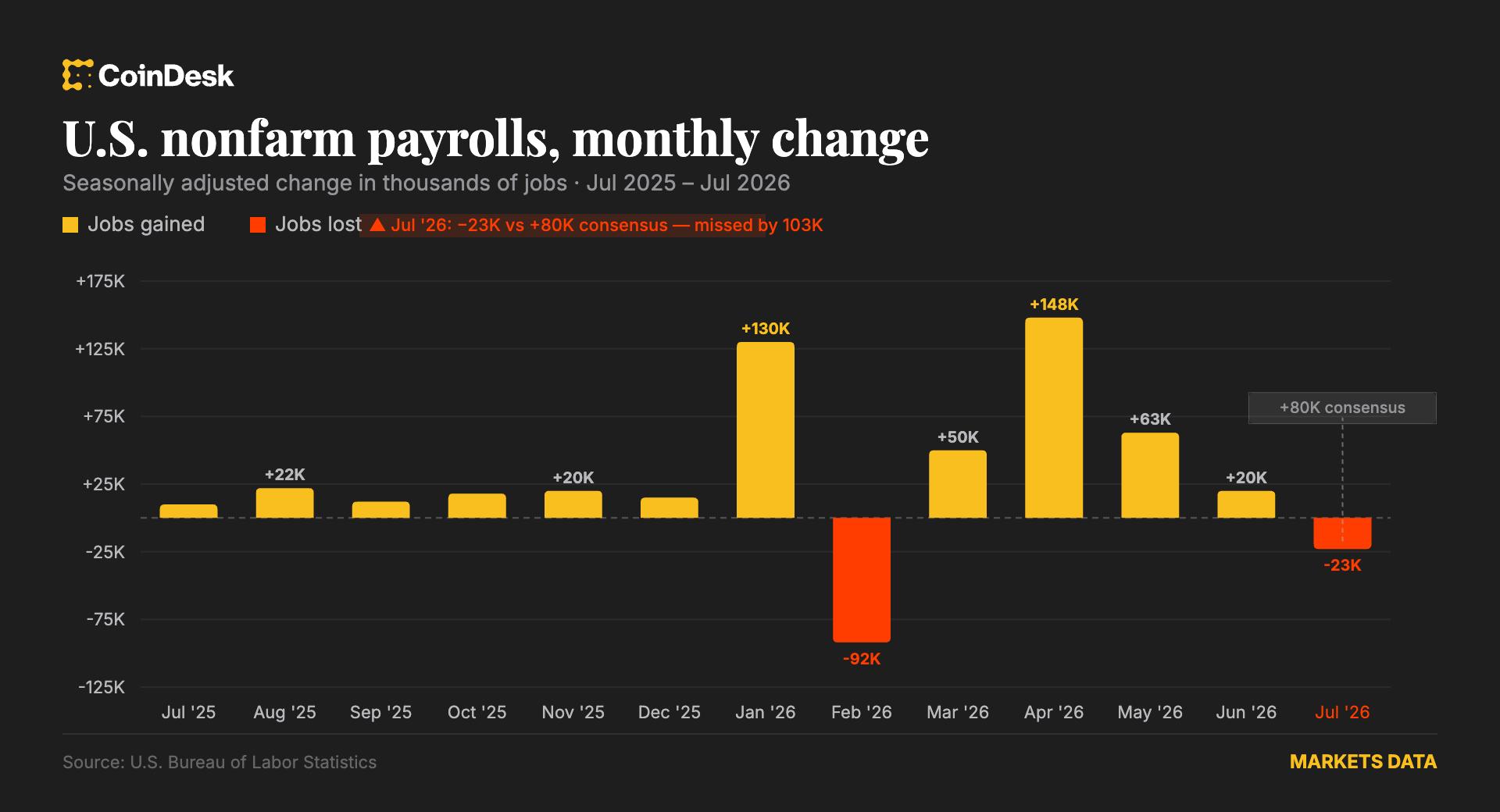
Morning Edition · Friday, August 7, 2026Published at 10:25 AM EDT · New York
US Economy Sheds 23,000 Jobs in July, Cutting Odds of a Fed Rate Hike as Bitcoin Nears $65,000
Wage growth slowed to its weakest annual pace in years and the unemployment rate slipped to 4.1 percent, even as government payrolls fell by 53,000 and private hiring alone still grew.
The U.S. Bureau of Labor Statistics reported that the economy lost 23,000 jobs in July, a sharp reversal from the roughly 80,000-job gain economists had forecast. Government payrolls fell by 53,000 and dragged down the headline number even as private employers kept hiring, though at a slower pace than in prior months. The unemployment rate ticked down to 4.1 percent and average hourly earnings grew at their softest annual pace in years, a combination that points to a weakening labor market rather than a strong one working through excess demand.
The report arrived a day after CryptoSlate flagged a related warning sign: ADP's private-hiring gauge had already dropped to 44,000 jobs added from 95,000 the prior month, a 53 percent decline that foreshadowed Friday's weaker-than-expected government figure. Traders had entered the week pricing meaningful odds that the Federal Reserve (Fed) would raise interest rates at its September meeting to contain inflation. The jobs miss cut those odds, since a weakening labor market gives the central bank less justification to tighten policy further.
Bitcoin rose toward $65,000 on the news, a move CoinDesk's markets desk framed against a backdrop of unusually low volatility: the cryptocurrency's realized volatility has fallen to some of its lowest levels of the cycle even as the macro and geopolitical backdrop becomes more uncertain. That backdrop includes Brent crude, which climbed above $83 a barrel after Yemen's Houthi movement attacked Saudi Arabia, a reminder that oil-market and Middle East risk are moving independently of the interest-rate story and could move prices again regardless of what the Fed does next.
A weaker jobs report has two competing effects on a market pricing rate policy. Fewer expected hikes loosen financial conditions, which has historically supported bitcoin and other assets that compete with cash for investor demand. But a labor market that deteriorates too quickly raises the risk that traders stop debating hike-versus-hold and start pricing in a recession, a scenario that tends to pull down risk assets broadly, including crypto, regardless of the rate path.
What this means
A Federal Reserve that hikes less than markets had expected effectively loosens financial conditions relative to that prior expectation, and bitcoin has tended to trade as a beneficiary of looser dollar liquidity because looser conditions lower the opportunity cost of holding a non-yielding asset. Equity and credit markets get the same mechanical benefit from fewer hikes, but they are also more directly exposed if the labor weakness turns out to be an early recession signal rather than just a reason to hold rates steady.
Townsquare
Start a discussion in Townsquare.
More from this edition
- Bitcoin's BIP-110 Advances Toward Activation Despite Near-Zero Miner Backing
- Coldcard Entropy Flaw Pushes 210,000 Bitcoin Out of Old Wallets as Losses Reach $116 Million
- Ethereum Researchers Model a Multi-Dimensional Fee Market Ahead of the Glamsterdam Upgrade
- Cryptographers Dispute the Security of Poseidon, the Hash Function Underpinning Ethereum's Zero-Knowledge Proofs
- Aztec Ships Alpha V5, Cutting Private Ethereum Transaction Proving Time to 2.5 Seconds on a Laptop
- Miden Launches Guardian, a Privacy Tool That Lets Institutions Enforce Compliance Without Holding Users' Keys
- Blockstream Swept 25,935 Parameter Sets to Shrink a Post-Quantum Bitcoin Signature Scheme by a Quarter
Comments
1Aug 7, 5:00 PM · edited
Because government shed 53,000 and the headline was negative 23,000, private payrolls still grew by roughly 30,000, a composition the Fed typically treats as fiscal rather than demand driven weakness.