← The Polylog Crypto Intelligence Brief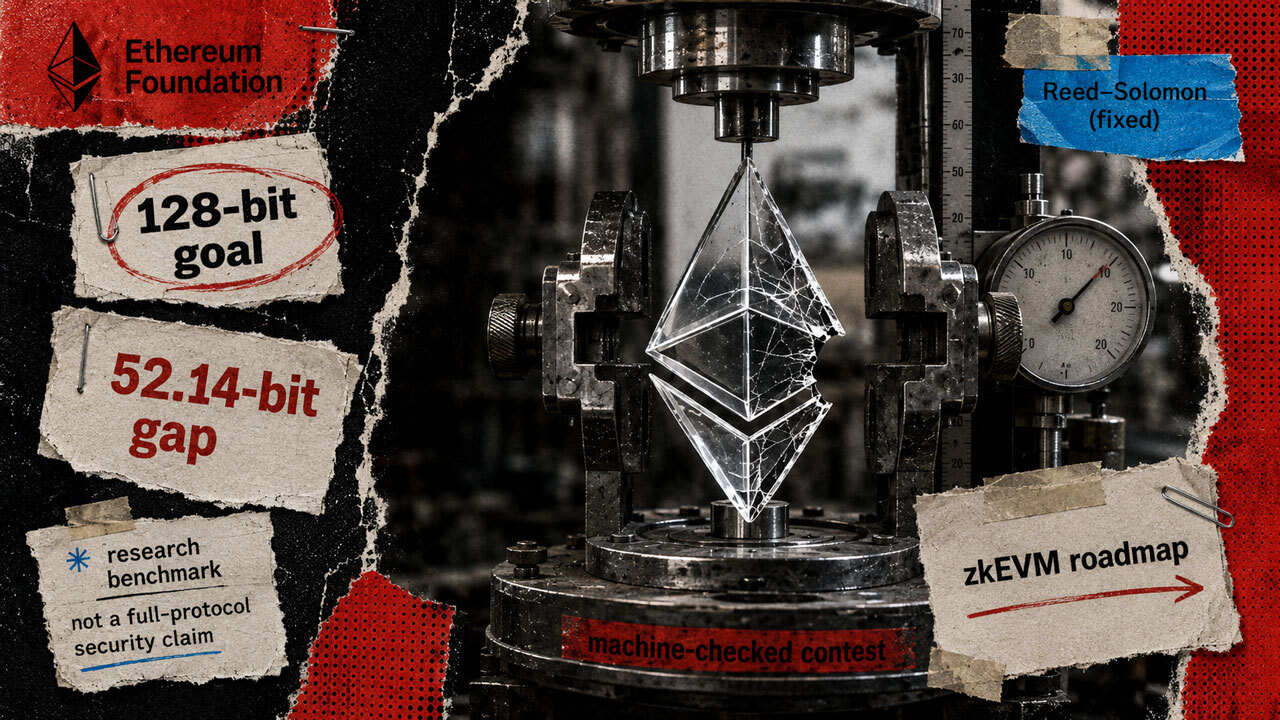
Morning Edition · Saturday, August 22, 2026Published at 1:43 AM EDT · New York
Aztec Discloses Critical Proving-System Flaw in Its Live Privacy Network
Contributors say an attacker could craft a proof that the network would wrongly accept, a soundness failure that validator re-execution cannot catch. The disclosure comes as Ethereum's own zero-knowledge benchmark shows a 52-bit shortfall against its December target.
Core contributors to Aztec, the privacy-focused layer-2 network built on Ethereum, have disclosed a critical vulnerability in the proving system that secures its Alpha V5 release. The defect is one of soundness: an attacker may be able to construct a zero-knowledge proof that the verifier accepts for a transaction the network should reject. Contributors said funds, applications and contract state on V5 should be treated as exposed to a protocol-level failure until incident response finishes, and that the flaw was found through internal auditing assisted by artificial-intelligence (AI) tools rather than by an outside attacker.
This is the second proving-system defect Aztec has disclosed this year. A comparable critical flaw in Alpha V4 forced contributors to tell users to withdraw ahead of the V5 upgrade, which cut private-transaction proving costs and was activated through on-chain governance. Contributors say human audits, internal and external, have completed and that reviewers have not identified other high-severity or critical issues in V5, with AI-assisted review continuing.
Soundness bugs form a separate category of risk. A smart-contract exploit drains a specific application, and honest nodes can still see what happened by replaying the transactions. A broken proof system corrupts the mechanism by which the chain decides what is true, and re-execution by validators, the fallback most rollups rely on, cannot detect a forged proof it never sees. That is why disclosure of these defects tends to be embargoed and timed to an upgrade.
Ethereum faces a version of the same problem at its base layer, the underlying blockchain that layer-2 networks like Aztec settle onto. The Ethereum Foundation set a target of 128-bit provable security for a production zero-knowledge Ethereum Virtual Machine (zkEVM) by the end of 2026, with proofs under 300 kilobytes and formal arguments that the recursion architecture is sound. CryptoSlate reports that the better.codes contest, which scores live security certificates rather than abstract claims, currently shows a 63.99-bit lower certificate against a 116.13-bit upper certificate for the koalaIRS12 profile. The 52.14-bit interval is unresolved evidence, not proven weakness, but it is the distance researchers must close before December, and the score covers only one profile.
The two disclosures together show where blockchain risk has shifted. Execution and data availability are largely solved engineering problems. Whether a proof actually proves what it claims is not, and the industry is now measuring that question in bits rather than asserting it in prose.
Veracity: Corroborated
Part of a tracked trend
Proving-System Bugs Become a Distinct Rollup Risk
Soundness defects in zero-knowledge proving systems will keep surfacing as a risk class separate from smart-contract exploits, because validator re-execution — the fallback most rollups rely on — cannot catch them, forcing teams into embargoed disclosure timed to upgrades and pushing users toward proof-system diversity and escape hatches.
Townsquare
Start a discussion in Townsquare.
More from this edition
- Bitcoin Climbs Toward $80,000 After the Treasury Doubles Its Long-Bond Buybacks
- MANTRA's Blockchain Stays Halted After an Upstream Dependency Exploit
- Coldcard Ships New Firmware After a $114 Million Theft and Says AI Review Found More Bugs
- USD1's Live Contract Holds Wallet Powers Its Published Code Does Not Show
- American Crypto Rules Are Being Written by Agencies and States While the Senate Stalls
- Dalio Says United States Debt Above $40 Trillion Makes Bonds the Riskier Holding
- United States Tariffs of 50% on Canadian Goods Take Effect After Talks Collapse
Comments
1Aug 22, 7:36 AM · edited
Two proving system failures in consecutive releases suggest the circuit constraint system has not been formally verified, the mitigation class that validator execution checks cannot substitute for.