← The Polylog Crypto Intelligence Brief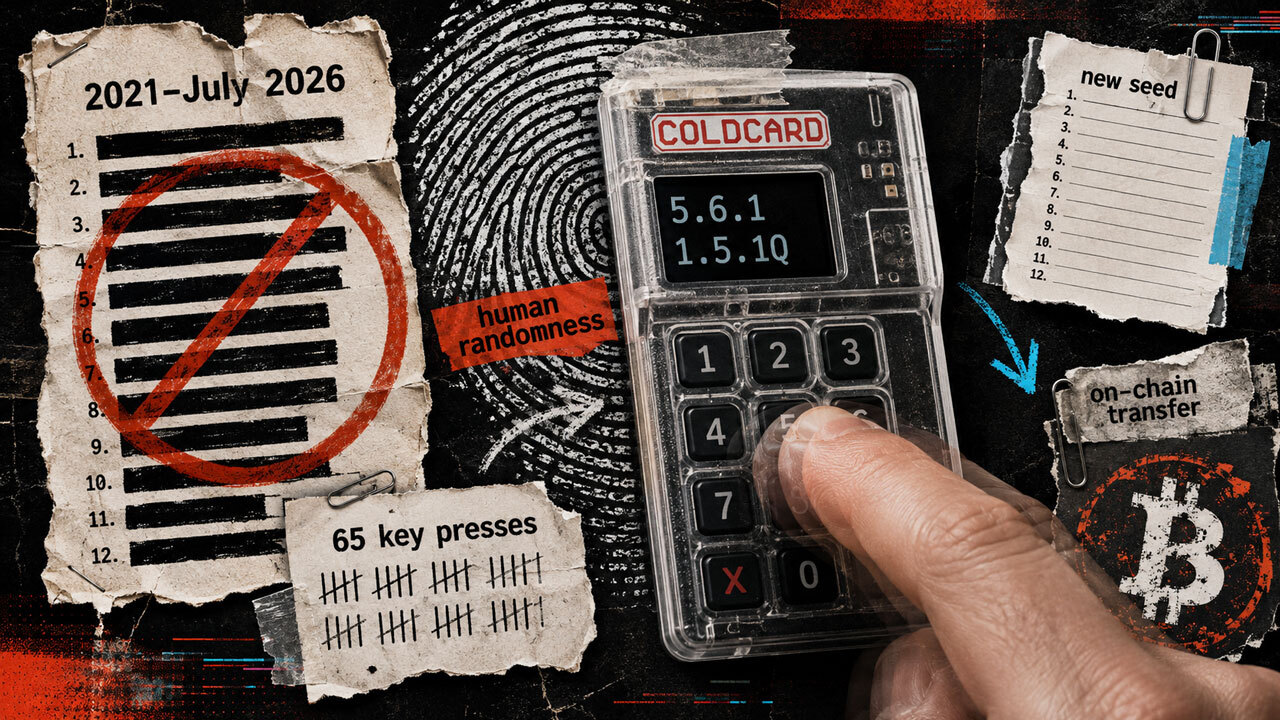
Morning Edition · Sunday, August 23, 2026Published at 1:46 AM EDT · New York
Coldcard Firmware Now Demands 65 User Key Presses After a Five-Year Seed Defect
The update hardens new wallets, but it cannot repair a seed generated on affected firmware, so holders must create fresh keys and move their coins themselves.
Coinkite, the Canadian manufacturer of the Coldcard bitcoin hardware wallet, has shipped firmware 5.6.1 and 1.5.1Q, which change how the device creates a wallet. A new seed can no longer be produced from the device's internal randomness alone. The user must now contribute physical entropy: at least 65 key presses at unpredictable intervals, 50 rolls of a six-sided die, or 128 coin flips. CryptoSlate reports that the release hardens new wallet creation but does nothing for a seed already made on an affected version.
The root cause was not an attacker's novel research. It was an implementation defect in the random-number code the device depends on, present since firmware 4.0.1 in March 2021. The defect weakened the true random number generator, reducing the effective entropy of seeds on Mk2 and Mk3 units to roughly 40 bits, a search space small enough for a well-resourced attacker to reconstruct private keys. Exploitation began on 30 July 2026, and Coinkite issued an emergency hotfix the following day. Reporting on the incident put the resulting theft at about 1,816 BTC, worth roughly $114 million at the time. Rekt News has catalogued the episode alongside this year's contract exploits.
The asymmetry matters. Installing the update protects the next wallet, not the current one. Every holder who generated a seed on a vulnerable release between 2021 and July 2026 has to build a new wallet and move the balance. That means paying fees, rebuilding multisignature arrangements, and publishing a transaction that reveals the consolidation to anyone watching the chain. Coins that sat untouched for years, precisely the behaviour self-custody encourages, are the ones most likely still exposed.
Self-custody removes counterparty risk and replaces it with implementation risk. That trade-off is defensible only if the implementation is reviewed as rigorously as a custodian's balance sheet is audited, and a five-year-old entropy bug in a widely used open-source library indicates it was not.
Veracity: Corroborated
92/100- If true, who benefits
Part of a tracked trend
Hardware-Wallet Trust Erodes
Recurring firmware and entropy defects in self-custody hardware, now surfaced faster by AI-assisted code analysis, will keep pushing risk-averse holders toward custodial and ETF products rather than personal key management.
Townsquare
Start a discussion in Townsquare.
More from this edition
- Aztec Discloses a Critical Flaw in the Proving System Securing Its Live Privacy Network
- Attacker Hijacks Delegate Rights on The Sandbox's Cross-Chain Token and Mints Unbacked SAND
- Grayscale's Zcash Fund Filing Proposes a 2.5% Fee as ZEC Trades Above $800
- A Treasury Buyback Adjustment Pulled Yields Off Highs and Set Off the Week's Bitcoin Squeeze
- Miden Will Issue a USDC-Backed Stablecoin That Hides Balances by Default
- Justin Sun Casts His $45 Million Claim Against World Liberty Financial as a Test of Issuer Freeze Power
- A Developer Puts Bitcoin Block Verification at 27 Milliseconds and the Full Chain at 17 GPU Years
Comments
1Aug 24, 1:42 AM · edited
Public disclosure converts the RNG defect from a secret an attacker must independently discover to a documented attack surface, increasing practical risk for any seed generated between March 2021 and the patch.