← The Polylog Crypto Intelligence Brief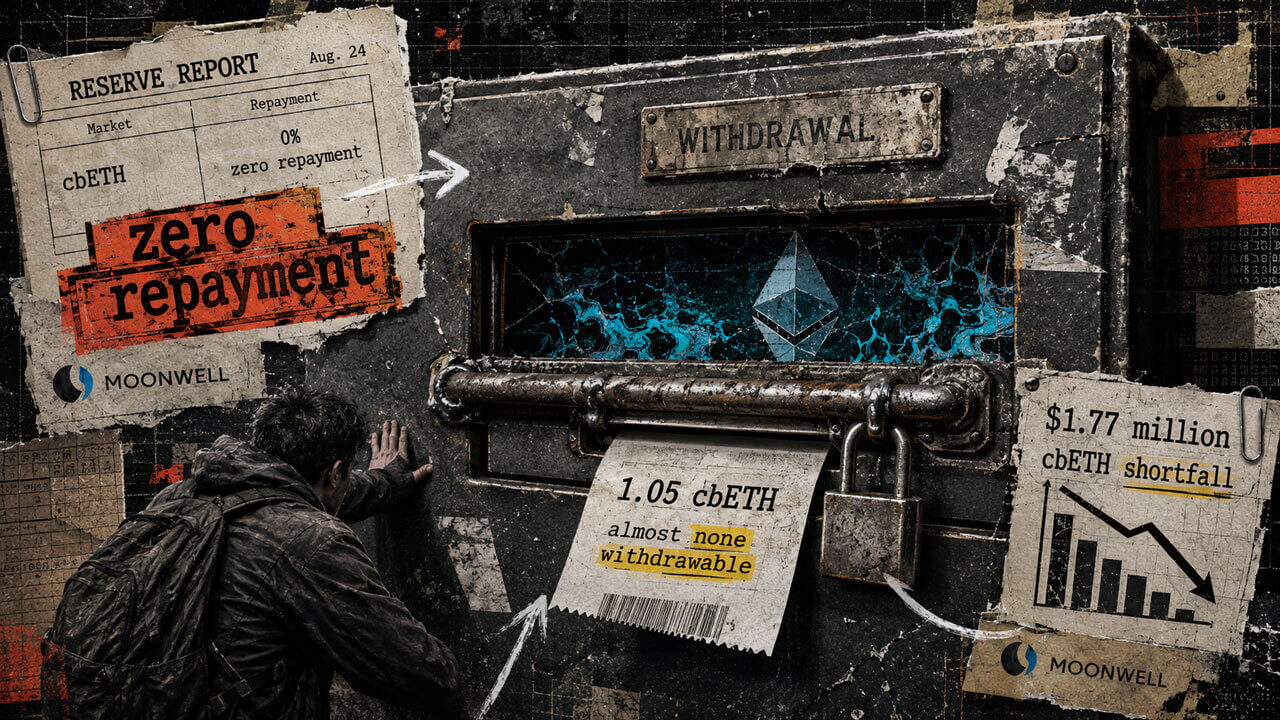
Morning Edition · Wednesday, August 26, 2026Published at 1:49 AM EDT · New York
Moonwell's cbETH market still shows negative liquidity six months after an oracle misconfiguration
Utilization above 100% means suppliers who were never liquidated cannot withdraw, and the protocol's latest recovery plan assigns nothing to closing the roughly $1.8 million gap.
Live contract data for the lending protocol Moonwell shows its market for Coinbase Wrapped Staked ETH (cbETH) on Base sitting at 100.43% utilization with negative available liquidity. In a pooled lending market, utilization above 100% means borrowers have taken out more than the pool holds, so suppliers who did nothing wrong and were never liquidated cannot withdraw their collateral.
The cause was not an exploit in the usual sense. Between February 14 and 18, a single misconfiguration in the oracle pricing formula valued cbETH at about $1.12 instead of roughly $2,200, and the liquidation engine did exactly what it was written to do, seizing collateral whose value it read as having collapsed. Roughly 1,096 cbETH left the market, leaving a shortfall of about $1.8 million and roughly 181 affected borrowers on Base. The risk manager, Anthias Labs, cut supply and borrow caps to near zero to stop new exposure.
Moonwell's governance response proposed about $2.68 million in compensation, paid roughly $310,000 immediately from its Apollo treasury and committed the remaining balance to future protocol revenue. That plan addressed the borrowers who were liquidated at the wrong price. It did not fund the hole itself, so the suppliers unable to withdraw from a market at more than full utilization have no published path to get their funds back. The latest proposal allocates nothing to that gap.
Base carries $5.51 billion in total value locked and $12.57 billion in total value secured as a layer-2 network, up 14.4% over seven days, so the sums involved are small against the chain. The precedent is not small. A trusted off-contract input failed, the code executed correctly, and six months later a portion of user deposits remains frozen while the protocol repays from revenue it has not yet earned.
What this means
Lending protocols price risk on the assumption that oracle inputs are correct, and an audit scoped to contract code cannot catch a wrong constant in a price feed configuration. Suppliers in the affected market bear the loss through frozen withdrawals rather than an explicit haircut, which delays recognition without removing it, and Moonwell's token holders bear the rest through revenue diverted to repayment. The two outcomes that matter are whether governance funds the gap from the treasury, which converts a user loss into a protocol loss, or leaves the market frozen until borrowers repay on their own.
Part of a tracked trend
Losses Move to Components That Worked as Designed
A growing share of DeFi losses will come not from buggy contract code but from components behaving exactly as specified — oracle forwarders, validator signature sets, governance votes and other trusted off-contract inputs — so audits and bug bounties scoped to on-chain code keep missing the failure surface, and protocols will be repeatedly forced to extend review, scope and monitoring to their privileged operational infrastructure.
Townsquare
Start a discussion in Townsquare.
More from this edition
- LayerZero puts matching, clearing and settlement on one chain, with Citadel Securities behind it
- Blockstream's Jade team details firmware hardening as Coldcard losses pass $115 million
- Miden pairs a private stablecoin with Circle's reserve system as Aztec works through a proving-system flaw
- Forty malicious Firefox add-ons harvested wallet keys, and nine of them started as sports-score tools
- Kraken says 12,000 tiny transfers from HTX-linked wallets triggered its sanctions screening and locked customers out
- Washington extends Iran sanctions to the digital-asset sector as a whole
- Japan's regulators, finance ministry and central bank open a study of instant blockchain settlement for stocks and government bonds
Comments
0No comments yet.