← The Polylog Crypto Intelligence Brief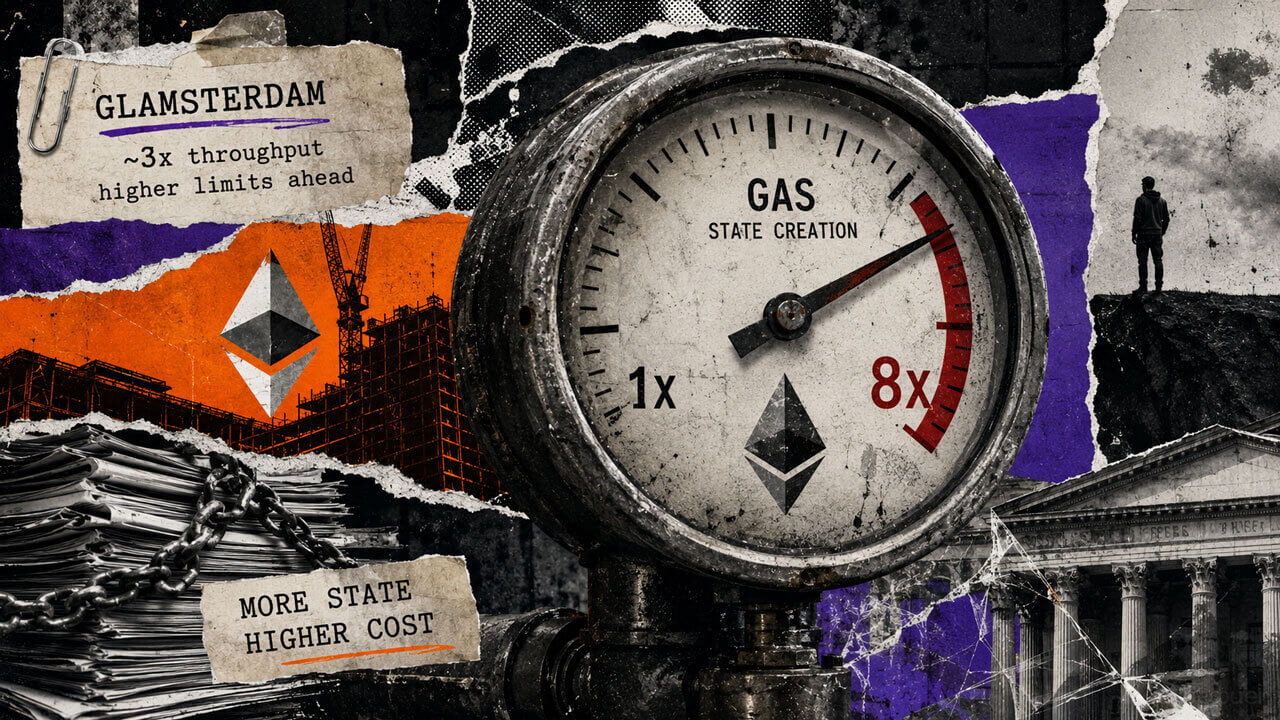
Morning Edition · Friday, August 28, 2026Published at 1:39 AM EDT · New York
Ethereum's Glamsterdam Gas Repricing Would Break Wallets, Indexers and a Subset of Live Contracts
Replay tests of historical mainnet transactions found that most contracts are unaffected, but a smaller group with hardcoded gas assumptions will need higher gas limits, code changes or migration before the block gas limit rises from 60 million toward 200 million.
Ethereum's core developers are preparing to reprice the cost of individual operations on the base layer, and their own testing shows the change will affect the software built on top of it. Two proposals scheduled for the Glamsterdam upgrade, Ethereum Improvement Proposals 8037 and 8038 (EIP-8037 and EIP-8038), adjust the gas schedule so the block gas limit can be raised safely from 60 million today toward roughly 200 million. The Ethereum Foundation replayed historical mainnet transactions under the new schedule to identify what would stop working.
The results split into two groups. Most contracts run unchanged. A smaller set depends on assumptions the new schedule alters, above all hardcoded gas values passed to internal calls. CryptoSlate reported that most of the failures found in the replay simply need a higher gas limit set at the transaction level, while a smaller group would need code changes or migration to a new deployment. Immutable contracts cannot be patched, so their operators face redeployment rather than a simple upgrade.
The larger operational burden falls outside the contracts themselves. The Foundation's protocol operations team said any tool that assumes a fixed maximum gas limit, including wallets, indexers and gas estimators, will need updating. That is infrastructure work spread across hundreds of teams, with no single deadline forcing it to happen.
The economic effect is the one that will show up in prices. Raising layer-1 capacity lowers the cost of transacting directly on Ethereum, which undercuts the same cost advantage that rollups have marketed against it. Layer-2 networks currently secure $44.44 billion in value according to L2Beat, led by Base at $12.61 billion and Arbitrum One at $11.62 billion, and their pitch rests on being cheaper than the chain they settle to. Meanwhile, the fee itself is increasingly hidden from users. CryptoSlate notes that paymasters and sponsors let stablecoin applications shield users from the gas bill, but the bill is still paid, settled in ether or in solana. Separate work on the research forum, including an evaluation of trustless transaction discovery, reaches a similar conclusion: the cost of running independent infrastructure, not raw throughput, is becoming the real measure of decentralization.
Veracity: Corroborated
Townsquare
Start a discussion in Townsquare.
More from this edition
- Moonwell Loses About $8.7 Million on Base After an Attacker Inflated the Price of Its Own Collateral Token
- Aztec Says a Flaw in Its Alpha V5 Proving System Could Let an Invalid Transaction Pass Verification
- Bitcoin's First Quantum-Safe Spend Was Mined Without Any Change to Consensus Rules
- A Race Condition Let a Ledger Device Sign a Transaction Different From the One on Its Screen
- Miden Will Issue a Private USD Coin-Backed Stablecoin Using Circle's Reserve Infrastructure
- Governance Capture and Token Accounting Bugs Drive the Week's Smaller On-Chain Losses
- KuCoin Will Screen Transfers That Merely Touched 17 Named Platforms, Including HTX
Comments
0No comments yet.