← The Polylog Crypto Intelligence Brief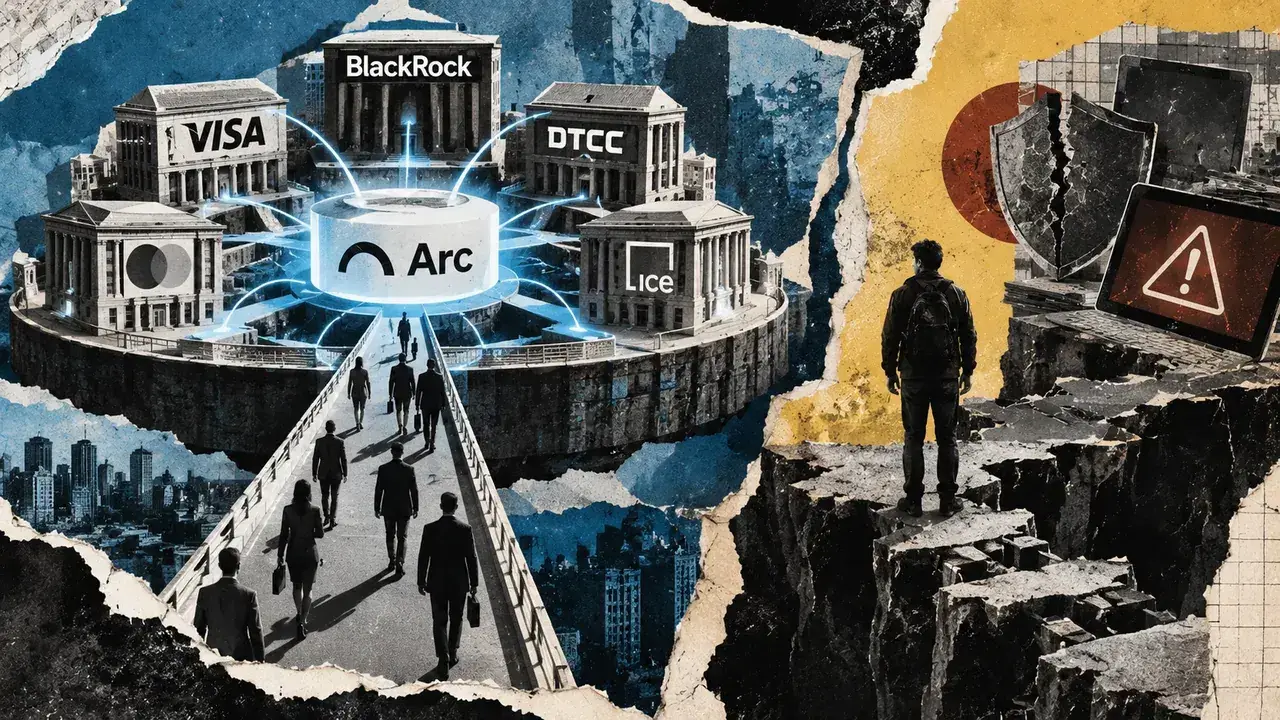
Morning Edition · Tuesday, September 15, 2026Published at 1:52 AM EDT · New York
Circle Opens a Public Blockchain on Wednesday With BlackRock, Visa and DTCC Running the Validators
Arc uses USDC as its gas token and settles in under half a second, but the institutional validator set guarantees ledger operation, not user losses.
Circle brings its Arc network to public mainnet on 16 September with a founding validator cohort drawn almost entirely from regulated finance. Circle's announcement lists BlackRock, the Depository Trust and Clearing Corporation (DTCC), Visa, Mastercard, Intercontinental Exchange, Standard Chartered, MoneyGram, SBI Group, Sumitomo, Galaxy and Global Payments alongside Circle itself. BlackRock plans to move its BUIDL money-market fund onto the chain, and DTCC has said it will begin tokenizing custodied assets there in 2027.
The design choices are deliberate. USDC is the native gas token, so every fee is denominated in dollars rather than a floating asset. The chain runs a Malachite consensus engine with finality below half a second and an Ethereum-compatible execution layer built on the Reth client. For treasurers who cannot hold a volatile asset just to pay for transactions, that removes a real accounting obstacle.
What the validator roster does not do is insure anyone. As CryptoSlate notes, these firms commit to operating the ledger honestly, not to covering losses in applications built on top of it. A user whose funds are drained by a faulty contract on Arc has no claim on BlackRock.
Set against the wider market, the scale is notable. USDC circulation stands at $74.37 billion against Tether's $183.36 billion, in a stablecoin market of $312.37 billion, while all of decentralized finance holds $88.39 billion in total value locked. Circle is building the settlement venue where its own liability is the unit of account and the validators are the incumbents it once competed against. That is a different proposition from a permissionless chain, and it is worth naming plainly rather than counting Arc as another decentralized network.
Veracity: Corroborated
87/100- If true, who benefits
Circle captures a settlement venue denominated in its own liability and a fee base it controls, and the eleven founding validators secure position in tokenized settlement before permissionless chains can take that volume.
Part of a tracked trend
Race to Bank and Distribute Stablecoin Reserves
Over 3-6 months, established financial and payments firms compete to custody stablecoin reserves and embed stablecoin rails into cross-border settlement, institutionalizing the plumbing beneath stablecoins.
Townsquare
Start a discussion in Townsquare.
More from this edition
- Senate Takes Up Crypto Market-Structure Bill Today With Banks and 17 State Attorneys General Opposed
- Aztec Discloses a Soundness Flaw That Let a Valid Proof Authorize an Invalid Transaction
- Solana Raises Its Transaction Size Limit to 4,096 Bytes on Mainnet
- Ethereum and Base Abandon a Shared Wallet Standard and Will Ship Two Formats
- US Prosecutors Seek $61 Million Tied to Iranian Oil Sales Laundered Through Binance
- A Dormant Governance Contract, a Reentrancy Bug and Four Chained Flaws: Three Exploits Documented
- Miden Says It Will Issue a Native Private Dollar Backed Through Circle's Reserve Programme
Comments
0No comments yet.