← The Polylog Crypto Intelligence Brief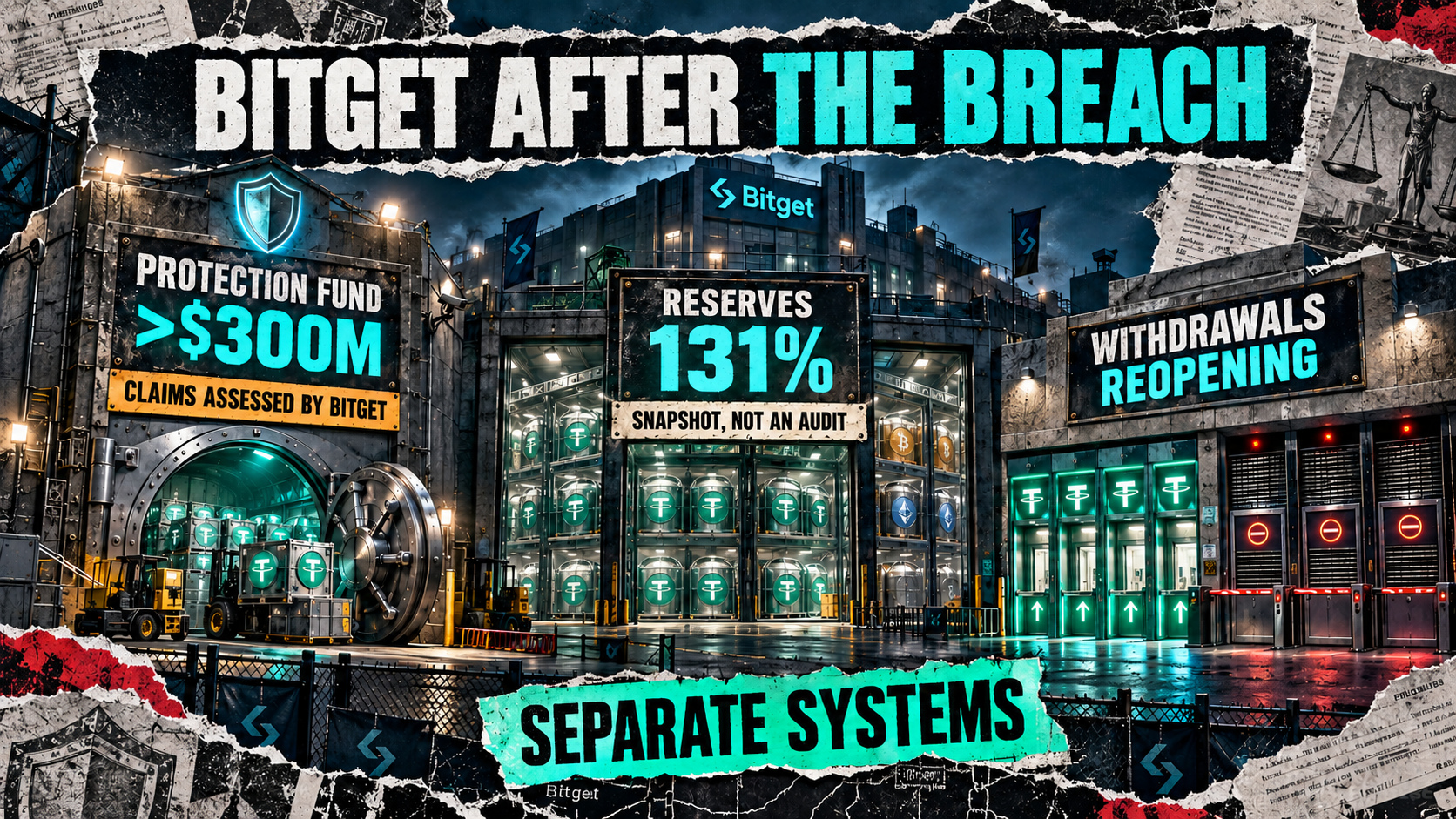
Morning Edition · Friday, October 2, 2026Published at 2:09 AM EDT · New York
Bitget Refills $300 Million Protection Fund After $387.5 Million Breach as September Sets 2026's Worst Loss Total
Two incidents, Bitget and the Liquid Network, accounted for roughly 92 percent of the month's $768 million in reported losses, and neither started with a smart-contract bug.
Bitget has restored its $300 million protection fund after absorbing the $387.5 million loss it suffered in late September, and is reopening withdrawals in phases. The exchange says the fund sits separate from customer reserves, and that claims remain subject to its own assessment.
The attack did not begin on-chain. Researchers describe a zero-day exploit against two third-party security appliances in Bitget's own infrastructure, where the intruder obtained privileged access, installed a web shell and opened a command-and-control channel before draining hot and warm wallets across seven networks in a window of about three hours. Earliest malicious activity has been dated to 31 August. Bitget chief executive Gracy Chen has said cold wallets and private keys were never compromised. CoinDesk reported that roughly $83 million of stolen XRP was moved into a form Ripple cannot freeze.
September's aggregate numbers follow from that single event plus one more. French-language crypto channel Goku Crypto News put the month at about $768 million lost across 30 days, with two attacks above 90 percent of the damage. Security firms differ at the margin, with CertiK counting 97 incidents and about $768.4 million and PeckShield counting 55 incidents and $766.5 million. The second large loss was the Liquid Network, a Bitcoin sidechain, at roughly $320 million, of which more than $270 million was later returned. Rekt News has logged both Bitget and Liquid Network among its incident write-ups.
For the year, CryptoSlate reports nearly $2.7 billion in losses across 658 incidents through September on CertiK's count, with about $420.4 million frozen or returned and North Korea-linked thefts above $1 billion.
Veracity: Corroborated
84/100- If true, who benefits
Part of a tracked trend
Losses Move to Components That Worked as Designed
A growing share of DeFi losses will come not from buggy contract code but from components behaving exactly as specified — oracle forwarders, validator signature sets, governance votes and other trusted off-contract inputs — so audits and bug bounties scoped to on-chain code keep missing the failure surface, and protocols will be repeatedly forced to extend review, scope and monitoring to their privileged operational infrastructure.
Townsquare
Start a discussion in Townsquare.
More from this edition
- Aztec Discloses Critical Soundness Flaw in Alpha V5 Proving System and Tells Teams to Halt Deployments
- NEAR Intents Says It Has Identified Its Attacker and Gives 48 Hours to Return $3.8 Million
- Ethereum Foundation and Open Anonymity Project Ship zkAPI, Letting Users Pay for Metered Services Without an Identity
- SEC Proposes Crypto Custody Framework Allowing Advisers to Self-Custody Client Assets in Limited Cases
- US Treasury Sanctions A7 Network, Saying Its Sub-Agents Moved More Than $17 Billion for Russia and Iran
- IMF Releases $139 Million to El Salvador After Waiving Its Breach of the Bitcoin Accumulation Limit
- Fiserv Puts a State Bank's Dollar Token on Solana, Opening Stablecoin Issuance to Its Bank Clients
Comments
0No comments yet.