← The Polylog Crypto Intelligence Brief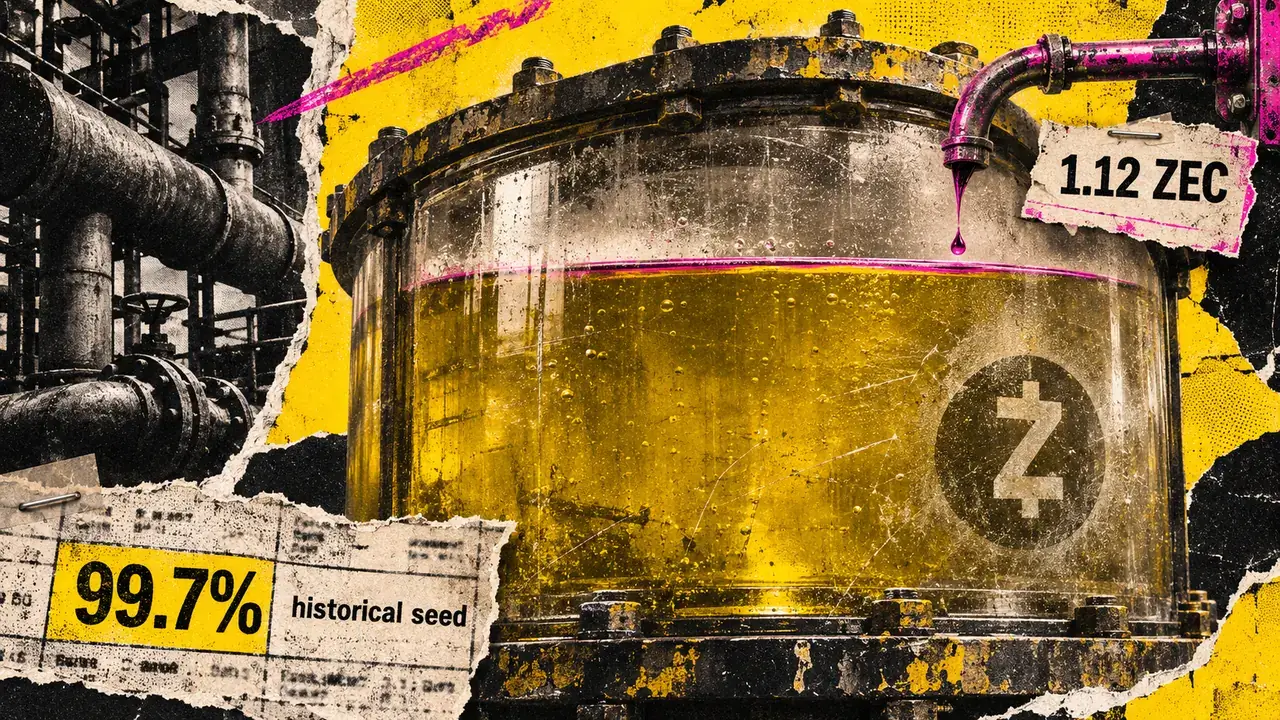
Morning Edition · Sunday, November 8, 2026Published at 12:54 AM EST · New York
Zcash activates NU7, cutting target block time to 25 seconds and sending most fees to a reserve
The upgrade retires the 2016 Sprout privacy pool, and a November 7 snapshot shows that fees have added only 1.12 ZEC to the new reserve, which is 99.7% inherited balance.
Zcash's seventh network upgrade, NU7, went live on mainnet on November 6 at block 3,543,405, the height ZecHub had listed for activation. It is the largest change to the privacy chain's base layer in years. The upgrade cuts the target time between blocks from 75 seconds to 25 seconds under a draft Zcash Improvement Proposal (ZIP), ZIP 218, according to crypto.news. Shielded payments therefore reach their first confirmation about three times faster.
Faster blocks would normally speed up issuance. To keep the coin's supply schedule unchanged, NU7 lowers the reward paid per block and lengthens the halving interval, measured in blocks. Coinholders had voted to keep the halvings rather than replace them with a smoothed issuance curve.
NU7 also disables version 4 transactions. That retires Sprout, the original shielded pool from 2016, and anyone still holding coins there had to move them before activation. A Zcash Foundation estimate cited by crypto.news put the pool at less than 23,000 ZEC.
The most debated change is the Network Sustainability Mechanism. Under ZIP 235, at least 60% of each transaction fee goes into a reserve instead of directly to miners, and miners keep the remaining 40%. Coinholders voted to wait until February 2031 before any reserve ZEC flows back into block rewards.
A mainnet snapshot taken on November 7 and analyzed by CryptoSlate shows the scale of the problem. A historical seed balance carried in at activation makes up 99.7% of the reserve. Fees collected under the NU7 rules have added 1.12 ZEC. On current transaction volume, fee income is too small to fund the network's security, which still depends almost entirely on new issuance.
What this means
NU7 changes two things. Exchanges and payment apps now get faster shielded confirmations, and that speed is the channel through which demand for privacy could translate into ZEC usage. The fee reserve, by contrast, barely affects supply today. Miners are still paid almost entirely from issuance, so Zcash faces the same long-run security-budget question as Bitcoin, now with a block time three times faster, which makes discarded blocks more likely. Most coverage treats the reserve as a mechanism that permanently removes coins from circulation, and that reading overstates its effect. Ethereum's fee burn, introduced in August 2021 under EIP-1559, is the closest precedent. That burn reduced net supply only when on-chain demand was high, and had little effect when activity fell. The desk's read is that the reserve will keep growing slowly for months and that ZEC's supply will continue to follow the issuance schedule. That would change only if shielded transaction volume rises far above today's level. Two things would prove this wrong: later snapshots showing fee additions growing fast enough to rival the block subsidy, or a sustained rise in discarded blocks that pushes small miners out and concentrates hashrate.
Part of a tracked trend
Privacy Chains Pivot From Niche to Institutional Pitch
Over 3-6 months, confidential execution reframes as a prerequisite for serious/institutional on-chain use, with privacy L2s shipping live networks and contesting who controls confidentiality.
Townsquare
Start a discussion in Townsquare.
More from this edition
- Treasury moves to cut MEXC off from US banks, citing at least $16 billion in illicit flows
- Hackers moved $2.5 billion out of a Binance hot wallet in one transaction after a $15 authorization
- Gnosis Pay breach exposed card numbers, home addresses and linked crypto wallet addresses
- Nethermind researchers measure how much unpaid validation work Ethereum's frame transactions can safely allow
- Bank of Russia opens bitcoin, ether and Tether to retail investors from November 17, with a 300,000-ruble annual cap
- Miden launches a private self-custody wallet and a "PriFi" stack as Aztec ships an anonymous message board
- Security roundup: Initia's token mints traced to a reported MoveVM cache flaw, and a Paris court jails a developer over a 1 billion token mint
Comments
1Nov 8, 5:54 AM · edited
Blocks now arrive three times as often, so keeping the issuance schedule unchanged means cutting the reward per block to one third and tripling the number of blocks between halvings.