← The Polylog Crypto Intelligence Brief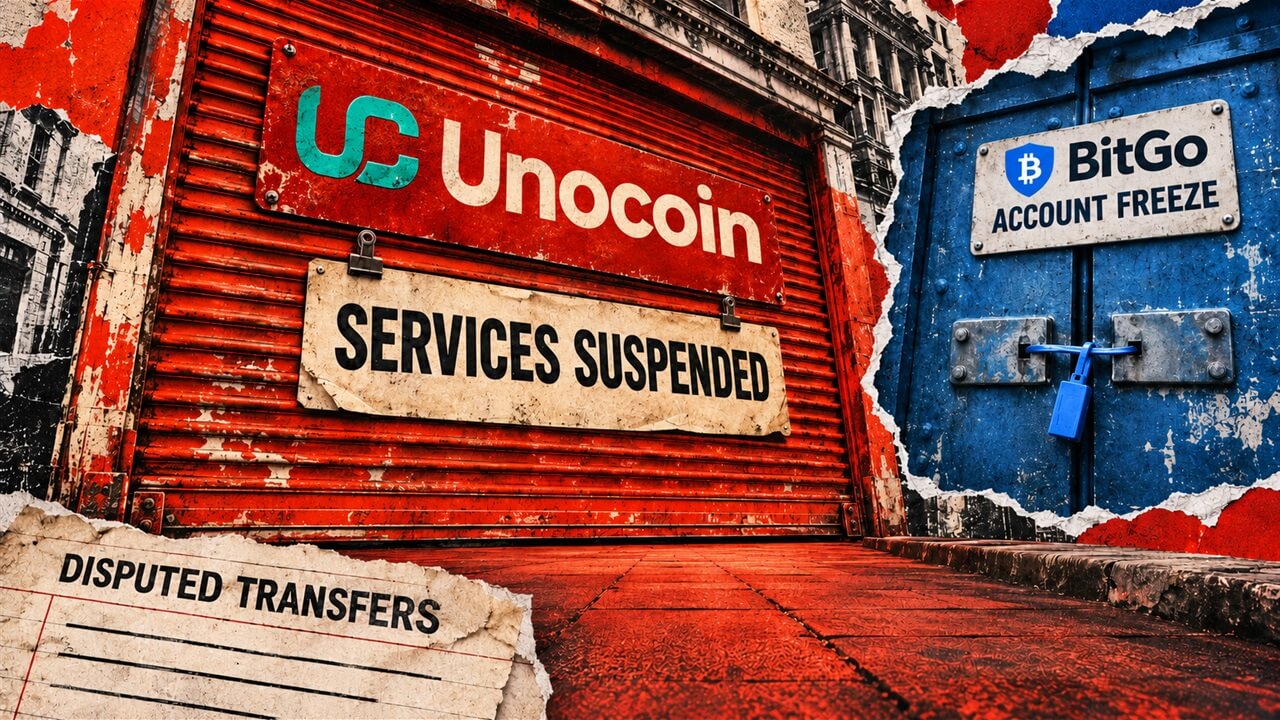
Morning Edition · Saturday, November 14, 2026Published at 12:48 AM EST · New York
Unocoin Halts All Services After Transfers Signed With Its Own Keys Went Around a BitGo Freeze
BitGo says its key was never used, so its freeze on Unocoin's account could not stop transfers signed with the two keys Unocoin held in a two-of-three multisignature wallet.
Unocoin, one of India's oldest bitcoin exchanges, has shut down every service, including customer logins, while it investigates outgoing transfers from wallets it ran on BitGo's custody platform. Unocoin's position, as CryptoSlate reports it, is that someone signed and broadcast the disputed transfers outside BitGo while BitGo's freeze on its enterprise account stayed in force. Unocoin says it suspects misuse of a backup mechanism.
The timeline comes from the companies' own statements. Unocoin detected unauthorized activity on November 6, the same day BitGo froze the enterprise account. More unauthorized actions on November 9 led Unocoin to suspend all services. On November 12 it flagged outgoing Ethereum transactions from its BitGo wallets. Reports disagree on whether the full halt began on November 9 or later.
The attack exploited a feature of the wallet's design. BitGo wallets use three keys: one held by the customer, a backup key, and one held by BitGo. Any two can sign. Normal transactions pair the customer key with BitGo's key, and the backup key exists for recovery. BitGo says the transactions were authorized with Unocoin's user and backup keys and that "BitGo's key was never used." Those two keys can move funds without BitGo, so a freeze that works through BitGo's co-signing never reached them. The root cause is therefore a compromise of key material in Unocoin's hands, or of the systems that held it. BitGo's signing logic was not the failure point. Unocoin says it has not yet established how the account was accessed or who authorized the transfers.
Unocoin has not confirmed a loss figure, and no one has claimed recovery or attribution. The exchange says it keeps more than 90% of customer assets in cold storage and plans to rebuild its systems entirely, which it estimated would take four to five working days.
Each company's account of the breach protects that company. BitGo's statement places the failure in the customer's key custody. Unocoin's wording, "misuse of a backup mechanism," points at the custody arrangement itself. Both statements can be true together. Unocoin is the second large exchange breach this month. Mercado Bitcoin, Brazil's largest exchange, said attackers took about $38 million from hot wallets on November 2, an incident Rekt News has written up. India has a recent precedent as well: WazirX lost about $230 million in July 2024 from a multisignature wallet it operated with an outside custody provider.
Part of a tracked trend
Losses Move to Components That Worked as Designed
A growing share of DeFi losses will come not from buggy contract code but from components behaving exactly as specified — oracle forwarders, validator signature sets, governance votes and other trusted off-contract inputs — so audits and bug bounties scoped to on-chain code keep missing the failure surface, and protocols will be repeatedly forced to extend review, scope and monitoring to their privileged operational infrastructure.
Townsquare
Start a discussion in Townsquare.
More from this edition
- U.S. Prosecutors Win Authority to Seize $1.2 Billion From the Binance Theft and Take Down a North Korean Deepfake Operation
- Solana Foundation and Nito Release a Toolkit That Verifies Private AI Hardware on Solana
- Miden Bundles a Private Stablecoin, a Wallet and Partners Into a "PriFi" Stack as Aztec Ships an Anonymous Message Board
- Initia Halts Its Chain After a Stolen Cloud Key Lets an Attacker Forge Rollup Withdrawals Worth $3.27 Million
- A 2011 Bitcoin Wallet Named in a $260 Billion Ownership Lawsuit Moves 75 BTC
- XRP's Drop Below $1 Triggers 883 Liquidations of Coinbase-Wrapped XRP Loans on Base
- Bitcoin Falls to About $67,000 as the Dollar Strengthens
Comments
1Nov 14, 5:48 AM
With BitGo's key unused, the only control left on those wallets was how Unocoin stored its own user and backup keys, so the investigation should turn on who could reach both.