← The Global Intelligence Brief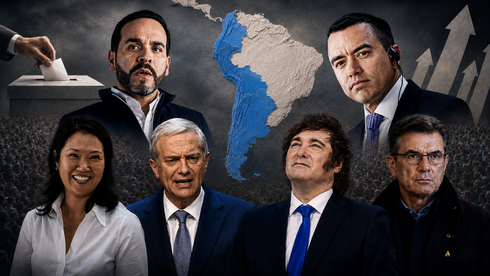

 2 sources
Morning Edition · Saturday, July 4, 2026Published at 6:15 AM EDT · New York
A Rightward Turn Sweeps South America's Politics
A series of elections has shifted power toward the right across the continent, a change investors are watching for its effect on spending, currencies and commodity policy.
After years in which left-leaning leaders governed most of the region's major economies, a series of recent elections has moved South America to the right, the Israeli outlet Ynet reported. Its survey pointed to Javier Milei in Argentina, Daniel Noboa in Ecuador and José Antonio Kast in Chile, alongside a change of government in Bolivia and narrow results in Colombia and Peru. Ynet attributed the trend to public fear of crime, economic crises, fatigue with the incumbent left and the appeal of a strong security-focused governing style.
The shift is uneven and, in several countries, decided by thin margins, which argues for caution before treating it as a settled realignment. Where it has become established, it tends to bring promises of spending discipline, deregulation and openness to foreign investment, the agenda Milei has pursued most aggressively in Argentina. Those policies bear directly on the region's role as a supplier of energy, metals and agricultural goods.
For investors, the direction matters more than any single vote. A continent moving toward market-friendly governments changes the outlook for currencies that have struggled with inflation, for state control of resource industries, and for the balance of influence among the United States, China and local powers across Latin America.
Veracity: Corroborated
85/100- If true, who benefits
Foreign investors and commodity buyers who gain from deregulation and openness, and a market-friendly framing that reads narrow wins as a durable realignment.
- The nuance
The turn is real but uneven and decided by thin margins in several countries, with major economies like Brazil and Colombia still unsettled, so calling it a continental sweep overstates a trend still in progress.
An open-source-intelligence read of how likely this story is true with its real nuance, not a judgment of any outlet. It assesses the claim, weighing independent and adversarial reporting. How we label confidence.
What this means
South America supplies a large share of the world's copper, lithium, oil and food, so the ideological direction of its governments shapes commodity supply and investment terms. A durable rightward turn would generally favor foreign investment and tighter budgets, but the narrow margins in several countries mean the shift could reverse. Markets will judge each new government by whether it can control inflation and honor its openness to capital.
What to watch
Synthesized from: Ynet · The New York Times
Townsquare
Start a discussion in Townsquare.
More from this edition
- Weak US Jobs Report Cools Rate-Hike Bets and Lifts Gold Off Its Lows
- Ukraine Strikes Oil Terminals Near St Petersburg in Deepening Energy Campaign
- Bitcoin Recovers Toward $62,000 as Rate-Hike Fears Ease
- Europe's Top Court Makes Google's 4.1-Billion-Euro Android Fine Final
- Hundreds of Thousands Mourn Iran's Khamenei Amid Questions Over Succession
- Saudi-Led Coalition Threatens Force as Houthis Block Its Warplanes
- The Fight Over Chinese 'Overproduction' Divides a Rebalancing World Economy
- Germany's Far-Right AfD Meets Behind Mass Protests
Comments
0No comments yet.