← The Global Intelligence Brief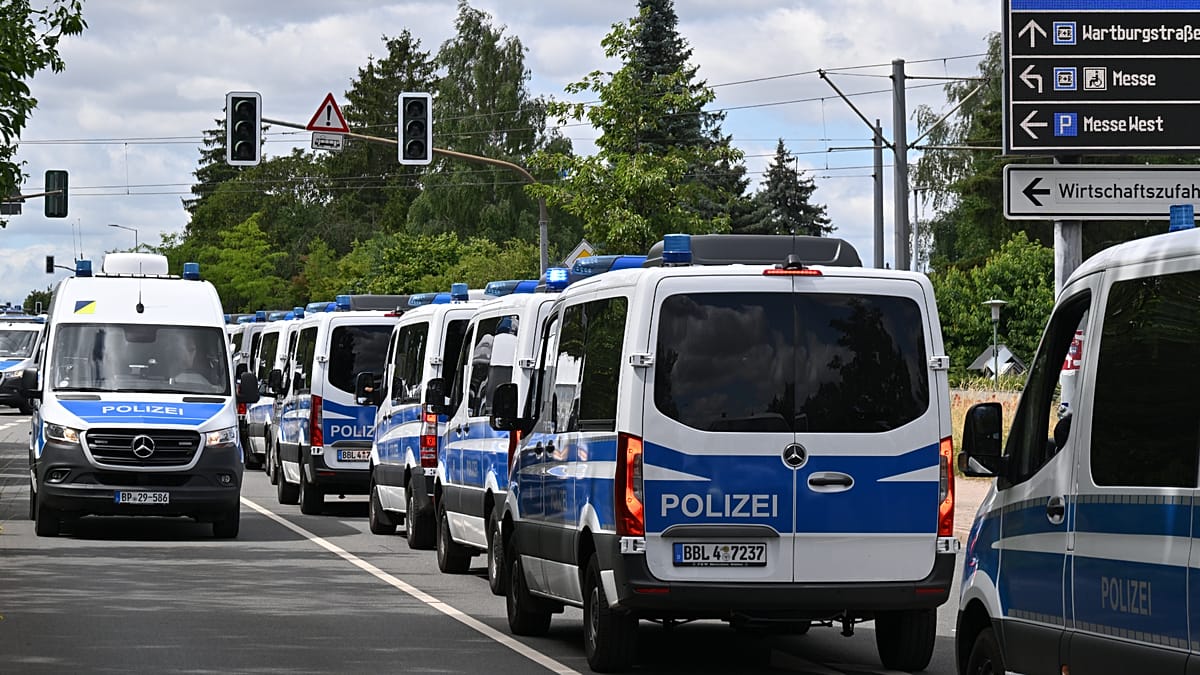

 2 sources
Morning Edition · Saturday, July 4, 2026Published at 6:15 AM EDT · New York
Germany's Far-Right AfD Meets Behind Mass Protests
Tens of thousands demonstrated against a party conference in Erfurt as the anti-immigration party consolidates its position in German politics.
The Alternative for Germany (AfD), the country's main far-right party, opened a conference in Erfurt as large crowds protested outside. Euronews reported that around 20,000 people demonstrated. Police in Thuringia called the protest legitimate while reporting that an AfD constituency office and officers were attacked with paint and fireworks. Deutsche Welle reported that thousands marched and blocked roads across the city as the party gathered.
The confrontation reflects the tension in German politics, where the AfD has built durable support on opposition to immigration and to the established parties, while much of the public and the political mainstream mobilizes against it. The events in Erfurt are a local instance of a pattern visible across Europe, as parties on the nationalist right gain support and provoke organized resistance.
The political direction carries economic weight. A stronger nationalist right pushes European governments toward tighter migration rules and more skeptical positions on the European Union, energy policy and trade, all of which affect labor supply, public spending and the bloc's cohesion. Germany, as the region's largest economy, is where those pressures carry the most consequence.
Veracity: Corroborated
84/100- If true, who benefits
Both the AfD, which casts itself as a besieged movement, and the mainstream opponents mobilizing to isolate it ahead of eastern state elections.
- The nuance
Crowd figures diverge sharply, with the cited roughly 20,000 sitting between police estimates near 15,000 and organizer expectations above 50,000, and who instigated the paint-and-firework clashes is disputed.
An open-source-intelligence read of how likely this story is true with its real nuance, not a judgment of any outlet. It assesses the claim, weighing independent and adversarial reporting. How we label confidence.
What this means
The rise of the nationalist right in Germany and across Europe changes the terms of debate on immigration, the European Union and economic policy well before such parties enter government. Tighter migration limits affect the labor force that European industry depends on, and greater euro-skepticism complicates joint fiscal and energy decisions. Political fragmentation raises the difficulty of coordinated policy in the region's largest economy.
What to watch
Synthesized from: Euronews · Deutsche Welle
Townsquare
Start a discussion in Townsquare.
More from this edition
- Weak US Jobs Report Cools Rate-Hike Bets and Lifts Gold Off Its Lows
- Ukraine Strikes Oil Terminals Near St Petersburg in Deepening Energy Campaign
- Bitcoin Recovers Toward $62,000 as Rate-Hike Fears Ease
- Europe's Top Court Makes Google's 4.1-Billion-Euro Android Fine Final
- Hundreds of Thousands Mourn Iran's Khamenei Amid Questions Over Succession
- Saudi-Led Coalition Threatens Force as Houthis Block Its Warplanes
- A Rightward Turn Sweeps South America's Politics
- The Fight Over Chinese 'Overproduction' Divides a Rebalancing World Economy
Comments
0No comments yet.