← The Global Intelligence Brief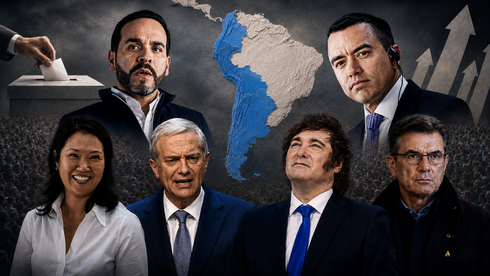
 1 source
Morning Edition · Saturday, July 4, 2026Published at 6:29 AM EDT · New York
South America's Political Map Turns Rightward
A series of elections has brought market-friendly and hard-line conservative leaders to power across the continent, driven by crime, economic crisis and fatigue with the left.
After years in which leftist leaders governed most of South America's major economies, recent elections have marked a decisive shift to the right. The Israeli outlet Ynet described a continental turn across the continent, from Argentina's Javier Milei to Ecuador's Daniel Noboa and Chile's José Antonio Kast, alongside a change of government in Bolivia and narrow conservative gains in Colombia and Peru.
The report attributes the trend to a common set of pressures, fear of crime, economic crises, exhaustion with left-wing governments, and the appeal of a "strong hand" model of leadership promising order. It is a single-source account from one outlet, so specific outcomes should be read as its framing, but the broad direction it describes matches a visible regional pattern.
For markets, the composition matters as much as the direction. Leaders such as Milei have pursued aggressive fiscal tightening, deregulation and currency reform, an agenda that appeals to foreign investors even as it imposes sharp near-term costs on households. Whether the rightward shift translates into durable pro-market policy or only into harder security postures will vary country by country.
Veracity: Corroborated
78/100- If true, who benefits
Foreign investors and market-friendly governments who benefit from framing the region as turning toward deregulation and fiscal tightening.
- The nuance
The broad rightward trend is well documented across Bloomberg, Foreign Affairs, and others, but the single Ynet source overstates specifics, and Bolivia's Rodrigo Paz is more accurately a centrist reformer than a hard-line conservative.
An open-source-intelligence read of how likely this story is true with its real nuance, not a judgment of any outlet. It assesses the claim, weighing independent and adversarial reporting. How we label confidence.
What this means
South America is a major supplier of oil, copper, lithium, soy and other commodities, so its politics feed directly into global supply and investment flows. A cluster of market-friendly governments could attract capital through deregulation and fiscal discipline, while a turn toward hard-line security-first rule could bring instability of its own. The region is also central to the US-China contest for influence in the Western Hemisphere, which makes its political direction strategically consequential.
What to watch
Source: Ynet (Hebrew)
Townsquare
Start a discussion in Townsquare.
More from this edition
- Ukraine Strikes a Major St. Petersburg Oil Terminal, Widening the Economic War on Russia's Fuel Revenue
- Iran Buries Khamenei as Succession Divisions Break Into the Open
- Russia Claims Capture of Kostiantynivka, a Gateway to Ukraine's Donbas Strongholds
- India's Small-Cap Rally Intensifies as Retail Money Chases Triple-Digit Returns
- Europe's Top Court Makes Google's 4.1 Billion Euro Android Fine Final
- India Courts the Chinese Market Even as the West Talks of Decoupling
- Saudi-Led Coalition Threatens Force as Houthis Reopen Yemen's Skies to Iran
- Tens of Thousands Protest as Germany's AfD Opens Party Conference
Comments
0No comments yet.