← The Global Intelligence Brief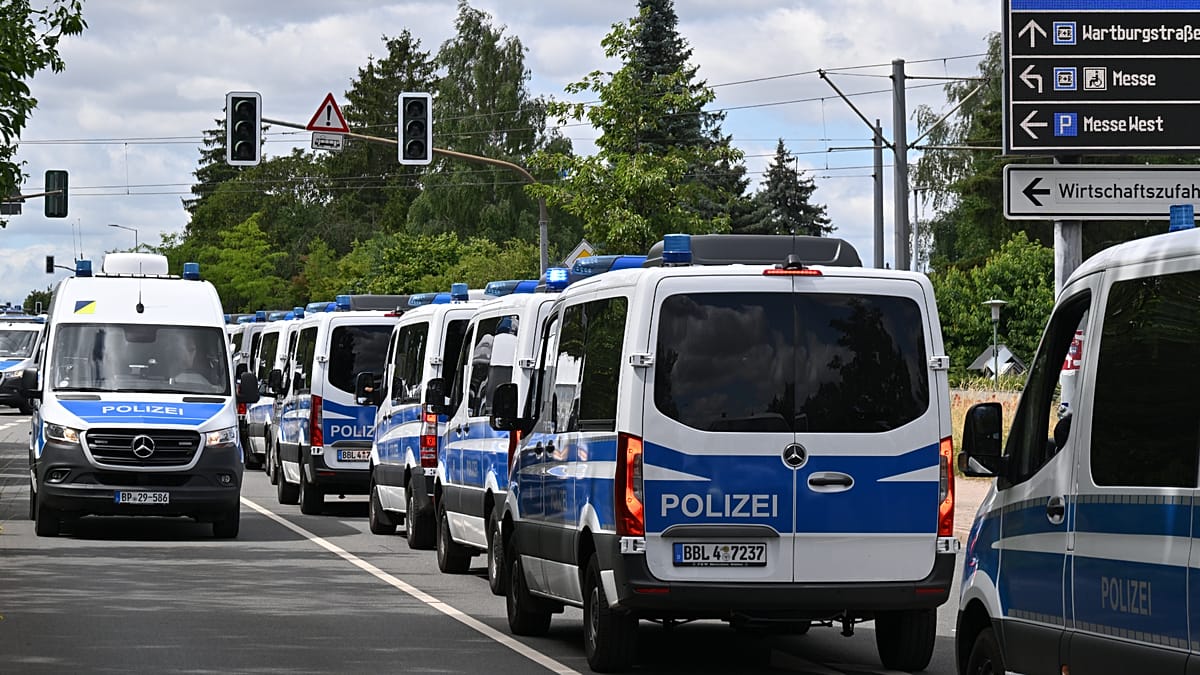

 2 sources
Morning Edition · Saturday, July 4, 2026UpdatedPublished at 5:01 PM EDT · New York
Tens of Thousands Protest as Germany's AfD Opens Party Conference
Roughly 20,000 demonstrators marched in Erfurt against the far-right party, in confrontations that police called largely legitimate but marked by some violence.
Updated at 5:01 PM EDT
The AfD reelected its leadership and a Thuringian court cleared the congress to proceed, developments that came after this morning's report of the protests.
As Germany's Alternative for Germany (AfD) party opened its conference, large protests took place in the streets around the venue. Euronews reported that around 20,000 people demonstrated in the state of Thuringia, and that police described the protest as legitimate while reporting that an AfD constituency office and officers had been targeted with paint bombs and fireworks.
Deutsche Welle reported that the gathering took place in Erfurt as thousands marched and blocked roads across the city, with a separate major fire straining emergency services in Stuttgart. The demonstrations did not stop the conference from proceeding. A court in Thuringia had overturned an attempt to prevent the congress from taking place, and inside the venue delegates reelected the party's leadership, extending the current leaders' terms, according to Al Jazeera. The two accounts, one pan-European and one German public broadcaster, largely agree on the scale of the protests and the mix of peaceful demonstration and isolated confrontations.
The events reflect the tension at the center of German politics. The AfD has grown into one of the country's strongest parties while facing sustained street opposition and official scrutiny, a divide that shapes the stability of Europe's largest economy at a moment when it is already contending with industrial weakness and questions about its energy and defense spending.
What this means
Political fragmentation in Germany matters for markets because the country anchors the euro area and its industrial base. A stronger nationalist right complicates coalition-building and injects uncertainty into decisions on energy policy, migration, defense spending and Europe's stance toward Russia and China. Persistent polarization raises the political risk premium on the bloc's largest economy at a time when it can least afford instability.
What to watch
- The AfD's standing in coming state and federal polling, which shapes how governable Germany remains.
- Whether mainstream parties can form stable coalitions that exclude the AfD, the key variable for policy continuity.
Observations to monitor, not financial advice.
Synthesized from: Euronews · Deutsche Welle
Townsquare
Start a discussion in Townsquare.
More from this edition
- Ukraine Strikes a Major St. Petersburg Oil Terminal, Widening the Economic War on Russia's Fuel Revenue
- Iran Buries Khamenei as Succession Divisions Break Into the Open
- Russia Claims Capture of Kostiantynivka, a Gateway to Ukraine's Donbas Strongholds
- India's Small-Cap Rally Intensifies as Retail Money Chases Triple-Digit Returns
- Europe's Top Court Makes Google's 4.1 Billion Euro Android Fine Final
- India Courts the Chinese Market Even as the West Talks of Decoupling
- South America's Political Map Turns Rightward
- Saudi-Led Coalition Threatens Force as Houthis Reopen Yemen's Skies to Iran
Comments
0No comments yet.