← The Global Intelligence Brief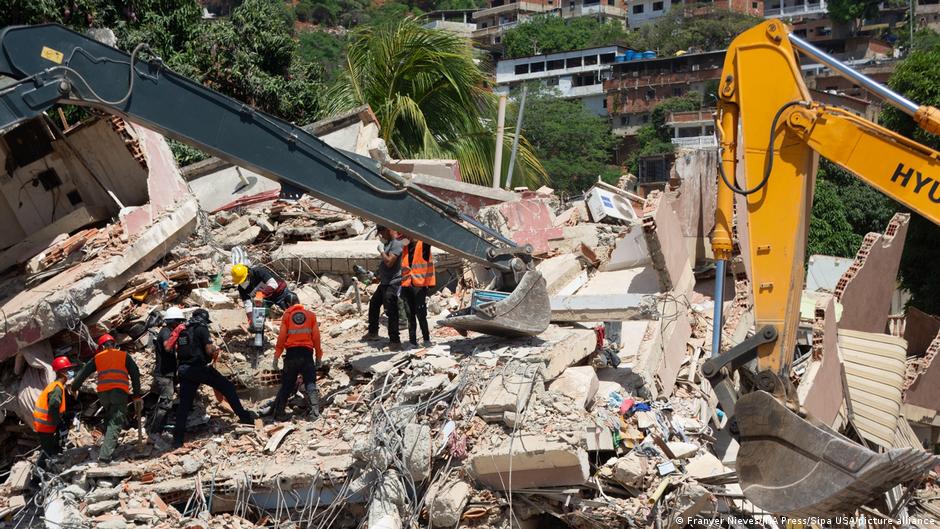

 2 sources
Morning Edition · Tuesday, August 4, 2026Published at 1:17 AM EDT · New York
Venezuela's earthquake death toll passes 6,000 as the first repatriation flight from the United States lands
The June 24 quakes of magnitude 7.2 and 7.5 destroyed most buildings in La Guaira, while oil production and refining were largely undamaged.
Deutsche Welle reports that the confirmed death toll from Venezuela's twin earthquakes has crossed 6,000, weeks after the magnitude 7.2 and 7.5 events struck within about thirty seconds of one another on 24 June. More than 16,000 people were injured, and tens of thousands remain unaccounted for. In the coastal state of La Guaira, about 80 percent of buildings collapsed. The first official count in the days after the quakes was 188 dead, an indication of how slowly information moved out of the affected areas.
RIA Novosti reported that Venezuela has received its first repatriation flight from the United States since the earthquakes, resuming deportation flights that had been suspended during the emergency.
The country's oil sector sustained far less damage than its cities. S&P Global reported that production and refining were essentially unharmed, with minimal damage in the Orinoco Belt, where most of the roughly 1.2 million barrels a day of output originates. That divergence defines the economic problem. The revenue base survived while the housing stock, ports and workforce around Caracas and the coast did not, leaving reconstruction dependent on a state whose fiscal capacity was already limited before the quakes.
Part of a tracked trend
Disasters as Political and Supply Shocks
Major natural disasters in commodity-producing states translate into political instability and supply disruptions that markets increasingly have to price, recurring as climate and geological shocks hit fragile economies.
Veracity: Corroborated
84/100- If true, who benefits
Caracas gains from a documented toll that strengthens appeals for aid and sanctions relief, Washington gains from the resumption of deportation flights, and oil counterparties gain from confirmation that roughly 1.2 million barrels a day of output was unaffected.
- The nuance
Independent tallies support a figure above 6,000 dead, but the count comes from a government that controls access to the affected areas, United States Geological Survey modeling pointed to a materially higher number, and the missing total remains an estimate rather than a register, while the first flight returned 147 people to a country where an earlier deportation group died in a collapsed hotel.
An open-source-intelligence read of how likely this story is true with its real nuance, not a judgment of any outlet. It assesses the claim, weighing independent and adversarial reporting. How we label confidence.
What this means
A disaster that spares the export sector but destroys the domestic capital stock leaves a country with foreign-currency income and no ability to rebuild at the scale required. Venezuela's oil revenue continues, so counterparties and traders are unaffected, while the reconstruction burden falls on the state budget, remittances and whatever aid arrives. The resumption of deportation flights adds returning population to cities that lost most of their housing, which raises the political stakes for the government inside Venezuela and the migration pressure on neighbors if reconstruction stalls.
Synthesized from: Deutsche Welle · RIA Novosti
Townsquare
Start a discussion in Townsquare.
More from this edition
- Washington joins Tokyo in buying yen, pulling the currency back from a four-decade low
- Brent settles below $80 as Bessent says a Strait of Hormuz deal could come within a day, and United States stocks set records
- Google's guarantees underwrite Anthropic's data-center buildout as artificial-intelligence capacity shifts onto borrowed money
- Russian officials report five killed by a drone near Moscow and seven at a Black Sea beach
- Russia assembles a shadow tanker fleet for liquefied natural gas before the European Union ban takes effect
- France takes reactors offline in the heat as Greek wildfires kill five and Washington State fires displace 64,000
- Long-dormant bitcoin wallets keep moving after a hardware wallet flaw drained about $89 million
Comments
0No comments yet.