← The Global Intelligence Brief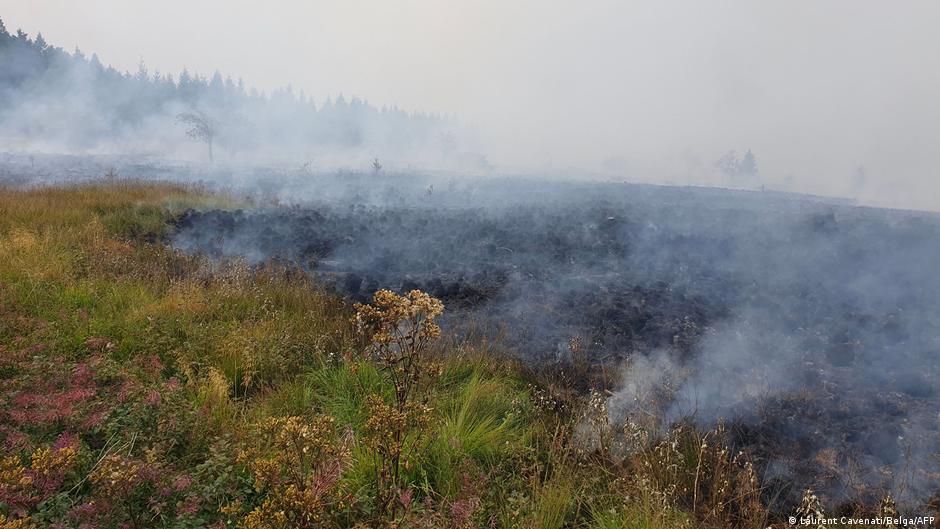


 3 sources
Morning Edition · Sunday, August 16, 2026UpdatedPublished at 7:48 AM EDT · New York
Belgium Fights Its Largest Recorded Wildfire as European Companies Tally Heat Costs
Around 3,000 hectares have burned in the High Fens reserve and the fire remains uncontained, while European earnings calls increasingly cited heat, drought and fire as cost factors this summer.
Updated at 7:48 AM EDT
The fire has grown from about 2,700 to roughly 3,000 hectares and remains uncontained; the European Union has sent firefighting aircraft from three countries.
Firefighters in Belgium are working to contain what Deutsche Welle reports is the largest wildfire on record in the country. The blaze in the High Fens nature reserve near the German border has grown to roughly 3,000 hectares, up from about 2,700 hectares on Saturday, and remained uncontained as of Sunday morning, according to US News. More than 250 firefighters are working the blaze, hundreds of residents have evacuated, and the European Union has sent firefighting aircraft from the Czech Republic, Sweden and the Netherlands. The fire is now nearly double the size of the country's previous record, a roughly 1,400-hectare blaze in 2011.
The fire arrives as European businesses quantify what a hotter summer costs them. The Financial Times reports that companies cited the effects of extreme heat, drought and wildfires on a record share of earnings calls in recent weeks, with both costs and gains: utilities and cooling equipment makers benefit while agriculture, construction, transport and tourism absorb losses.
The pattern is not confined to Europe. In Hong Kong, the South China Morning Post reports that a very hot weather warning has remained in force with maximum temperatures reaching 35 degrees Celsius before a low-pressure system brings thunderstorms midweek.
For investors the significance lies in measurement rather than novelty. Weather losses that were once treated as one-off items are now being disclosed as recurring operating costs, which changes how they are modelled. Insurers reprice, utilities plan for higher peak load, and agricultural processors budget for lower yields. Each of those adjustments passes through to prices, and the aggregate effect is a persistent upward pressure on the cost base of the European economy that monetary policy cannot address.
Veracity: Corroborated
87/100- If true, who benefits
Insurers and reinsurers seeking justification for higher European property premiums, and suppliers of cooling, irrigation and grid equipment whose demand case strengthens when heat costs are booked as recurring rather than exceptional.
- The nuance
The record is real, with the High Fens fire at about 2,700 hectares against roughly 1,400 in 2011 per France 24, though Xinhua reported 1,600 hectares the same day as the figure moved hourly, and the count of earnings calls citing heat measures corporate disclosure practice, which responds to investor and regulatory pressure, not only to weather.
An open-source-intelligence read of how likely this story is true with its real nuance, not a judgment of any outlet. It assesses the claim, weighing independent and adversarial reporting. How we label confidence.
What this means
When companies move heat effects from exceptional-item disclosure into regular guidance, the cost becomes structural rather than episodic, and it affects industries unevenly. Insurers, agricultural producers, rail and road operators and construction firms carry the losses, while power generators, cooling and irrigation suppliers capture revenue. For central banks the complication is that supply-driven food and energy price increases from heat and drought raise headline inflation without any excess demand to restrain, which forces a choice between tolerating higher prices and tightening into a supply shock.
Synthesized from: Deutsche Welle · Financial Times · South China Morning Post
Townsquare
Start a discussion in Townsquare.
More from this edition
- Trump Says He Will Declare the Strait of Hormuz United States Territory, and Iran Refuses
- Gold Holds Near 4,400 Dollars as United States Inflation Slows to 3.4 Percent
- Bitcoin Trades Below 63,000 Dollars While Gold Sits Near Its Highs
- Carmakers Reformulate Engine Oils as Gulf Base-Oil Supply Stays Cut Off
- Most American Voters Say They Are Worse Off, Financial Times Poll Finds
- Ukraine Strikes Industrial Sites in Russia's Samara Region as Long-Range Attacks Widen
- Saudi Arabia, Turkey and Pakistan Build a Defence Bloc Outside the American Alliance System
- Kim and Putin Reaffirm Alliance as South Korea Offers Talks to Formally End the Korean War
Comments
0No comments yet.