← The Global Intelligence Brief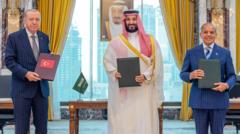


 3 sources
Morning Edition · Sunday, August 16, 2026Published at 1:05 AM EDT · New York
Saudi Arabia, Turkey and Pakistan Build a Defence Bloc Outside the American Alliance System
The Mecca agreement signed on 7 August treats an attack on one signatory as an attack on all three and is open to further members.
Turkish President Recep Tayyip Erdogan, Saudi Crown Prince Mohammed bin Salman and Pakistani Prime Minister Shehbaz Sharif signed a joint defence agreement in Mecca on 7 August under which an attack on any one of the three is treated as an attack on all, as detailed by Al Jazeera. Pakistan's Foreign Minister Ishaq Dar described the pact as "purely defensive in nature" and said other states could join, PBS reported.
The three combine close to 1.4 million active military personnel, about 3,400 aircraft, 6,000 tanks and more than 340 naval assets. Pakistan is the only nuclear-armed state among Muslim-majority countries, Turkey is a member of the North Atlantic Treaty Organization (NATO) with an expanding domestic arms industry, and Saudi Arabia supplies the financing. The agreement builds on a bilateral Saudi-Pakistani defence commitment signed in September 2025.
Indian commentary treats the arrangement as a strategic problem rather than a regional curiosity. BBC News Hindi asked how large a challenge the new alignment presents for New Delhi, noting that Pakistan's presence in a pact backed by Saudi money and Turkish industry changes the security calculation in West Asia and on India's western border at the same time.
The context is the Gulf war and its aftermath. Riyadh has watched the United States fight Iran across the Gulf without a settled outcome, and the Mecca agreement gives Saudi Arabia a security guarantee that does not run through Washington. Analysts writing on the pact note that the practical obstacles are considerable, including the absence of a joint command and divergent interests among the signatories, but the political direction is unambiguous.
Veracity: Corroborated
88/100- If true, who benefits
Turkish and Pakistani defence manufacturers competing for Saudi orders, Islamabad, which converts military capability into Gulf financing, and Riyadh, which gains leverage in negotiations with Washington by demonstrating an alternative.
- The nuance
The signing and the attack-on-one clause are confirmed by Al Jazeera and PBS, but no clause extends Pakistan's nuclear deterrent to the other signatories and Islamabad has said so directly, the full text is not public, and the personnel and equipment totals come from the compiled Global Firepower Index rather than from the governments.
An open-source-intelligence read of how likely this story is true with its real nuance, not a judgment of any outlet. It assesses the claim, weighing independent and adversarial reporting. How we label confidence.
What this means
The dollar's role in oil markets has always rested partly on an implicit exchange: American security guarantees for Gulf producers in return for their integration into dollar-denominated finance. Each arrangement Gulf states build outside that framework loosens the political leverage Washington holds over them, which over time affects their willingness to price, invoice and invest exclusively in dollars. The immediate exposure is to defence contractors, with Turkish and Pakistani suppliers gaining Saudi orders that might otherwise have gone to American firms, and to India, which now faces a better-financed Pakistani military.
Synthesized from: BBC News Hindi · Al Jazeera · PBS News
Townsquare
Start a discussion in Townsquare.
More from this edition
- Trump Says He Will Declare the Strait of Hormuz United States Territory, and Iran Refuses
- Gold Holds Near 4,400 Dollars as United States Inflation Slows to 3.4 Percent
- Bitcoin Trades Below 63,000 Dollars While Gold Sits Near Its Highs
- Carmakers Reformulate Engine Oils as Gulf Base-Oil Supply Stays Cut Off
- Most American Voters Say They Are Worse Off, Financial Times Poll Finds
- Ukraine Strikes Industrial Sites in Russia's Samara Region as Long-Range Attacks Widen
- Kim and Putin Reaffirm Alliance as South Korea Offers Talks to Formally End the Korean War
- Belgium Fights Its Largest Recorded Wildfire as European Companies Tally Heat Costs
Comments
0No comments yet.