← The Global Intelligence Brief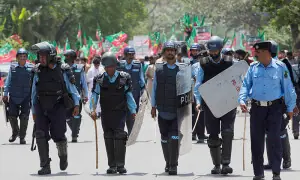

 4 sources
Morning Edition · Monday, September 21, 2026Published at 1:16 AM EDT · New York
Pakistan deploys more than 22,000 security personnel in Islamabad as Imran Khan's sisters are detained
The authorities have again commandeered freight trucks to block roads, and transport operators say the seizures are damaging a sector that carries most of the country's goods.
Pakistan's authorities are placing more than 22,000 security personnel across Islamabad and the Rawalpindi division ahead of a march called by Pakistan Tehreek-e-Insaf (PTI), the party founded by the imprisoned former prime minister Imran Khan, according to Dawn. Other opposition parties have called rallies on the same days.
PTI says several members of Khan's family have been detained, including his sisters Uzma Khan and Noreen Niazi, after the detention of Aleema Khan on the order of Lahore's deputy commissioner, as reported by Dawn. Khan's family told Al Jazeera that three sisters were detained in Lahore ahead of the march demanding his release. The authorities have not published charges.
The economic cost is visible in freight. Goods transporters say the government is again seizing their trucks to barricade roads into the capital, and that the sector, which moves most of the country's cargo, is being treated as an instrument of crowd control, Dawn reported. Police counter that licensing rules are being enforced and cite millions of traffic violations by goods vehicles this year.
The confrontation arrives while Pakistan is absorbing an energy import bill inflated by the closure of the Strait of Hormuz. A state that suspends internal freight movement for several days each time it faces a protest adds a distinct cost to every supply chain crossing the country, separate from the price of the fuel those trucks burn.
Veracity: Corroborated
88/100- If true, who benefits
The governing coalition, which removes organisers before a scheduled march, and PTI, which converts the detentions of Imran Khan's relatives into mobilisation ahead of the 27 September protest.
- The nuance
Dawn, Al Jazeera and Pakistani outlets confirm the detentions, and the absence of charges is not an omission but the design of the Punjab Maintenance of Public Order Ordinance, which permits preventive detention for up to 30 days, while the truck-seizure account comes from transporters and the police describe the same actions as licensing enforcement.
An open-source-intelligence read of how likely this story is true with its real nuance, not a judgment of any outlet. It assesses the claim, weighing independent and adversarial reporting. How we label confidence.
What this means
Repeated road closures and vehicle seizures raise the delivered cost of goods inside Pakistan and interrupt the Afghan transit trade, which shows up as higher local inflation and lower tax collection in the weeks around each confrontation. The sovereign is the exposed party, because Pakistan's financing depends on hitting revenue targets set with the International Monetary Fund while its import bill rises with crude. Foreign holders of Pakistani debt and companies with local operations price political confrontation as an operating cost rather than a tail risk.
Synthesized from: Dawn · Dawn · Al Jazeera · Dawn
Townsquare
Start a discussion in Townsquare.
More from this edition
- Iran says it has given Washington its conditions for reopening the Strait of Hormuz
- United States and China agree to open a dialogue on artificial intelligence before Thursday's summit
- Bitcoin trades above 81,000 dollars as risk assets rally on the United States-China talks
- France says public debt will reach its highest level since 1978 as Lecornu prepares 54 billion euros of cuts
- United Russia heads for a constitutional majority in the State Duma election
- Attacks on Black Sea shipping cut Russian and Ukrainian grain exports as wheat reaches a three-year high
- The Federal Reserve and the Bank of England step up scrutiny of bank lending to trading firms after Jane Street's loss
Comments
0No comments yet.