← The Global Intelligence Brief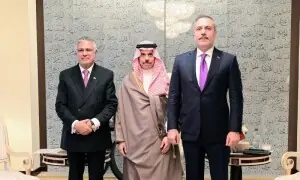

 2 sources
Morning Edition · Friday, September 25, 2026Published at 1:16 AM EDT · New York
Pakistan Institutionalises Its Gulf Defence Pact While Fighting Escalates on the Afghan Border
Islamabad is building a formal command structure with Riyadh and Ankara at the same time as its forces exchange fire with Afghan Taliban units.
Pakistan's deputy prime minister and foreign minister, Ishaq Dar, met his Saudi and Turkish counterparts on Friday to review progress on institutionalising the tripartite Makkah Joint Defence Agreement, signed by the three states on August 7. The agreement commits the signatories to treat an attack on one as a matter for all three, and the current work concerns the permanent machinery that would make that commitment operational.
On its western frontier, Pakistan is already fighting. Its security forces reported killing Afghan Taliban fighters in continuing cross-border exchanges, the latest round of clashes with the authorities in Kabul. Islamabad says armed groups operate from Afghan territory. The Afghan administration rejects that account and describes Pakistani strikes as violations of its sovereignty.
The two developments belong to the same story. A state with a constrained budget and an active internal security problem is extending formal defence obligations to the Gulf at the same time as it commits forces along a long and contested border. Saudi Arabia is buying a security guarantee that does not depend on Washington. Turkiye is expanding its defence industrial reach. Pakistan is gaining financial and diplomatic support in exchange for manpower and nuclear-adjacent prestige.
Part of a tracked trend
Middle Powers Build Security Blocs Outside Washington
States that once relied on American guarantees keep forming their own mutual defense arrangements, redirecting arms procurement away from Western suppliers and creating overlapping commitments that make regional crises harder to contain.
Veracity: Corroborated
85/100- If true, who benefits
Riyadh gains a security guarantee that does not run through Washington, Ankara gains defence-industrial reach, and Islamabad gains Gulf financing and status.
- The nuance
The pact and the ministers' meeting are documented, but the border casualty claims come from unnamed Pakistani security sources with no official confirmation from either government, and Kabul disputes both the toll and the account of who fired first.
An open-source-intelligence read of how likely this story is true with its real nuance, not a judgment of any outlet. It assesses the claim, weighing independent and adversarial reporting. How we label confidence.
What this means
Gulf states are converting American security dependence into a set of regional arrangements, and the arms procurement that follows flows to Turkish, Chinese and Pakistani suppliers rather than to American ones. That shift matters for defence contractors on both sides and for the Gulf risk premium, because overlapping mutual defence commitments make a local incident harder to contain once it starts. Pakistan's exposure is fiscal: it is taking on external obligations while fighting on its own border, and its capacity to fund both depends on Gulf financial support continuing.
Synthesized from: Dawn · Al Jazeera
Townsquare
Start a discussion in Townsquare.
More from this edition
- Brent Moves Above $106 After Houthis Claim New Strikes on Saudi Aramco Sites
- Trump and Xi Extend Their Tariff Truce to January Without Settling Any Dispute
- Japan Says Trump Raised the Weak Yen, and the Dollar Fell Toward 158
- Long-Term Treasury Yields Sit Near Their Highest Levels Since 2007 as Gold and Bitcoin Retreat
- Drone Strike Halts a Rostov Refinery as About 50 Aircraft Attack Southern Russia
- Russia's Ship Registry Grows by a Third as Enforcement Strips Tankers of Other Flags
- Brussels Tells London to Raise Tariffs on Chinese Cars or Face 'Made in Europe' Barriers
- A $40 Million Startup Prices an AI Model at Four Cents per Million Tokens
Comments
0No comments yet.