← The Global Intelligence Brief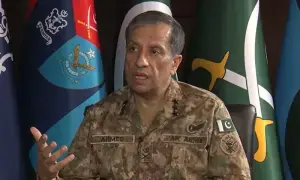


 4 sources
Morning Edition · Thursday, October 8, 2026Published at 1:19 AM EDT · New York
Pakistan's military spokesman says its troops have been in Saudi Arabia for decades across multiple domains
The statement follows reports of a deployment of about 8,000 Pakistani troops with Chinese-made air defenses, at the same time the United States is ending its military mission in Iraq.
Lieutenant General Ahmed Sharif Chaudhry, director general of Inter-Services Public Relations (ISPR), the Pakistani military's media wing, said Pakistani troops are in Saudi Arabia and have been there "for decades" across multiple domains, Dawn reported. He presented the presence as a long-standing arrangement, not a new commitment.
Earlier reporting suggests the deployment has grown since the Iran war began. In May, Pakistani security officials and government sources said Pakistan had sent about 8,000 troops, a squadron of about 16 aircraft (mostly JF-17 fighters developed with China), and a Chinese HQ-9 air defense system to Saudi Arabia under a mutual defense pact, according to reporting carried by the Denver Gazette and The New Arab. The two countries signed the pact on September 17, 2025, and both say it obliges each to defend the other if attacked. Khawaja Asif, Pakistan's defense minister, has implied that it places Saudi Arabia under Pakistan's nuclear protection. One government source said the pact allows up to 80,000 Pakistani troops to be deployed. Pakistan has also served as the main mediator in the Iran war.
The United States is reducing its own presence in the region. It has ended its military mission in Iraq, the South China Morning Post reported. Analysts told the paper this gives Baghdad more room to diversify its partnerships and indirectly helps China's energy and commercial interests. They also said it is unlikely to leave a gap that Beijing could fill.
Part of a tracked trend
Middle Powers Build Security Blocs Outside Washington
States that once relied on American guarantees keep forming their own mutual defense arrangements, redirecting arms procurement away from Western suppliers and creating overlapping commitments that make regional crises harder to contain.
Veracity: Corroborated
80/100- If true, who benefits
Saudi Arabia gains military protection that does not depend on Washington, Pakistan gains Gulf financing and status, and China gains buyers for its HQ-9 air-defense system and JF-17 fighters.
- The nuance
Dawn and The Express Tribune confirm the statement. Chaudhry made it to CNN when asked about the Makkah Joint Defence Agreement, which also includes Turkiye, and its members agreed at an emergency meeting in Riyadh on Monday to deploy forces quickly. Neither government has officially confirmed the reported figure of 8,000 troops.
An open-source-intelligence read of how likely this story is true with its real nuance, not a judgment of any outlet. It assesses the claim, weighing independent and adversarial reporting. How we label confidence.
What this means
Saudi Arabia is buying security from a nuclear-armed neighbor that uses Chinese weapons, while Washington withdraws from Iraq. Pakistan gains Gulf financing and status. China gains a market for its arms and a stake in Gulf security without deploying its own forces. Pakistan risks being drawn into a war with Iran, its neighbor, even as it tries to mediate that conflict. The arrangement challenges the desk's thesis that India dominates South Asia: Pakistan now has Gulf military influence that India's economic ties there do not match. The precedent is the 1980s, when Pakistani brigades were stationed in Saudi Arabia after the Iranian revolution, paid for largely by Riyadh. The desk's read is that within months the Saudi-Pakistani arrangement becomes more open, through joint exercises, Saudi financial support for Pakistan, and more Chinese-made equipment in the kingdom. If US strikes on Iran resume, Islamabad will try to limit its role to defending Saudi territory. A public Pakistani statement that its forces will not take part in any operation against Iran would confirm that limit. A Pakistani reduction of forces in the kingdom would contradict the read.
Synthesized from: Dawn · South China Morning Post · The New Arab · Denver Gazette
Townsquare
Start a discussion in Townsquare.
More from this edition
- Brent settles at $104 as Iran steps up tanker attacks, while Trump rules out Iran strikes before the midterms
- Fed minutes show unanimous backing for September rate hike and a majority leaning toward another by year end
- Hormuz shipping falls to lowest since July as a Kpler analyst suspects Gulf producers are paying Iran for passage
- Bitcoin falls below $83,000 as oil and Treasury yields rise on the Iran strike report
- Flávio Bolsonaro's team studies spending curbs worth up to 250 billion reais as investors bet on a runoff win
- Samsung's preliminary third-quarter operating profit tops 107 trillion won as AI demand lifts memory prices
- More Russians now pick cash over bank deposits for savings as cross-border transfers draw tougher penalties
Comments
0No comments yet.