← The Global Intelligence Brief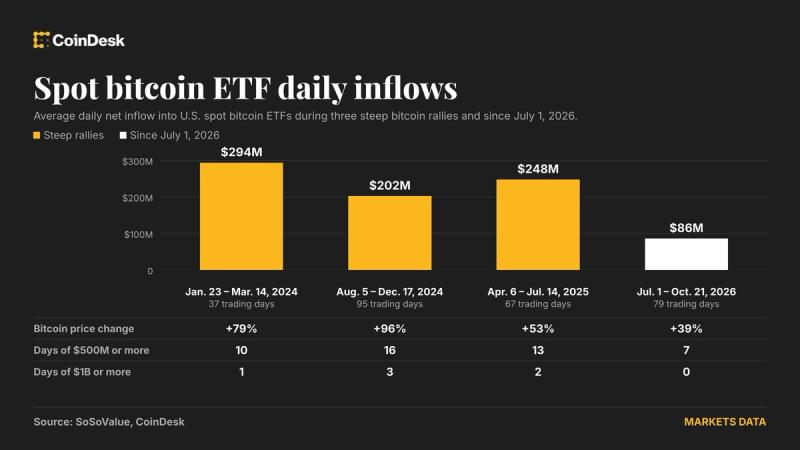

 3 sources
Morning Edition · Thursday, October 22, 2026Published at 1:18 AM EDT · New York
Bitcoin funds draw $1.08 billion in three days, short of the pace behind past rallies
Standard Chartered agreed to absorb custodian Zodia Custody, and three companies told the US securities regulator they plan to trade tokenized stocks.
US spot bitcoin exchange-traded funds (ETFs) took in $1.08 billion over three days, according to data analyzed by CoinDesk. That is roughly $360 million a day for a short period. CoinDesk's analysis finds that past steep rallies were supported by an average of about $235 million a day in net inflows, sustained over longer periods, and the funds have not yet matched that sustained pace. Bitcoin traded between about $82,700 and $84,400 early on Thursday, according to Investing.com historical data.
Bitcoin moved with risk assets during the morning's geopolitical scare. It stayed in a narrow range while Asian equities fell after the US embassy drawdown in Saudi Arabia. Gold also slipped about 0.3%. Neither asset attracted safe-haven buying, so today's trading neither supports nor disproves the view that bitcoin is a substitute for gold.
Banks are building the infrastructure behind the asset. Standard Chartered agreed to acquire Zodia Custody, the crypto custodian incubated by its own SC Ventures arm, and will fold its bitcoin and crypto custody services into the bank. According to Standard Chartered's venture unit, Zodia will spin out its infrastructure platform separately, and the deal still needs regulatory approval. In the United States, three companies notified the Securities and Exchange Commission (SEC) that they intend to start trading tokenized stocks. The SEC is accepting such applications even though the CLARITY Act market-structure bill failed in Congress.
Part of a tracked trend
Bitcoin Trades as a Risk Asset, Not Digital Gold
At each geopolitical or inflationary stress point, bitcoin keeps trading with liquidity-sensitive risk assets rather than with monetary metals, so the digital-gold framing continues to fail exactly when investors most want it to hold.
What this means
The bitcoin price now depends mostly on ETF flows. Those flows come from wealth managers who also own equities and cut risk when rates or oil rise. That ties bitcoin to dollar liquidity rather than to its scarcity. Large banks taking over custody and the arrival of tokenized equities make the asset more like a regulated financial product. That brings a larger investor base, and also more correlation with the stock market. Consensus treats a few days of strong inflows as the start of a new rally. CoinDesk's own benchmark shows that rallies need sustained inflows, and a Gulf escalation in early November would test that. The likelier outcome over the next month is range-bound trading near current levels, with a breakout depending on daily inflows staying above the historical rally pace for weeks. A day of large outflows during an oil spike would confirm that bitcoin is behaving as a risk asset.
What to watch
- Daily ETF net flows over the next two weeks. Sustained inflows near the historical rally pace would be the first signal of a durable move.
- Bitcoin's behavior on the day of any US strike on Iran. Falling with equities or rising with gold would settle the safe-haven question for this cycle.
- Whether the SEC approves trading of the first tokenized stock, which would move crypto infrastructure into mainstream equity trading.
Observations to monitor, not financial advice.
Synthesized from: CoinDesk · Bitcoin Magazine · Bitcoin Magazine
Townsquare
Start a discussion in Townsquare.
More from this edition
- Brent crude rises to $110 as Washington orders diplomats out of Saudi Arabia
- US and Israel have plans for a short strike campaign on Iran after the November 3 midterms, The New York Times reports
- France's 10-year borrowing cost briefly tops 5% for the first time since 2002 as protests spread
- Egypt moves toward defending Saudi Arabia as Houthi drones reach Saudi cities
- Lula's campaign asks Brazil's electoral court to annul Flávio Bolsonaro's ticket days before the runoff
- Japan says yttrium supplies have stalled under Chinese export controls
- Reserve Bank of India rules out near-term rate cuts while Asian central banks lean toward tightening
Comments
0No comments yet.