← The Global Intelligence Brief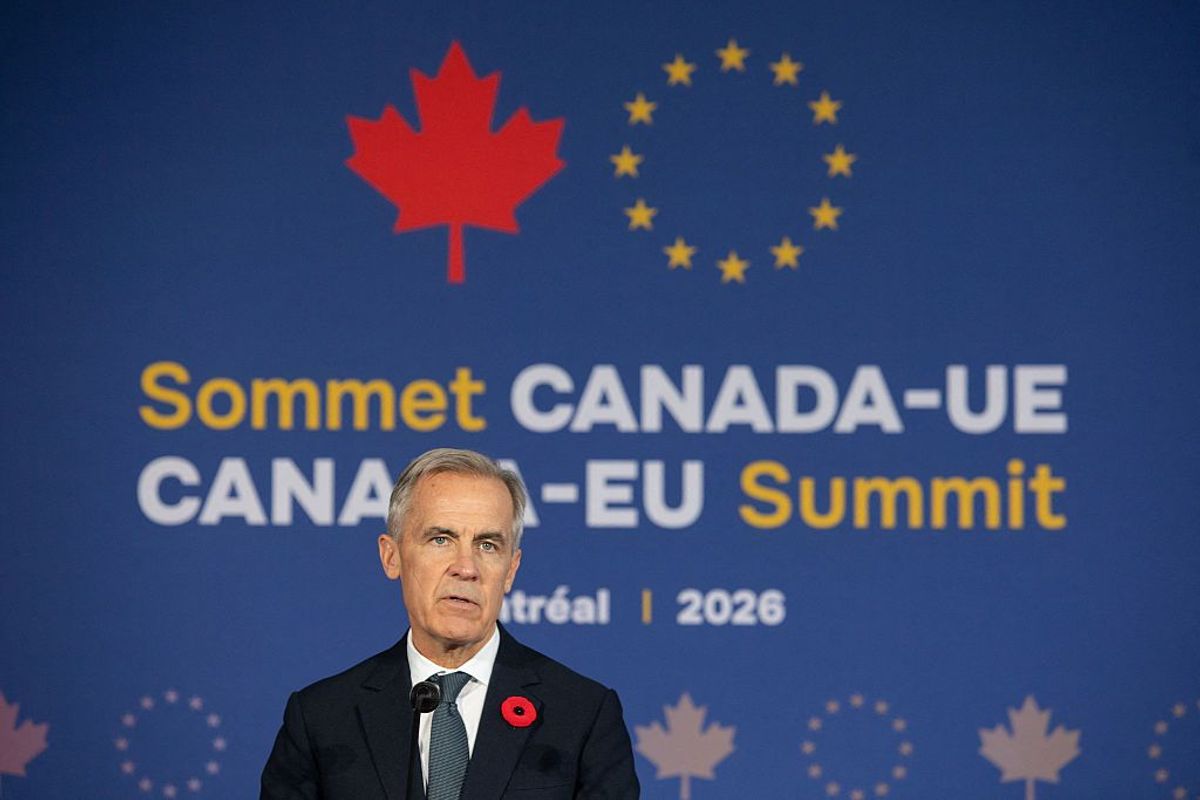


 3 sources
Morning Edition · Saturday, October 31, 2026Published at 1:13 AM EDT · New York
Canada and the EU Launch an "Alliance for the Future" Open to Other Countries
Prime Minister Mark Carney welcomed an offer of EU associate membership at the Montreal summit and said Canada's Parliament would vote on the final structure.
Canada and the European Union announced a new alliance at their summit in Montreal on Thursday and Friday. The Guardian reported that leaders described the "Alliance for the Future" as a "protective canopy under which our citizens can thrive" and said it was designed for a world "shaken by new storms." The alliance is open to other like-minded countries.
Prime Minister Mark Carney said Canada welcomes the offer from European Commission President Ursula von der Leyen to become the EU's first associate member, a status with no precedent. He said the Canadian Parliament would debate and then vote on the final structure, and that Canada does not intend to cede sovereignty to Brussels. The summit launches formal negotiations that are expected to run over the next year. Carney has described the arrangement as a basis for a new "prosperous world order."
Ukraine was a central item. According to Ukrinform, the two sides pledged to increase pressure on Russia and to support Ukraine's reforms and integration with Europe and NATO. Canada pledged €500 million toward a loan to cover Ukraine's 2027 budget shortfall.
Part of a tracked trend
Middle Powers Build Security Blocs Outside Washington
States that once relied on American guarantees keep forming their own mutual defense arrangements, redirecting arms procurement away from Western suppliers and creating overlapping commitments that make regional crises harder to contain.
Veracity: Corroborated
80/100- If true, who benefits
If the alliance deepens, Canadian exporters of energy, critical minerals and financial services gain better access to EU markets and public contracts. The European Commission gains a model for linking non-members to the bloc, and both changes reduce Canada's dependence on trade with the United States.
- The nuance
The joint statement commits both sides only to work toward an "ever-closer association of Canada to the EU, short of full membership" by the next summit. Il Foglio reported that Germany and France opposed von der Leyen's associate-membership proposal, so the status is still undefined and needs agreement from EU member states.
An open-source-intelligence read of how likely this story is true with its real nuance, not a judgment of any outlet. It assesses the claim, weighing independent and adversarial reporting. How we label confidence.
What this means
Canada is hedging against its dependence on the United States, which takes most of its exports, by building a formal institutional link to the EU. The commercial channel is regulation and procurement: associate status could align Canadian standards with the EU single market and give Canadian firms better access to European defense and energy contracts, while European buyers gain a reliable supplier of liquefied natural gas, critical minerals and uranium outside the Gulf and Russia. Washington can still use tariffs and the integrated North American supply chain to limit how far Ottawa goes, and that leverage is real. The closest precedent is Norway's membership of the European Economic Area, which gave it single-market access without full EU membership for three decades. The desk's read is that negotiations produce a defense procurement and critical-minerals agreement within a year, well before any full associate status, which would require parliamentary approval in Canada and unanimity in the EU. That read is wrong if Washington ties its North American trade review to Canada limiting the arrangement.
Synthesized from: The Guardian · Ukrinform · Kyiv Independent
Townsquare
Start a discussion in Townsquare.
More from this edition
- Intel's 29% Collapse and OpenAI's Smaller Fundraising Push the AI Sell-Off Into Credit-Dependent Tech
- Brent Ends October Up 13.6% at $117.64 as Iran Says Four Tankers Struck Mines in Hormuz
- Gold Falls to a One-Year Low Below $3,900 and Silver Breaks $50 as Markets Price a Fed Rate Increase
- Binance Loses $6.3 Billion in Half an Hour After Hackers Linked to North Korea Compromise an Engineer's Laptop
- Brazil's Real Posts Its Worst Week Since 2008 After Lula's Re-election Raises Fiscal Doubts
- Poland's Government Suspends the Constitutional Tribunal's President, and President Nawrocki Calls It a Forcible Seizure
- Bank of Japan Holds at 1.25% and More Than Doubles the Pace of Its ETF Sales
Comments
0No comments yet.