← The Global Intelligence Brief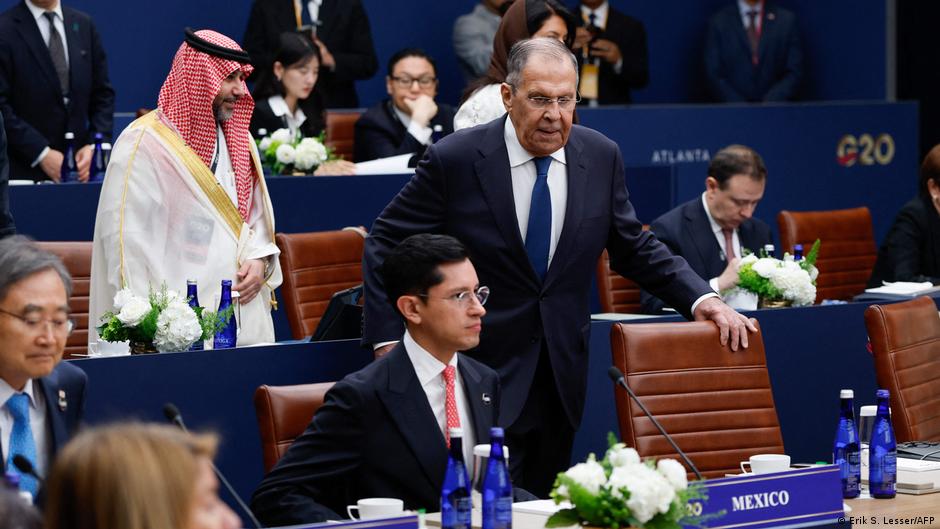


 4 sources
Morning Edition · Saturday, October 31, 2026Published at 1:13 AM EDT · New York
Washington Hosts Lavrov at the G20 in Atlanta and Cancels the Group Photo After European Objections
Lavrov said Europe had lost its chance to mediate in Ukraine, and a report says US officials asked NATO allies to moderate their warnings about Russia.
Russian Foreign Minister Sergey Lavrov attended the Group of 20 (G20) foreign ministers' meeting in Atlanta, which the United States hosted. Secretary of State Marco Rubio scrapped the traditional group photo after several European ministers objected to standing with Lavrov and threatened to walk out. Polish Foreign Minister Radosław Sikorski called the cancellation "the right decision." Deutsche Welle reported that European diplomats avoided the Russian delegation. Lavrov declined to tell DW whether Russia would attend the G20 leaders' summit in December, and said Ukrainian President Volodymyr Zelensky should travel to Russia if he wanted talks with Vladimir Putin.
Lavrov also set out Moscow's position on who may negotiate. RT reported that he said Europe cannot be trusted to mediate because it failed to uphold earlier peace agreements. TASS reported that he told the DW journalist not to believe Ukrainian officials.
The gap between Washington and its European allies appears in another report. ZeroHedge, republishing The Cradle, reported that US officials asked several North Atlantic Treaty Organization (NATO) members to "tone down their rhetoric" about the Russian threat, saying recent European statements had undermined US efforts. The desk could not independently confirm that report through other outlets.
Not every US ally kept its distance. The Japan Times reported that Japan held a rare high-level meeting with Lavrov in Atlanta and demanded the release of a Japanese national held in Russia.
Part of a tracked trend
Great Powers Negotiate Ukraine Over Europe's Head
Washington, Moscow and Beijing increasingly treat the end of the Ukraine war as a bargain among themselves, so European governments and Kyiv keep losing influence over the terms while being asked to fund the outcome.
Veracity: Corroborated
75/100- If true, who benefits
If Washington is treating Moscow as a negotiating counterpart, the Kremlin gains diplomatic standing and a channel on Ukraine that bypasses European governments. US negotiators gain room to decide on sanctions relief, a decision that affects European energy and defense budgets.
- The nuance
CNN and Bloomberg confirm that the photo was cancelled. Reports say objections also came from non-European participants such as Australia and Canada, and the United States said it wanted to keep the focus on substantive discussions. The reported US request that NATO allies moderate their statements about Russia rests on a single report from The Cradle, which no other outlet has confirmed.
An open-source-intelligence read of how likely this story is true with its real nuance, not a judgment of any outlet. It assesses the claim, weighing independent and adversarial reporting. How we label confidence.
What this means
Washington is treating Russia as a negotiating counterpart, while most European governments still treat it as a party to be isolated, and the host decides who sits at the table. Europe can refuse a photograph but cannot set the agenda. That reduces its say over Ukraine's settlement terms, which it is expected to help fund. European defense contractors gain if Europe concludes it must arm without US cover. Ukraine is exposed if a US-Russia track moves ahead without Kyiv's conditions. The precedent is the 2022 G20 in Bali, where the photo was also cancelled because of Lavrov, but at that time Washington led the boycott. The reversal of roles is the new information. The desk's read is that Russia attends the December leaders' summit in the United States at some level and that a US-Russia channel on Ukraine becomes more visible over the coming weeks, with European governments responding through their own coalition structures. That read is wrong if Washington formally excludes Russia from the leaders' summit.
Synthesized from: Deutsche Welle · RT · ZeroHedge · The Japan Times
Townsquare
Start a discussion in Townsquare.
More from this edition
- Intel's 29% Collapse and OpenAI's Smaller Fundraising Push the AI Sell-Off Into Credit-Dependent Tech
- Brent Ends October Up 13.6% at $117.64 as Iran Says Four Tankers Struck Mines in Hormuz
- Gold Falls to a One-Year Low Below $3,900 and Silver Breaks $50 as Markets Price a Fed Rate Increase
- Binance Loses $6.3 Billion in Half an Hour After Hackers Linked to North Korea Compromise an Engineer's Laptop
- Brazil's Real Posts Its Worst Week Since 2008 After Lula's Re-election Raises Fiscal Doubts
- Poland's Government Suspends the Constitutional Tribunal's President, and President Nawrocki Calls It a Forcible Seizure
- Bank of Japan Holds at 1.25% and More Than Doubles the Pace of Its ETF Sales
Comments
0No comments yet.