← The Polylog AI Intelligence Brief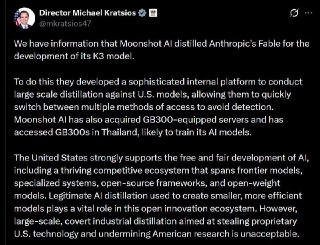
Morning Edition · Thursday, July 23, 2026Published at 1:46 AM EDT · New York
White House Accuses Moonshot of Distilling Anthropic's Fable to Build Kimi K3, Treasury Threatens Sanctions
Officials also allege Moonshot trained on Nvidia GB300 servers accessed in Thailand, though skeptics note Fable has been public only since July 1.
Michael Kratsios, director of the White House Office of Science and Technology Policy, said the administration has information indicating that the Chinese lab Moonshot AI used Anthropic's Fable model while developing its Kimi K3 system, describing a purpose-built internal platform that ran large-scale distillation against US models while switching between access methods to avoid detection. The claim revives an earlier allegation from Anthropic that Moonshot generated more than 3.4 million Claude exchanges through fraudulent accounts to extract reasoning, coding, tool use, and computer-vision behavior.
Treasury Secretary Bessent threatened sanctions and Commerce Entity List designations for firms conducting what he called covert, industrial-scale distillation. Kratsios separately alleged that Moonshot acquired GB300-equipped servers and accessed Nvidia GB300s in Thailand, likely to train its models, which would place the case inside the existing compute export-control regime as well.
The technical claim is contested. Several researchers dispute that Kimi K3 could have been built primarily by distilling Fable, which has been publicly available only since July 1, too short a window to transfer a frontier model's full capability profile through output imitation alone. Distillation can cheaply copy style and some reasoning traces, but reproducing tool use and coding at K3's level typically requires substantial independent pretraining. What is verified is the accusation and the threatened penalties. What remains asserted is the causal claim that Fable is the source of K3's capabilities. Anthropic, which sells access to Fable, benefits if the distillation narrative holds, while Moonshot benefits from framing K3 as independently trained.
Veracity: Plausible
54/100- If true, who benefits
Anthropic and US closed labs gain a policy rationale to meter model access and blunt a cheaper Chinese open-weight rival, while the administration gains an export-control lever over China's AI sector.
Part of a tracked trend
AI Sovereignty and Export Controls on Frontier Models
Over the next 3-6 months, governments increasingly treat frontier AI models as strategic national assets — extending export controls to model access itself and backing domestic 'champion' labs as sovereignty plays.
Townsquare
Start a discussion in Townsquare.
More from this edition
- Nvidia Brings First DGX GB300 Online at the US Naval Postgraduate School
- OpenAI, Google, and Meta Pour Compute and Credits Into the Genesis Mission for National Science
- Judge Gives Final Approval to Anthropic's $1.5 Billion Settlement Over Pirated Training Books
- OpenAI Launches Presence, an Enterprise Agent Platform, as Codex Cuts NTT DATA Incident Analysis to 30 Minutes
- New Benchmark 'SysAdmin' Measures Whether Frontier Models Seek Power Beyond Their Task
- Two Papers Warn That Safe LLMs Do Not Compose Into Safe Multi-Agent Systems
- Anthropic Adds Screen-Recording to Teach Claude New Skills
Comments
0No comments yet.