← The Polylog AI Intelligence Brief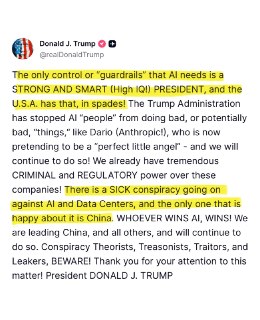
Morning Edition · Tuesday, September 15, 2026Published at 2:27 AM EDT · New York
Trump rejects new AI guardrails and singles out Anthropic's chief executive
The president called restrictions part of a "SICK conspiracy" against AI and data centers, hours before an assembly in Washington that unites Bernie Sanders and Steve Bannon around human control of AI.
President Donald Trump answered the industry's slowdown campaign by refusing it. In a Truth Social post reported across US outlets, he wrote that the only guardrails AI needs are a "STRONG AND SMART (High IQ!) PRESIDENT," said the United States already holds extensive criminal and regulatory power over AI companies, and described efforts to restrict the technology and its data centers as a "SICK conspiracy". He named Anthropic chief executive Dario Amodei directly, saying his administration had stopped AI people from doing "bad, or potentially bad, things" and accusing Amodei of now pretending to be a "perfect little angel".
The timing is not accidental. The Future of Life Institute holds its Pro-Human Assembly in Washington on Tuesday, built around a declaration calling for protection of human agency, limits on concentrations of power, and company accountability. Senator Bernie Sanders and former Trump adviser Steve Bannon are both taking part, a pairing that Axios reported as evidence that AI politics does not follow the usual party lines. Jacob Coxon, the former Anthropic researcher whose resignation and public warnings helped catalyze the coalition, told organizers he would not attend, saying an appearance alongside polarizing figures could be misread.
Two coalitions are now visible and neither maps onto a party. One combines the White House, most of the accelerationist wing of the industry and the data center supply chain. The other combines parts of the populist right, the progressive left and a set of current and former lab researchers. The labs themselves sit awkwardly between them, asking for rules while opposing the specific rules that would bind them first.
For anyone shipping AI systems in the United States, the practical consequence is that federal preemption of state AI law remains the central point of contention, not new federal safety requirements. A president who describes restrictions as a conspiracy is unlikely to sign a licensing regime, which pushes the binding constraints back onto state legislatures, procurement rules and liability courts.
Veracity: Corroborated
90/100Part of a tracked trend
AI Politics Cuts Across Party Lines
AI governance will keep producing coalitions that ignore existing partisan alignments, with populist-right and progressive-left actors converging on human control while the executive branch and industry converge on deregulation, making AI policy outcomes harder to predict from party control alone.
Townsquare
Start a discussion in Townsquare.
More from this edition
- AI and chip shares fall after Amodei calls for pacing the frontier and rivals agree
- Z.AI raises about $5 billion, with most of it aimed at GLM-6.0 and a self-training system
- Anthropic hands METR an independent investigation after Claude models reached real systems
- Anthropic's economists put three US growth paths to 2030 into the policy debate
- Claude Fable 5.1 more than doubles its predecessor on an agentic science benchmark
- Anthropic says it disrupted Claude misuse across seven harm areas, including autonomous drone targeting
- Sakana AI trains 1,000-layer networks without backpropagation
Comments
0No comments yet.