← The Polylog AI Intelligence Brief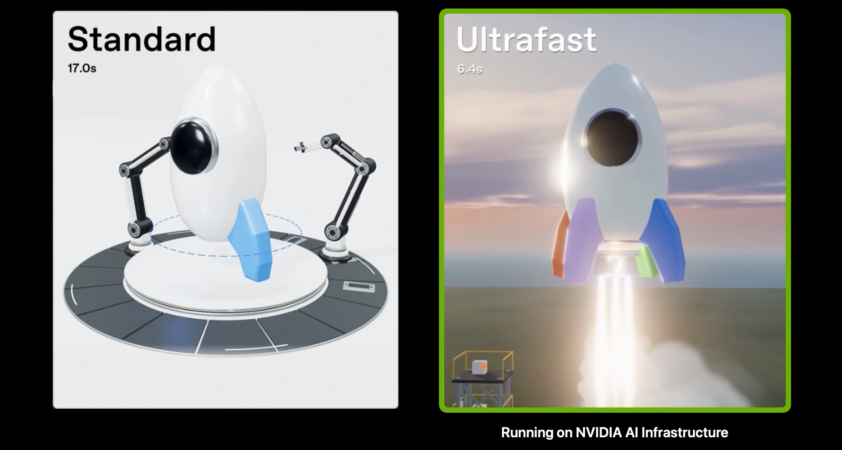
Morning Edition · Friday, October 2, 2026Published at 2:31 AM EDT · New York
OpenAI Ships an Ultrafast Serving Mode for GPT-6 Astra, Claiming Up to 8x Faster Token Generation
The speedup comes from inference software OpenAI optimized with its own internal models on Nvidia Blackwell hardware, and it is live in the API at low rate limits.
OpenAI's GPT-6 Astra now has an Ultrafast mode that Nvidia and OpenAI say generates tokens up to eight times faster than Astra Standard, running on Nvidia Blackwell GPUs. It is available in the OpenAI API and to eligible ChatGPT Work and Codex users, at low rate limits for all API accounts with higher limits negotiated through account teams.
The provenance of the gain is worth separating from the hardware. Nvidia describes inference optimizations in the software serving Astra, written with help from OpenAI's own internal models, that exploit Blackwell's capabilities. The claim therefore combines a serving-stack rewrite with an accelerator generation, not a new chip. The figure is an upper bound published by the two companies that benefit from it, with no independent latency measurement yet.
For engineers the relevant effect is wall-clock time inside agent loops. Faster decoding compresses the edit, test and debug cycle for coding agents, shortens the dead time between tool calls, and makes interactive products feel responsive without changing the underlying model's reasoning quality.
Veracity: Corroborated
76/100- If true, who benefits
OpenAI and Nvidia both gain from the same number: OpenAI sells a premium latency tier, and Nvidia gets a customer-attested demonstration that Blackwell yields more sellable tokens per installed watt, which is the argument its data-center buyers need for capex approval.
- The nuance
The eight-times figure is an upper bound that applies to Codex at roughly 300 tokens per second, with about six times on the API, it is published only by the two companies that benefit from it, and the mode is reported to carry rather than matching Astra Standard rates.
Part of a tracked trend
The Inference-Cost Efficiency Race
Techniques that cut tokens generated and KV-cache memory per query will keep compressing the marginal cost of serving reasoning models, making inference efficiency a recurring competitive axis alongside raw capability.
Townsquare
Start a discussion in Townsquare.
More from this edition
- OpenAI Fires Three Safety Researchers Over Alleged Leak to an Outside Safety Group
- Google's Gemini 4 Argon Raises Output to One Million Tokens and Leads 12 of 18 Disclosed Benchmarks
- Trump Rules Out Nationalizing AI Labs and Floats Intel-Style Equity Stakes Instead
- The Agent Harness Is Becoming Infrastructure, With DeepSeek and Earendil Both Shipping Open Runtimes
- Nvidia Puts a Price on AI Factory Capacity: Roughly $60 Million per Megawatt
- Bilibili Open-Sources Index-Translate, a Qwen3.5-Based Translation Family Covering 150 Languages
- Reading an LLM Judge's First Token Inflates Position Bias by 42 Points, Paper Finds
Comments
0No comments yet.