← The Polylog AI Intelligence Brief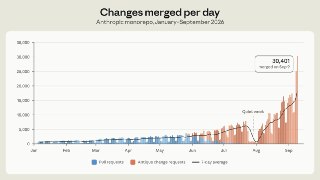
Morning Edition · Wednesday, October 14, 2026Published at 2:06 AM EDT · New York
Anthropic replaces Git with an in-house system after Claude pushes daily merges past 30,000
A seven-person team built the change-list system, called Scion, and moved Anthropic's monorepo off Git in five months, after daily merges rose about twelvefold between May and September.
Anthropic has moved its main code repository off Git and onto Scion, a version control system it built itself. The company described the change in an engineering post titled "Creating in-house source control," which was summarized by the Russian-language channel AI ML Big Data and by several developer outlets. Anthropic says Claude now writes enough code internally that source control became its largest development bottleneck.
The figures come from Anthropic. In May 2026 the company merged about 2,500 code changes per day. By September it was merging more than 30,000 per day, and on September 9 it merged 30,401 changes. According to Alpha Signal, a team of seven built Scion and completed the migration in five months.
Anthropic's technical argument targets Git's distributed design. Git lets any client hold and serve a full copy of the repository and work offline. That model suits human developers, but it adds overhead when thousands of agent sessions commit to one monorepo. Scion uses change lists, the centralized model behind Perforce and Google's internal monorepo tooling, under which a server serializes and validates submissions.
The disclosure has clear limits. A merge count is not a productivity measure. Anthropic has not published revert rates, defect rates, or the share of merges that agents produced without human review. The post also serves Anthropic commercially, since evidence of heavy internal Claude use supports the company's sales pitch for Claude Code. The engineering claim is credible on its face, because Git's performance limits on very large monorepos are well known, but no outsider has audited the numbers.
What this means
When agents produce code, the binding constraint shifts from writing code to the infrastructure that accepts it: source control, merge queues, continuous integration capacity and review. Exposed vendors are GitHub (Microsoft) and GitLab, whose products assume human-paced commits. Continuous-integration providers that bill by compute minute gain revenue instead. There is precedent. Google built Piper because Git and Perforce could not handle its monorepo, and Meta scaled Mercurial before releasing its own Sapling client in 2022. In both cases the in-house system stayed mostly internal, and the companies' scale advantage widened. Commentary has focused on frontier model scores, but this suggests that the advantage in agentic coding also depends on whether an organization can absorb agent output. The likelier outcome is that other labs and large software firms disclose similar rebuilds of merge and build infrastructure within months, and that GitHub responds with server-side features for agent-scale merges. That depends on other firms reaching comparable agent commit volumes. The read is wrong if Anthropic's merge rate falls back or if no other organization reports Git as a bottleneck by early 2027.
Part of a tracked trend
Developer Infrastructure Rebuilt for Agent Throughput
As coding agents raise commit volume by an order of magnitude, firms will repeatedly rebuild source control, build and review systems for agent-scale throughput, and the gains will go to those that control that infrastructure.
Townsquare
Start a discussion in Townsquare.
More from this edition
- Google opens Gemini 4 Argon to all users at half its list price, but independent rankings put it behind Claude Opus 5.5
- Anthropic prices Claude Haiku 5.5 at a tenth of its predecessor's rates
- Google and Anthropic now release their strongest cyber capabilities only to vetted defenders
- Character.AI files for Chapter 11 as Disney offers $20 million to license its intellectual property
- OpenAI says Russian operatives posed as Peruvian education officials to stage pro-Bandera school events
- Google DeepMind and Singapore put a fine-tuned Gemma model on phones to scan private chats for scams
- NVIDIA's RTX Spark laptops ship this week from $2,599 with up to 128GB of unified memory
Comments
0No comments yet.