← The Polylog AI Intelligence Brief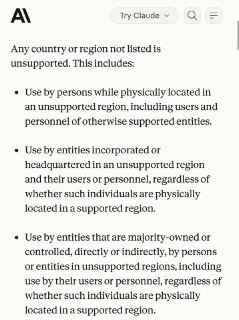
Morning Edition · Thursday, November 12, 2026Published at 1:18 AM EST · New York
Anthropic's Claude ban now reaches staff of China- and Russia-controlled companies wherever they work
The revised Supported Regions Policy takes effect November 12. It covers Claude.ai, Claude Code, Cowork, the API and Claude models resold through cloud platforms, so checks on ownership and location now determine who can buy access to the model.
Anthropic's revised Supported Regions Policy takes effect today. The policy works as an allowlist, so any country or region not named on it is unsupported. Mainland China, Hong Kong, Macau and Russia are not on the list. The rules apply to Claude.ai, Claude Code, Cowork and the API, and to Claude models sold through cloud platforms and authorized resellers, according to the policy page and a summary from the Russian-language channel AI ML Big Data. The channel's main point is that employees of Russian and Chinese companies who work outside those countries can now fall under the restriction.
The policy sets three separate tests. The first bars anyone from using Claude while physically located in an unsupported region. The second bars any entity registered or headquartered in an unsupported region, along with its users and employees, regardless of where they are sitting. The third bars entities that are directly or indirectly majority-owned or controlled by people or entities in unsupported regions, wherever those entities operate, according to summaries by KuCoin and TokenPost.
Most of this builds on earlier rules. In September 2025, Anthropic barred companies more than 50% owned by entities in China, Russia, Iran or North Korea. At the time it said some groups were reaching Claude through subsidiaries incorporated in other countries. In July 2026, Bankless Times reported that Anthropic was moving against workarounds involving foreign subsidiaries, cloud platforms and VPNs. A NodeLoc forum analysis argues the new text mainly makes the location, registration and control rules explicit. The two clear additions are the control test, which goes beyond majority shareholding, and the employee test.
Chinese-language coverage has been heavier than Western coverage. Sina Finance called it the strictest wave of account bans yet. Secrss noted that Taiwan remains a supported region. Taiwan's ABMedia warned that a business trip to the mainland or Hong Kong could put an account at risk. One Chinese-language explainer reports that the policy also prohibits relaying requests through consumer subscriptions and keeps safety-monitoring data for 30 days. The desk could not match those two details against the official text.
Companies cut off from Claude still have alternatives. DeepSeek's V4 family is released under the MIT license, and Moonshot and Alibaba ship downloadable Kimi and Qwen weights, according to comparison trackers. The agentic-coding scores those trackers cite are mostly self-reported by the vendors, and the trackers do not always agree with each other.
Part of a tracked trend
Chinese Open-Weight Models Emerge as the Non-US AI Stack
As Washington restricts foreign access to US frontier models, governments and enterprises cut off from American AI increasingly standardize on downloadable Chinese open-weight models, splitting the world into competing AI supply blocs rather than a single frontier.
Townsquare
Start a discussion in Townsquare.
More from this edition
- Anthropic markets 825 million shares at $70 to $78 for an initial public offering valued at up to $1.4 trillion
- Claude Fable 5.2 raises Anthropic's FrontierCode score to 49.1% and cuts API prices by 20%
- AlphaGenome 2 finds 30% of causal variants on the TenK10K test, nearly double its predecessor
- Gemini Robotics 2.5 sorts metal parts with 96% success on Mercedes-Benz assembly lines
- Nvidia's 2-billion-parameter GR00T 2 learns chemistry-lab tasks from a handful of demonstrations and will ship open weights
- Google prices Gemini Decision 1 at $0.10 per million input tokens and charges nothing for output
- Five AI models chatted with 1,277 dating-app matches for six days, and only eight people asked whether they were talking to a bot
Comments
0No comments yet.