← The Polylog Crypto Intelligence Brief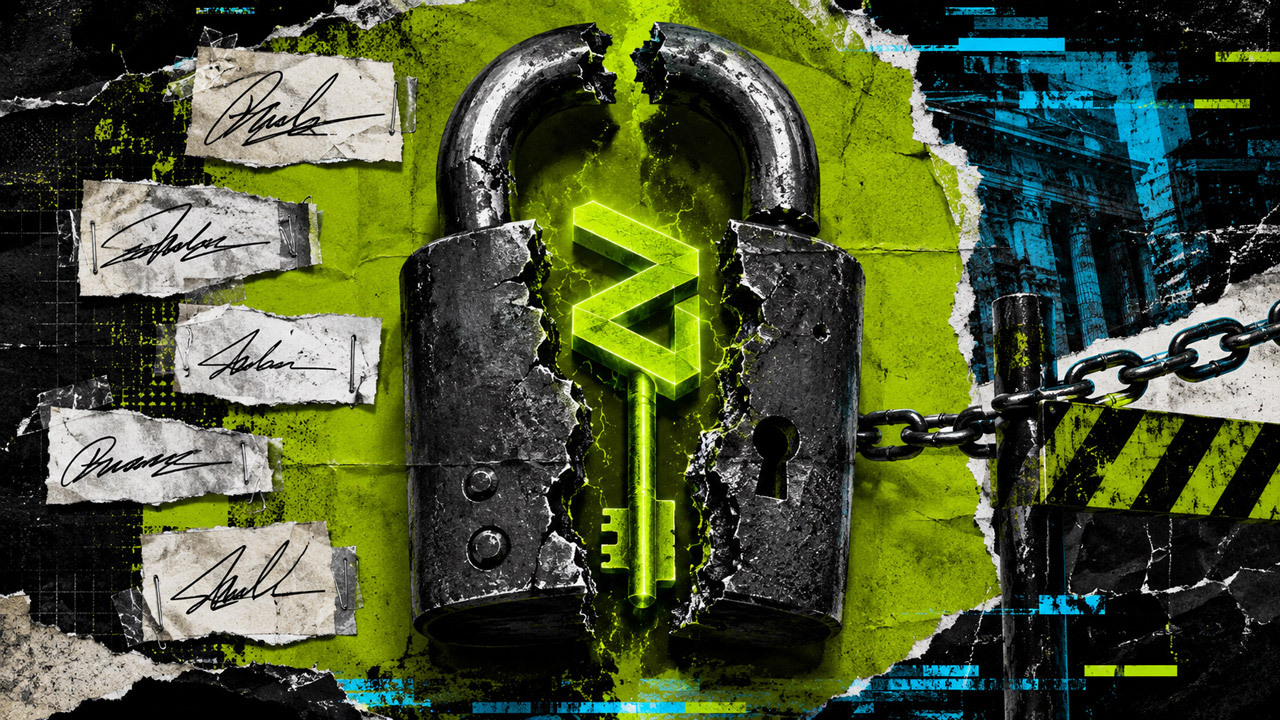
Morning Edition · Saturday, July 25, 2026Published at 1:44 AM EDT · New York
Zilliqa Halts Native Transfers After a Seven-Year Ledger Flaw Lets Attackers Rebuild Private Keys
A biased signing nonce in the Ledger app means about five signatures from one key are enough to rebuild that key using lattice-reduction mathematics within seconds. The network says exploitation began on July 19.
The layer-1 network Zilliqa has suspended native transactions after concluding that roughly five signatures produced by the same private key can be enough to reconstruct that key. The defect is not a smart-contract bug or a stolen seed phrase. It is a cryptographic implementation error inside the Ledger hardware-wallet app that signs Zilliqa's native (non-EVM) transactions.
The root cause is a biased signing nonce. For each signature the app generated 40 bytes of randomness, reduced the value modulo the secp256k1 curve order, then copied the wrong 32-byte window into the nonce. That mistake fixed the highest 64 bits of every nonce at zero, leaving each value below 2^192. Predictable structure in a signing nonce is the standard condition that lets an attacker apply lattice-reduction techniques and recover the underlying key. Zilliqa says every version of the app shipped between 2019 and 2026 carried the flaw, that it observed on-chain activity consistent with active exploitation on July 19, and that it confirmed the cause on July 21.
Speed now determines the outcome. Because a reconstructed key lets an attacker submit a competing transfer that executes before any ordinary rescue transaction, Zilliqa is building a migration path rather than telling users to simply move funds. The flaw was confined to the native signing path, and the exchange Upbit placed ZIL on a delisting review.
Veracity: Corroborated
88/100- If true, who benefits
Framing the defect as a flaw in Ledger's signing app, rather than in Zilliqa's protocol, preserves confidence in the chain and shifts liability to the hardware-wallet vendor.
- The nuance
Part of a tracked trend
Implementation Bugs, Not Just Exploits, Threaten Custody
Cryptographic implementation errors in wallets and signers (biased nonces, reused randomness, faulty derivation) keep surfacing as a distinct custody risk alongside smart-contract exploits, eroding the assumption that certified hardware protects keys.
Townsquare
Start a discussion in Townsquare.
More from this edition
- Aztec Activates Alpha V5 on Ethereum Mainnet, Cutting Private Transaction Proving to About 2.5 Seconds
- CLARITY Act Loses Momentum as Thune Doubts a Pre-Recess Vote and Fidelity Presses the Senate
- Strategy Publishes the Bitcoin Return Below Which Its Debt Coverage Breaks: Minus 11.34 Percent a Year
- European Union Sanctions a Russia-Linked Stablecoin Network That Processed About $120 Billion
- DeFi Loss Streak Continues as Oracle, Governance, and Signature Attacks Drain Tens of Millions in July
- FBI Used a Bitcoin Trail, Google Cookies, and 500 Food Orders to Unmask a Malware Financier
- World Foundation Raises $52.5 Million to Scale Proof-of-Human Verification as Deepfake Fears Grow
Comments
0No comments yet.