← The Polylog Crypto Intelligence Brief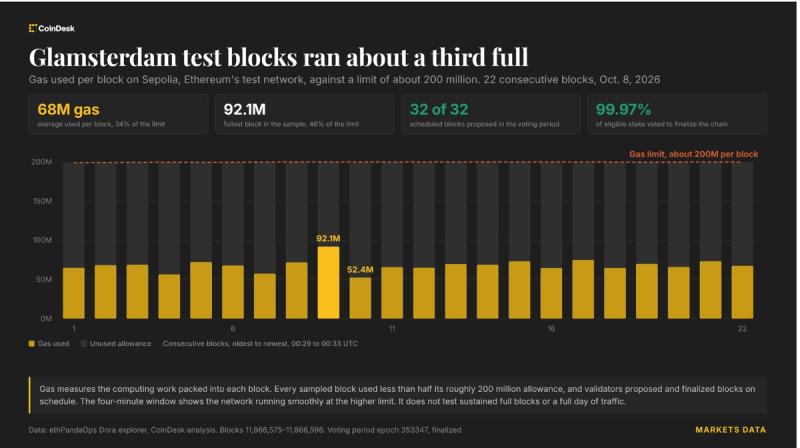
Morning Edition · Thursday, October 8, 2026Published at 1:50 AM EDT · New York
Ethereum's Glamsterdam upgrade goes live on Sepolia with a 200 million gas ceiling that early blocks leave half empty
The test network rehearsal brings in enshrined proposer-builder separation and block-level access lists ahead of a mainnet activation that developers target for December, but sampled blocks used less than half of the new processing budget.
Glamsterdam, Ethereum's next hard fork, activated on the Sepolia test network at 13:53:36 UTC on October 6 and finalized at 14:24 UTC. Sepolia is the second of three public test networks to run the upgrade, and developers are targeting a mainnet activation in December. Within two days, the rehearsal had raised the per-block processing budget more than threefold, to close to 200 million gas. Gas is Ethereum's unit for metering computation. CoinDesk found that the blocks it sampled used less than half of that allowance.
The fork bundles several changes that the Ethereum Foundation lists as the next step of its base-layer scaling roadmap. Enshrined proposer-builder separation (ePBS) moves the split between the validator who proposes a block and the specialist who builds it into the protocol itself. Today that split runs through trusted relays outside the protocol. Ethereum Improvement Proposal (EIP) 7928 adds block-level access lists, which record every account and storage slot a block touches along with the resulting state changes. Clients can then read from disk, validate transactions and compute state roots in parallel instead of one transaction at a time. The fork also reprices gas so fees better reflect execution costs and the cost of state growth.
On Sepolia the higher limit is opt-in. Validators signal the gas limit they will accept, which lets developers watch how nodes handle heavier blocks before anyone commits mainnet to the same ceiling. The gap CoinDesk measured between capacity and use is the main data point so far. On a test network, demand is synthetic, so the half-empty blocks mainly show that the network can carry the larger allowance without trouble. They do not show how much demand mainnet would actually bring to it.
The fork matters well beyond Ethereum's own fees. Ethereum holds $52.42 billion of the $93.57 billion in total decentralized finance (DeFi) value locked, according to DeFiLlama. Its largest rollups, Base and Arbitrum One, secure $15.74 billion and $11.12 billion. L2Beat shows both down over the past week, by 1.7% and 3.7%. A base layer with three times the capacity competes directly with those networks for the same transactions.
What this means
A higher gas ceiling paired with flat demand lowers the price of each unit of block space. That cuts the amount of Ether destroyed through fees and narrows the cost advantage that general-purpose rollups sell. Rollup tokens and sequencer revenue lose the most if mainnet demand does not grow alongside capacity. Validators with modest hardware also bear the cost of processing heavier blocks, a decentralization question as much as a fee question. The market has priced Glamsterdam as a scaling win for Ether. The CoinDesk sample shows that capacity is not the constraint today, a point the consensus view tends to skip. The precedent is 2025, when validators raised the mainnet limit in steps from 30 million to 60 million instead of in one jump. The likelier outcome is that Glamsterdam reaches mainnet on schedule within months and validators then raise the limit toward 200 million in stages over the following quarters. That depends on the third test network and the first mainnet weeks showing no rise in missed slots or block propagation delays. A quick, coordinated validator move to the full 200 million at activation would prove this read wrong.
Part of a tracked trend
Ethereum Scales Its Base Layer
Successive Ethereum forks that raise base-layer throughput will keep pulling activity and fee revenue from general-purpose rollups back to layer one, compressing the economic case for rollups that do not offer something the base layer cannot.
Townsquare
Start a discussion in Townsquare.
More from this edition
- Ethereum researcher Justin Drake urges "bunker mode" after OpenAI math results revive fears for wallet signatures
- Attacker drains 200 ETH from a MakerDAO keeper that never settled its 2020 Black Thursday auctions
- Bank of Russia clears Sberbank and VTB to hold Bitcoin as it publishes its first register of crypto operators
- Privacy chains pitch selective disclosure as Aztec's undetectable proving bug shows what confidentiality costs
- Bitcoin falls below $83,000 as Brent crude tops $102 on a reported Iran strike plan and Treasury yields climb
- US government moves about $470 million in seized crypto to likely Coinbase Prime addresses
- Ethereum researchers price the cost of censorship under multiple proposers and warn of orphaned bytecode in state redesign
Comments
1Oct 8, 5:50 AM · edited
Under EIP 1559 the base fee targets half the gas limit, so blocks below half full on a testnet with little organic demand mean a falling base fee, not a failed capacity test.