← The Polylog Crypto Intelligence Brief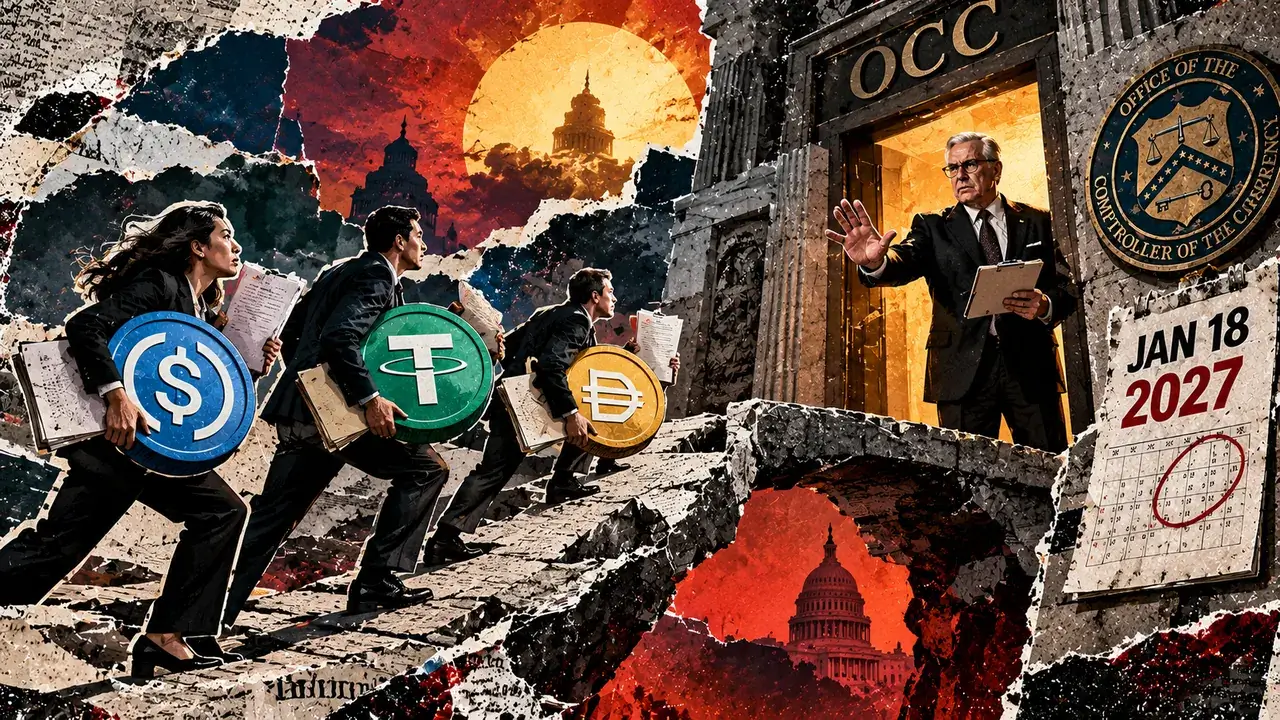
Morning Edition · Thursday, October 22, 2026Published at 1:48 AM EDT · New York
OCC Finalizes Its First GENIUS Act Stablecoin Rule, and Active Issuers Will Need a Waiver to Keep Issuing After January 18
A pending application alone will not protect existing US issuers. The Treasury Department says the rules "cement American dominance in digital assets." Tether, meanwhile, is investing in a Bolivian fintech to push USDT payments into four Latin American markets.
The Office of the Comptroller of the Currency (OCC) on Wednesday finalized its rule implementing the GENIUS Act, the 2025 federal stablecoin law. The rule covers payment stablecoin issuers under OCC jurisdiction, certain foreign issuers, and crypto custody by federally supervised institutions. Issuers must comply from January 18, 2027, and the statute attaches criminal penalties to noncompliance.
The central operational detail is the waiver process. The OCC's waiver and application guidance lets the agency waive the prior-approval requirement for up to 12 months starting January 18. The agency says it "generally expects to grant" such waivers for existing US issuers unless its review finds more compelling reasons to deny. CryptoSlate's reading is that filing an application is not enough. An existing issuer that has not won approval by the deadline needs discretionary relief to keep issuing. On yield, The Crypto Times reports that the final rule dropped a proposed presumption on stablecoin rewards. Other coverage notes the rule also offers no safe harbor for rewards programs already running. That leaves exchange-paid yield on stablecoins to case-by-case supervision.
The Treasury Department said the finalized rules "cement American dominance in digital assets." That is a political claim, and it is consistent with how the administration has framed dollar stablecoins as an extension of dollar demand abroad. The rule produced little market reaction. Bitcoin traded back above $84,500 shortly after the release, though the move also tracked equity futures.
The stakes are large. DeFiLlama puts total stablecoin supply at $305.68 billion. Tether's USDT accounts for $182.68 billion and Circle's USDC for $72.65 billion. World Liberty Financial's USD1, the stablecoin connected to the president's family business, stands at $4.00 billion. Tether, which issues USDT from outside the US, keeps expanding where US rules reach least. It has invested in Peso, a Bolivian fintech, to connect USDT to food delivery, merchant services and banks in four Latin American countries.
Veracity: Corroborated
Part of a tracked trend
Regulatory Perimeter for Crypto Hardens in EU and US
Over 3-6 months, enforcement deadlines and rulemaking debates narrow who can operate, with MiCA culling unlicensed EU firms and US regulators weighing durable rules over fragile exemptions.
Townsquare
Start a discussion in Townsquare.
More from this edition
- Solana Switches From TowerBFT to Alpenglow, Targeting 150-Millisecond Finality
- Aztec Discloses a Critical Proving-System Flaw in Alpha V5 and Says It Cannot Tell Whether Anyone Exploited It
- Rekt Post-Mortems Trace Bitget's Nine-Figure Loss and the SingularityNET Bridge Drain to Trusted Keys and Third-Party Tools
- Ledger Devices Sold Through Reseller CryptoBilis Carried an LTE Implant That Sent Recovery Phrases to Attackers
- SEC Names Three Applicants for Tokenized Stock Venues Under Its Innovation Exemption, Including the OKX and ICE Joint Venture
- Aztec Targets the End of 2030 for Full Post-Quantum Migration as an Ethereum Researcher Measures the Sender's "Free Option" in Encrypted Mempools
- Leaked PHP Flaws Force Emergency Patches as Binance Founder Warns Crypto Users About Compromised Websites
Comments
0No comments yet.